Archived pages
A collection of deleted pages, listed in file name order.
- Clothing
- Cosmonaut trivia
- Functional Cargo Block (FGB) Zarya
- Gidrolab training
- Personal hygiene
- Microgravity countermeasures
- Mini-Research Module-1 Rassvet
- Mini-Research Module-2 Poisk
- Progress cargo ship variants
- Soyuz ASU
- Soyuz console
- Soyuz launch escape system
- Soyuz features
- Soyuz landing profile
- Soyuz launch profile
- Soyuz modules
- Soyuz orbit profile
- Soyuz survival kit
- Soyuz crewed spaceship
- TsUP: Moscow Mission Control
- TsPK – Star City
- Docking Compartment-1 Pirs
- Service Module Zvezda
Clothing
Over the decades of long-duration flight in the Russian space program, various specialized items of clothing and hygiene have been developed to ensure the comfort of those living on board a space station.
Inflight clothing has been developed by the Kentavr-Science, Ltd. company, in consultation with the Institute of Medical and Biological Problems. There are 21 items of clothing to choose from, including underwear, socks and lingerie (for women). Color is considered an important psychological factor for long missions; they should be appealing and harmonious with the Station’s interior color scheme. Cosmonauts can choose any color combination that appeals to them.
Quality control is strict. The clothing is cleaned, inspected and x-rayed for any stray pins or needles, sterilized with an electronic beam, packed in a hermetically-sealed bag and numbered. The clothing is tear-resistant and no buttons are used in case these should come loose and be accidentally swallowed in zero-g (zippers, Velcro and snaps are used instead).
The descriptions below were taken from the Service Module Medical Operations, Book 1 (in Links section), dated 25 September 2000, so clothing may have changed somewhat since then.
Underwear
Set of undergarments:
- shirt
- underpants
- 2 pairs of socks (in a plastic bag with the size indication)
Change underwear once every 7 days; change socks every 3 days. 30 pairs of socks and 60 sets of underwear are provided for a 6-month flight per crewperson.
Kamelia-SM, «Камелиа-СМ» Set – worn as underwear and during physical training:
- sweatshirt with short sleeves and round collar: 1 ea.
- shorts: 1 ea.
- socks: 1 pair
- plastic bag: 1 ea.
Change Kamelia-SM set once every 3 days. Wear for three days, then put aside to wear for one more day only during physical exercises.
Kamelia-A is light underwear; Kamelia-SM is warmer long underwear for cooler conditions. It can be worn by men and women. The material is a special elastic cotton.
The socks are specially padded to prevent crewmembers from developing flat feet in weightlessness, and are reinforced for treadmill workouts.
Disposable underwear set – for everyday wear:
- disposable underwear (one-size-fits-all briefs, individual): 4 pairs
- plastic multipocket: 4 ea.
- plastic bag for disposable underwear: 1 ea.
Wear one set for four days.
Confection set – for everyday wear:
- briefs
- sports bra or tanktop (individual)
- plastic bag for each confection set
- bigger plastic bag for confection sets stowage
Confection sets come in individual sizes. Wear one set for three days.
Casual wear set – intended to provide for crew body temperature comfort during their stay in the ISS with ambient air temperature range of 20-30°С and is used for everyday wear:
- polo shirt with zipper made from dense cotton stockinet;
- shorts with zippered pockets;
- Each plastic bag is labeled.
The 6 T-shirts per package are different colors so a wearer can choose a color that suits his mood.
Costs (U.S. dollars): Camelia underwear is $45 to $50 apiece; a light suit is $90 to $95; socks are $3 per pair.
For ladies only!
Women have some nice lingerie to choose from: bras, T-shirts and bikini-type underpants, edged with lace, and made of cotton. A weekly set of underwear is provided; disposable underpants are changed each day. “The goal of this support is to make women on board feel like women, not just astronauts or cosmonauts.”
Cost: each lingerie set is $45 to $50 apiece.
Coveralls
Change coveralls
Change coveralls maintain crewmember’s comfortable body temperature under ISS ambient air temperatures in the range 20-30°С.
Coveralls have several types of pockets to hold documents, memos, photos, pencils, ballpoint pens, knife, etc.
Coveralls have lateral seams in thigh area with zippers. Upper part of coveralls’ backside with waist belt and lateral zippers forms a turndown flap (see Figure 3.2, p. 3-4 and Figure 3.3, p.3-5), allowing a wearer to use the toilet without doffing coveralls.
The coveralls are made of cotton and lavsan.
Cost: $350 per garment.
- Change coveralls diagram (40 KB).
Warm coveralls
Warm coveralls maintain a crewmember’s comfortable body temperature under ISS ambient air temperatures in the range 15-20°С. Comfortable temperatures are characterized by preservation of relatively high work capability. The fabric is a fine U.S. synthetic.
Features:
- The trouser legs of the coveralls are cuffed;
- Coveralls have upper and lower patch pockets on the left and right;
- Rounded collar has a Velcro strap fastener.
- Cost: $350 per garment.
Operator’s coveralls
Operator’s coveralls maintain crewmember’s comfortable body temperature under ISS ambient air temperatures in the range 20-30°С. Comfortable temperatures are characterized by preservation of relatively high work capability.
- There are patch pockets on trousers front and back thighs;
- shin pocket is located on the left trouser leg shin level;
- there are patch pockets on trousers seat (buttocks level).
- Cost: $350 per garment.
- Operator’s coveralls diagram (12 KB).
Accessories
Tool belt
The tool belt is worn by a crewmember when performing any maintenance or installation/deinstallation activities. Composition:
- tool belt: 1 ea.
- pockets and fixers from 6 to 10 (depending on configuration): 1 ea.
- Bag: 1 ea.
Depending on the type of activity, crewmember may use various configurations of tool belt, as well as its separate parts and components. The tool belt comes in one size and can be adjusted at the waist using provided Velcro clip. Tool belt is made from Velcro pile to which different types of multi-pockets are attached using a Velcro hook. The specific design of each multi-pocket or fixer is determined by its purpose (for screwdrivers, pencils, wrenches, etc.)
“Sprut” securing harness
“Sprut” securing harness is used to secure crewmember in working area during performance of various tasks.
Composition:
- belt 1 ea.
- short strap 1 ea.
- long strap 2 ea.
- stowage bag
Harness set consists of belt, short and long straps, and stowage bag. The elastic components have the following letter codes:
- Д – on the long strap
- К – on the short strap
Straps are made in the shape of special-design belts (see Figure 3.7, p. 3-10), consisting of tensile and non-tensile elements, and a waist belt. One of the non-tensile elements has a metal clasp with moving lock. For straps attachment, working area shall be equipped with snap hooks. A snap hook is attached to loop on the end of strap non-tensile element. Stowage bag, containing the Sprut securing harness, is made in the shape of polycaprolactam cover with Velcro fastener. Each component and separate ticket is labeled.
- Sprut diagram (70 KB)
Mounter’s set
Mounter’s set is used by crewmember when performing any maintenance or installation/deinstallation activities. Depending on type of required work, crewmember may use Mounter’s set in its various configurations, as well as its separate components.
Composition:
- apron: 1 ea.
- thigh multipocket (right, left): 1 pair
- arm multipocket: 1 ea.
- elbow sleeve: 1 ea.
- gloves: 1 pair
- wrist cuff: 1 ea.
- bag: 1 ea.
Front part of apron has pockets, metal D-rings, detail straps, attachment loops. Mounter’s set includes right (with two pouches) and left thigh multipockets whose special design allows them to be attached onto crewmember’s thighs. Mounter’s set includes arm multipocket attached to elastic cuff to be worn on a crewmember’s left arm. Multipocket is used for temporary stowage of various small items and tools required during in-flight maintenance (IFM) activities.
The elbow sleeve made from elastic stockinet protects crewmember’s working arm from possible skin abrasions or lesions when performing IFM activities in narrow spaces. Elbow sleeve together with wrist cuff provide for hand and arm protection from any neuromuscular strains possible during IFM work. Elbow sleeve should be worn on working arm providing comfortable compression sensation; after donning elbow sleeve, wrist cuff is put on and adjusted to provide similar sensation in wrist area.
All Mounter’s set parts are individually labeled.
- Mounter’s set diagram (66 KB)
Other
Sports footwear
Sports footwear (one pair) is used during physical training. Their containing plastic bag is labeled.
Soyuz
There are also garments worn during the Soyuz flight to the ISS, after the Sokol rescue suits are doffed. These consist of unisex change coveralls, a warm jacket and long-sleeved t-shirts. Note the zipper at the crotch of the coveralls, which is to facilitate using the toilet without removing one’s clothing.
“To make the suit fit.” ISS-64 crew tried on flight clothes
Before going into space, cosmonauts need to decide in advance on the sets of clothes that will be delivered to them by a cargo ship on board the International Space Station. Clothes are sewn individually, taking into account the characteristics of the figure and personal preferences of the Expedition members. It meets the conditions in which it is applied. In addition, flight clothing is functional, versatile and comfortable. Some items can be worn as casual wear or sportswear. An important feature of the products is the variety of colors. This has a positive effect on the psychological mood of cosmonauts during long-term expeditions.
T-shirts, polo shirts, shorts, trousers, overalls, suits and sportswear are preferred on the International Space Station. From shoes at the station – sneakers and cycling shoes for exercise on a stationary bike.
Each garment has a different lifespan: polo shirts are worn no more than 15 days, shorts are designed for 30 days, and trousers for approximately 45 days. The underwear is usually put on and worn within three days.
An important element in the trousers is the presence of strips. As the cosmonauts say, they allow to fix trousers along the entire length of the leg in zero gravity and prevent them from getting up.
To select and determine the size of clothes and shoes, Sergei Ryzhikov, Sergei Kud-Sverchkov and Kathleen Rubins conducted special classes at the Cosmonaut Training Center, where they took measurements from each crew member, tried on finished products, and recorded comments on tailoring. After these comments were entered into the protocol, the clothes were sent for revision.
“They sew clothes individually,” commented Nadezhda Simakhina, head of the training session at the CTC, when the crew tried on flight clothes. “Up to a centimeter, the length of the sleeve, pant leg, footstocks is calculated. At the request of the cosmonaut, a chevron with the emblem of the crew or expedition, his hometown or university where he studied, or a patch with the initials of his first and last name can be made on a jumpsuit or T-shirt.”
According to N. Simakhina, eco-friendly fabrics are used when sewing clothes, and all products are subject to special checks to avoid unnecessary inclusions possible during manufacture.
The range of products was developed taking into account the opinion of cosmonauts and specialists of the Yu.A. Gagarin, LLC Kentavr-Science by orders of the Rocket and Space Corporation Energia named after S.P. Korolev, with the participation of the Institute of Medical and Biological Problems of the Russian Academy of Sciences.
Gallery

Kentavr logo on Sergei Krikalyov’s overalls.

Expedition 64 in their blue change coveralls or jumpsuits on the ISS, 30/10/2020.

Expedition 2 wearing warm coveralls.

Yurii Gidzenko wearing operator’s coveralls.

The Soyuz TMA-6 crew are clad in the garments worn during Soyuz flights to the ISS, 19 April 2005.
Links
- Pravda: “Russian space apparel designers,” 13 April 2004
- Space.com: “Space Garments: What To Wear In Flight,” 10 July 2000
- Spaceref.com: Service Module Medical Operations, Book 1. Download this (an 8.8 MB PDF file) from the Space Station User’s Guide: Routine and Emergency Medical Operations. Included are descriptions of the various items of clothing and zero-g countermeasures equipment.
Updated: 24/7/2020
Cosmonaut trivia
Some bits and pieces of information about cosmonauts.
Cosmonaut callsigns
Each Soyuz cosmonaut crew has a call-sign (позывной, pozyvnoi). These are a tradition from when crews were commanded by military/Air Force officers, and the signs were used for secrecy. This is no longer necessary, but the tradition continues (call-signs belong to the Russian commanders of the flights). From Mir Hardware Heritage:
Crew code names travel with the commander, and crew members take on the code name of the commander with whom they travel. For example, Helen Sharman returned to Earth in Soyuz TM-11 with commander Viktor Afanasyev (code name Derbent, «Дербент») and flight engineer Musa Manorov (Derbent Dva, «два, 2»). She thus became Derbent Tri, три (3) for her return to Earth. Sergei Krikalyov became Donbass Dva after Alexandr Volkov (code name Donbass, «Донбасс») replaced Artsebarski as his commander aboard Mir.
From Soyuz: A Universal Spacecraft:
Following a practise begun on the Vostok missions, each Commander assigns himself a callsign – usually derived from a geographical feature, a celestial body, a mineral, meteorological conditions, or from numerous other elements or phenomena. The Commander normally uses the same callsign on each of his missions, while the remainder of the crew adapt the same callsign, adding either “2” or “3” for personal identification. Several Flight Engineers have therefore, throughout their careers, used different callsigns when flying with different Commaders.
TsUP has a page (in Russian) with cosmonaut callsigns.
Crew formation
This information is derived from that posted by “Shams”/Шамс on the Novosti Kosmonavtki forum (4 January, 2004).
Crews are formed according to the following principles:
- Crews alternate between 2 Russians and 1 American, then 2 Americans and 1 Russian.
- Commanders of the Expeditions are alternatively a Russian cosmonaut, then an American astronaut. This has now changed a little with 2-person crews: S-8 and S-9 are commanded by Americans M. Foale and W. McArthur, respectively, but S-10 will be commanded by Russians G. Padalka then S-11 by S. Sharipov.
- Only experienced (previously flown into space) cosmonauts are assigned as Expedition commanders.
- Russian cosmonaut-testers consist of two groups (TsPK and RKKE); therefore those in charge try to assign crews evenly from both groups. The old rule that only military pilot-cosmonauts (from TsPK) could fly/command the Soyuz is no longer adhered to; cosmonaut-engineers from RKKE can be Soyuz commanders, also. (For example, in the crews S-12 and S-14 the TMA commanders are, correspondingly, Usachyov and Lazutkin).
- In crews where there are two cosmonauts assigned, one is flown, but another will be making his (or her) first flight. (With the ISS crews temporarily reduced to two, however, only experienced astronauts and cosmonauts are assigned as the ISS needs much maintenance.) Americans also adhere to this rule.
Emblem
A description of the Cosmonaut Group emblem, as described on the Space Encyclopedia Astronote, Космическая Энциклопедия ASTROnote, site – Эмблема отряда космонавтов России:
The emblem has the shape of a dual circle and is in the shape of a stylized spacecraft window or porthole. The top inscription reads: the “Cosmonaut Group,” below it: “Russia”. The edging and inscription are yellow; the cartouche is dark navy-blue. The inherent background of emblem is executed in the form of three spheres, which pass into space. The spheres symbolize by themselves the stages of the embodiment of the dream of humanity into the reality. The blue-colored lower sphere symbolizes mastery by man of its cradle, continents and oceans of the planet Earth. The medium-blue colored middle sphere symbolizes the mastery of the air and ocean. The dark blue colored upper sphere depicts the exit of man into the near-Earth outer space. The colors of spheres blend into the black background (or dark navy-blue), which is the symbol of the universe, space, infinity and unknown nature. Accomplishing flight beyond the limits of these spheres, man is torn away from his cradle and is heading for the stars.
The constellations of Ursa Major and Minor (large and small ladle), colored white, are superimposed against the emblem’s inherent background. The Pole star emits multiple rays. On the large ladle of the Pole star men determined the guiding thread of all original discoverers, travellers, researchers, explorers. All the basic coordinate systems, necessary during calculations of displacement both over the Earth, and in outer space, are focused on the Pole star.
Along the horizontal line of the emblem is placed the Latin inscription, also in white: “Per aspera ad astra” (“Through adversity to the stars!”) – the motto of the Russian Federation Cosmonaut Group.
The figure of the flying person occupies the central place in the emblem. He is sunlit (and is colored yellow) and he is facing the guiding star of humanity. The angle of the slope of body to the celestial axis composes 25°, or 65° relative to equatorial plane. Our compatriot Yurii Alekseevich Gagarin completed the first flight into space in the world on 12 April 1961, aboard the Vostok spacecraft. The angle of the orbit inclination composed 65°.
The emblem was developed in collaboration with the space center “Planet Earth”.
The emblem of the force of the cosmonauts of Russia was made official on 21 January, 2000, by the-then Rosaviakosmos Director-General Yu.N. Koptev. By this affirmation it provided that:
- The people who have the right to wear the patch with the emblem of the Russian Federation force of cosmonauts are the forces or groups of cosmonauts in the regular posts of cosmonaut-tester, cosmonaut-researcher, instructor of cosmonaut-tester, instructor-cosmonaut-researcher.
- The patch with the emblem of the Russian Federation force of cosmonauts can be placed on the service uniform, daily wear, training apparel, flight suits, and spacesuits.
- The patch with the emblem of the Russian Federation force of cosmonauts is sewn on the outer side of the right arm of clothing.

Salary
How much do cosmonauts get paid? Below is an extract from Russia in Space: The Failed Frontier? (Springer-Praxis, 2001).
The changes in the 1990s led to a significant alteration in the way in which cosmonauts were paid, one which amazed the Americans (and still does). American astronauts receive a standard military paycheck or, as civilians, a standard NASA one, regardless of whether they are on or off the planet. By contrast, following 1991, cosmonauts were put on an incentive system mimicking the worst practices of capitalism. Cosmonauts received a contract for each space mission, for which they were paid at a rate of $1001) a day (civilians were paid $80). They got a bonus of $1000 for a spacewalk. If particular aspects of the mission were not accomplished, fines were applied afterwards and deducted from the contract. For some peculiar reason, a bonus was applied for carrying out a manual docking. From the moment it was introduced, cosmonauts unfailingly informed ground control, about 10 metres before a smooth automatic docking, that unspecified problems had arisen and they had urgently to take over manual control!
Cosmonauts’ pay was also mentioned in this 2000 article about the Expedition 1 Russian crews’ wives, “Olga Gidzenko and Elena Krikalyov: The Cosmonauts’ Wives Talk Space”:
Want to be rich in Russia? Don’t be a cosmonaut
While being a cosmonaut offers the prestige of being one of the few humans to leave the planet, monetary compensation for the job is a sour point for space flyers and their families.
“I don’t think that Yuri is … [getting] … decent compensation for his hellishly hard work,” said Olga Gidzenko. “I believe that he deserves more both morally and materially.“
Elena Krikalyov agrees. “People who took smaller risks and spent less effort than cosmonauts make much more money,” Elena said. “Russia currently does not have a fair salary hierarchy.”
… Yuri Gidzenkno’s monthly salary is $250. It is still much higher than of many [Air Force] officers in Star City who make about $100 per month. Prices in the City are a little bit lower though, and when Yuri is preparing for a mission he gets free meals.
Sergei Krikalyov’s salary at RKK Energiya is about the same.
Gidzenko’s eldest son, Sergei, is studying in a paid college. Almost half of Yuri’s salary is spent on his tuition.
“We are able to maintain decent way of life for our family thanks to the money which Yuri makes on contracts while flying in space,” said Olga.
The Gidzenkos live in a three-bedroom apartment supplied to them free by Star City authorities. Its total area is 700 square feet (65 square meters). Krikalyov’s family lives in a three-story townhouse approximately three times as big as the Gidzenkos’ apartment. It also includes a garage.
1 The figures given are in U.S. dollars as the rouble – like the Australian dollar – is pegged against this, so both fluctuate depending upon the exchange rate.
From a posting at CollectSpace.com, 27 October 2007:
I believe they have gotten rid of [the performance contract] system for ISS, mainly since the crews are so cosmonaut and astronaut integrated now with the commanders alternating between Russian and American.
Concerning the pay rates though, there is still a difference. If a cosmonaut is living in Star City and launches to the ISS on a Soyuz, he gets his normal cosmonaut pay. If he goes to Houston and flies into space on the shuttle, then his pay from what I have read goes up to the level that US trained astronauts make for the duration of his duties in the US.
A 2010 article reported that cosmonauts get USD$130,000-$150,000 for a 6-month mission on board the International Space Station. The cosmonauts sign contracts for each mission, and the pay is different from their regular salary on Earth. In contrast, NASA astronauts receive an annual salary of up to up to $130,000 whether in space or not.
In this 2012 article from RIAN, Sergei Krikalyov says:
The job is demanding, but not a lucrative one, with the monthly salary for a top-grade cosmonaut standing at around 70,000 rubles ($USD2,300), Krikalev said. “It pays better to work as a porter,” he said, adding that one of the prime criteria for selection was motivation to go into space.
Rehabilitation
In the Soviet era, cosmonauts were sent to resorts on the Black Sea as part of their postflight rehabilitation. This practice ended after the collapse of the USSR, so other options had to be found. For a while, the Canary Islands were chosed, as described in this article from Friends & Partners in Space in 2001:
Russia spacemen to undergo rehabilitation on Canary isles
Tuesday, June 05, 2001 8:00 a.m. EST
Madrid, Jun 05, 2001 (Itar-Tass via COMTEX) – Russian spacefarers Talgat Musabayev and Yurii Baturin arrived in the Canary Islands to undergo their post-flight rehabilitation. They will recuperate under the observation of doctors on the island of Lanzarote, one of the most beautiful on “the archipelago of eternal spring”.
The autonomous government of the Canary Islands and the Moscow Medico-Biological Institute signed an agreement last year that Russian cosmonauts, returning from their missions, will undergo medical rehabilitation on the Canaries.
While drafting the agreement, the sides proceeded from the premise that the Canary Islands are not only a balmful climate but also top-class medical establishments which will help cosmonauts to recuperate fully their forces.
Russian cosmonauts Sergei Krikalyov and Yurii Gidzenko who spent two weeks on the island of Grand Canary, were the first to undergo recuperation there.
In the future, the Canary authorities are ready to receive cosmonauts from all countries, participating in the large-scale project of the International Space Station. (By Sergei Sereda)
See also “Cosmonauts head for the sun”.
After his Expedition 11 mission in 2005, Sergei Krikalyov said that he would spend part of his postflight rehabilitation in the spa city of Kislovodsk, Кисловодск, which lies in the North Caucasus region of Russia.
In October 2006 an agreement was signed between the Bashkiriya government prime minister Raphael Baydavletov and the chief of the Russian Yu.A. Gagarin Russian State Science Research Cosmonaut Training Centre (RGNII TsPK), Lieutenant-General Vasilii Tsibliev, for cosmonauts to conduct their rehabilitation at the Krasnousol’sk, «Красноусольск», sanatorium. Bashkortostan/Bashkiriya is a republic in the south of Russia, near the Ural Mountains.
According to Anik at NASASpaceflight.com, the cosmonauts can choose from a list of resorts which the GCTC has an agreement with.
From 2018, the city of Sochi, Krasnodar Territory (Сочи, Краснодарского края), was utilized for post-flight rehabilitation, in one of the sanatoriums there:
In 2018, Alexander Misurkin became the first cosmonaut in the new history of Russia undergoing rehabilitation in the resort city of Sochi. “Previously, my colleagues and I underwent rehabilitation mainly abroad,” said Alexander Alexandrovich in an interview in April 2018. “But here the level of comfort is just as good.”
An agreement on the organization of the post-flight rehabilitation of Russian cosmonauts in the resorts of the Krasnodar Territory was signed between the Ministry of Resorts of the Krasnodar Territory and the Yu.A. Cosmonaut Training Center. Gagarin in November 2018 at the International Tourism Forum SIFT in Sochi.
Updated: 11/6/2020
Functional Cargo Block (FGB) Zarya

Zarya («Заря», “dawn”), the first module of the ISS was launched on 20 November 1998 by a Proton-K rocket. It was developed by GKNPTs M.V. Khrunichev in Moscow, Russia under a subcontract to the Boeing company. The module is thus Russian-built and U.S.-funded. Construction was begun in 1994.
FGB Zarya initially provided flight control when it was docked with Unity, as well as electricity and fuel supplies. It had enough heptyl fuel (4.5 metric tonnes) to keep it in orbit for 430 days without refuelling.
After the Zvezda Service Module reached orbit, Zarya was relegated to back-up life support and used for storage, many of its functions taken over by the Service Module. The FGB has a lifetime of at least 15 years from its launch.
Full name: ФГБ – Функционально Грузовой Блок / FGB: Functional cargo block / Funktsional’no Gruzovoi Blok
Structure
Zarya is comprised of two main components:
- The cylindrical instrument-cargo section ( PGO, РГО – приборно-грузовой отсек), itself divided into 3 sections:
- PGO-2 (conical section of the FGB);
- PGO-3 (the GA cylindrical section)
- and PGO-1 (lies between the former two sections);
- the spherical airtight adapter (GA, ГА – гермоадаптер) which provides docking connections.
An 800 mm-diameter hatchway connects the PGO and GA sections. The GA has 7.0 m3 of airtight volume; the PGO has 64.5 m3. Both segments are divided into an instrument zone (for various equipment) and habitable zone (for the crew). The instrument zone contains control systems and alarms, and is isolated from the habitable zone by panels.
The FGB has 90 storage lockers along its main corridor, in which supplies and various equipment are kept. Panel numbering in the PGO from forward – the GA, Pressurized Adapter – to aft (where Zvezda is attached):
- Plane I (floor): Panels from 101 to 116.
- Plane II (port): Panels 201 to 231.
- Plane III (ceiling): Panels 301 to 316.
- Plane IV (starboard): Panels 401 to 431.
Zarya has 3 docking assemblies. On the front end of the PGO (facing aft in the ISS layout) is located the active hybrid docking assembly, ASA-G, АСА-Г, and it is docked to the Zvezda Service Module. The rear end of the GA (forward in the ISS layout) is equipped with a passive androgynous docking assembly (АСПП, ASPP) which enables it to be docked with Pressurized Mating Adapter-1 of the U.S. segment. Also on the GA is a passive cone docking assembly perpendicular to the longitudinal X-axis of Zarya, where Soyuz and Progress ships can dock (i.e. it faces nadir or “down” towards Earth). The GA could be built with up to 5 docking ports, but only 2 were constructed for ISS use.
- GA forward: АСПП, APDS (Androgynous Peripheral Docking System)
- Nadir: АСП-Б, ASP-B (passive docking assembly)
- Aft port: АСА-Г, ASA-G (active/hybrid docking assembly)
Three types of engines were used by Zarya:
- Correction and approach (ДКС, DKS). There are two of these liquid propellant 11D442 rocket engines that were used by the ship to correct its orbit during autonomous flight. These are the main engines, used for large maneuvers.
- Approach and stabilization engines (ДПС, DPS). There are 24 of these 11D458 liquid propellant rocket engines that can do 8 repeated firings.
- Precision stabilization engines (ДТС, DTS). There are 16 liquid propellant 17D58E engines that were used for the precision approach to the Orbiter STS-88. These have the smallest thrust.
The engines were decommissioned after Zvezda was launched and its systems activated.
Zarya’s fuel system stores and supplies fuel to the engines, and comprises a fuel (nitric tetraksid) and a combustible (unsymmetrical dimethylhydrazine), stored in 16 fuel tanks (8 fuel, 8 oxidizer) and totalling 6100 kg. It can be resupplied via Progress cargo ships. It is divided into two subsystems: high pressure and low pressure. The latter supplies the low-thrust engines (DPS and DTS). 5 fuel and 5 oxidizer tanks are high-pressure; the remainder are low-pressure. Zarya was launched with partially-full tanks of 3800 kg.
Zarya derives its power from two solar arrays (СБ, SB), each 28 m2 (7 m long and 4 m wide) and covered on one side with glass-coated photoelectric converters; these were unfurled upon reaching orbit. The cells absorb 90% of sunlight on the side facing the sun, and 10% of reflected sunlight from Earth on their reverse sides. Power was transferred to 6 batteries in the power supply system (SES, СЭС) which, in the initial stages, supplied power to the FGB and Unity. Later after the arrival of Zvezda, Zarya converted power from the U.S. segment (124 V dc) for use in the Russian segment (28 V dc).
Zarya’s solar arrays were retracted in September 2007 to provide clearance for the U.S. segment radiators that would be unfurled later in the year. The starboard wing was folded in on 28/9 (14:09-14:26 UTC) and the port wing on 29/9 (12:59-13:14 UTC).
Zarya’s systems are divided into a support section and Station section. The support section helped Zarya function during autonomous flight and docking; the Station section helps the FGB interact with the rest of the ISS.
The support section comprises:
- the control system, Система Управления (СУ, SU);
- engine installation, Двигательная Установка (ДУ, DU);
- the feed system and pumping of fuel, Система Подачи и Перекачки Топлива (СПиПТ, SPiPT);
- onboard complex control system, Система Управления Бортовым Комплексом (СУБК, SUBK):
- internal lighting system, Система Внутреннего Освещения (СВО, SVO);
- “Komparus” control-measuring system, Командно-Измерительная Система (КИС, KIS);
- the BR-9TsU-8 radiotelemetry system, Радиотелеметрическая Система БР-9ЦУ-8;
- the Sirius-4 radiotelemetry system, Радиотелеметрическая Система «Сириус-4»;
- power supply system, Система Электроснабжения (СЭС, SES);
- the orientation system for the solar batteries, Система Ориентации Солнечных Батарей (СОСБ, SOSB);
- thermal control system , Система Обеспечения Теплового Режима (СОТП, SOTP);
- fire detection and fire extinguishing system, Система Пожарообнаружения и Пожаротушения (СПоПТ, SPoPT);
- Kurs-A, «Курс-А» active radio-technical rendezvous and docking system.
The Station section comprises:
- docking system, Система Стыковки (СС, SS);
- the integration and joining/docking system, Система Интеграции и Сопряжения (СИС, SIS);
- a system for assuring proper gas composition (atmosphere revitalization subsystem), Система Обеспечения Газового Состава (СОГС, SOGS);
- television system, Система Телевидения (СТ, ST);
- telephone communications system, Система Телефонной Связи (СТС, STS);
- communications/message acquisition equipment, Аппаратура Сбора Сообщений (АСС, ASS);
- onboard computing system, Бортовая Вычислительная Система (БВС, BVS);
- teleoperator mode of control equipment (ТОРУ, Оборудование Телеоператорного Режима Управления, TORU) of approach and docking;
- passive radio-technical rendezvous and docking system “Kurs-P,” Пассивная Радиотехническая Система Сближения и Стыковки «Курс-П»
Data tables
| Mass in orbit, kg | 20,040 |
| Length of housing, mm | 12,990 |
| Maximum diameter, mm | 4100 |
| Volume of airtight sections, cubic meters | 71.5 |
| Spread of solar batteries, mm | 24,400 |
| Area of photovoltaic cells, meters squared | 28 |
| Average power of power supply, KVT/SUT | 3 |
| Fuel mass, kg | 3800 |
| Duration of functioning in orbit, years | 15 |
| Manufacturer | Khrunichev |
| Designation | 77KM No 17501 |
| NASA designation | 1A/R |
| Name | ФГБ: Функционально Грузовой Блок FGB: Functional cargo block Funktsional’no Gruzovoi Blok |
| Launch vehicle | Proton-K (No 395-01) |
| Launch site | Launch complex 81/23, Baikonur Cosmodrome, Republic of Kazakhstan |
| Launch date | 20 November 1998 at 06:40 |
| Mission | Launch of the first Russian ISS module (FGB). The U.S. Unity module was docked to it during the STS-88 mission |
Diagrams
The following Zarya exterior diagrams are taken from the Space Station User’s Guide: NASA ISS EVA Operations Documents PDFs at Spaceref.com:
- Plane 1 view (nadir, bottom) (71 KB)
- Plane 2 (port) (86 KB)
- Plane 3 (zenith, top) (83 KB)
- Plane 4 (starboard) (79 KB)
Gallery

A nadir (bottom) view of Zarya, taken during the STS-88 mission, 6 December 1998. The cylindrical Pressurized Adapter (GA, ГА) is at the bottom of the picture.

Vladimir Dezhurov (ISS-3) in Zarya’s main corridor, at the forward end. Port is on the left of the picture; starboard on the right. The storage lockers are visible.

Zarya in October 2007 after its solar panels were retracted in September.
Links
- ГКНПЦ имени М.В.Хруничева/GPKNTs Khrunichev: Zarya Module (in Russian)
- MSNBC.com: “Silent suspense surrounded birth of space station,” James Oberg, 21/11/2003.
- NASA: Zarya Module and Zarya photo gallery
Updated: 12/4/2019
Future spaceships
Russia has no shortage of future spaceship designs and proposals, but as always the problem is in getting funding! The PTK NP looks to be the most certain at the time of writing, while the Kliper, Parom and TKS have been abandoned, though elements of their designs may still be used.
Oryol
In August 2019, Roscosmos chief announced that the Federation spacecraft would be named Oryol (or Orel), Орёл (Eagle), honoring the first Russian military sailing vessel. It will be launched from Vostochniy Cosmodrome on an Angara rocket.
Oryol – a reusable manned transport spacecraft of a new generation, developed by RSC Energia. Its purpose is the delivery of people and goods beyond Earth orbit, including to the Moon. If necessary, a lightweight ship can be used for flights to space stations in low Earth orbit. The crew of the Oryol will number up to four people. In autonomous flight mode, the ship will be able to stay up to 30 days, and while flying as part of an orbital station, up to one year.


Oryol news links
RSC Energia tests rappelling device for Orel CTS, June 5, 2020.
(Roskosmos website articles tagged with Oryol)
Rogozin denied information about the development of a new spacecraft
19/4/2020
MOSCOW, April 19 – RIA News. A new manned spacecraft for low-Earth orbit flights will not be created to replace Soyuz MS spacecraft, instead, astronauts will use the Oryol, “Eagle” (Орел) spacecraft intended for the lunar program, said Dmitry Rogozin, head of the Russian Space Agency. “In fact, there will be one and the same ship, just for delivery to the ISS (International Space Station) it will have less fueling. The only question is in the economy. How much will it cost,” Rogozin said on KP radio.
Earlier at the celebration of the 60th anniversary of the cosmonaut corps and the Cosmonaut Training Center, Rogozin announced the need to begin developing a new manned spacecraft. After that, a number of media reported that the new ship should be much lighter than the Oryol and Roscosmos in the coming days will begin to develop technical specifications for it. At the same time, the completion of the design of the orbital version of the Oryol was reported back in 2017.
The ship Oryol (formerly called the “Federation,” Федерация) has been developed since 2009. It is created primarily for flights to the Moon, and flights to orbital stations are considered for testing its systems. In September 2019, the press service of Roscosmos told RIA Novosti that Russia would build a universal version of the new manned spacecraft Orel instead of creating a separate version for flights to low Earth orbit and separately to the Moon. Russia is currently operating Soyuz spacecraft.
Cosmonauts will be in orbit on the Angara longer than Gagarin
03/03/2020
MOSCOW, Mar 3 – RIA Novosti. When launching from the Vostochny spaceport on the Angara rocket, the crew of the new Russian spacecraft Oryol will go into orbit longer than when launching from Baikonur in the Soyuz spacecraft on the Soyuz rocket, and longer than Yuri Gagarin flew into space, the materials of the Rocket and Space Corporation Energia, presented in Roskosmos, said (a copy is available to RIA Novosti).
According to the materials, 742 seconds will elapse from the launch of the Angara rocket to the separation of the Oryol ship from it at an altitude of 200 kilometers during normal flight. After that, the ship will have to fly autonomously, for example, to the International Space Station, as prescribed by the flight test program.
Now the astronauts get into orbit 200 km high on the Soyuz spacecraft in 528 seconds, that is, three and a half minutes faster. The difference is due to the fact that the mass of the Oryol when flying into low Earth orbit will be 20 tons, and the spacecraft Soyuz is 7.3 tons. In addition, the parameters of the missiles – the heavy Angara-A5 and the Soyuz-2 medium-class missiles – differ.
Roscosmos will spend eight billion rubles on the ship “Eagle”
03:08 01/13/2020 (updated: 09:06 01/13/2020)
MOSCOW, Jan 13 – RIA News. Roskosmos in 2021 plans to provide more than eight billion rubles for the serial production of a new generation of manned spacecraft “Eagle”, designed for flights on the ISS and the Moon. This follows from the materials posted on the public procurement website.
The space rocket Corporation Energia (an enterprise of Roscosmos) is engaged in production; in the coming years it is to build two ships.
One of them will become a full-size prototype for tests at the first launch on Angara-A5 heavy class carriers in 2023 and the Yenisei superheavy class in 2028. The second – a full reusable ship for flight tests and subsequent operation.
It is clarified that in 2021, Roskosmos intends to order the “creation of a second flight product” for 8.1 billion rubles.
The development of the first “Eagle”, which was previously called the “Federation”, has been ongoing for ten years. In December 2019, Energia requested an additional 18 billion rubles from Roskosmos. The CEO of the corporation Dmitry Rogozin explained that the money needed to create infrastructure at the Vostochny spaceport.
Earlier it was reported that the first test launch of the Orel ship will take place in August-September 2023 on the Angara-A5 rocket. In 2024, an unmanned flight is planned, in 2025, a manned flight to the ISS.
In 2026 and 2027, flights on the Angara should also take place, and in 2028 the first start on the Yenisei. Then the flight tests of the ship are planned to be completed and go to its operation. In 2029, the moon was preliminarily scheduled to fly, and in 2030, the Russian astronauts landed on its surface.
Some elements of Russia’s next-generation spacecraft already manufactured
MOSCOW, February 4 2020. /TASS/. Russia’s Rocket and Space Corporation Energia (RSC Energia) has already manufactured a number of elements for the next-generation spacecraft, Oryol, Roscosmos Director General Dmitry Rogozin told TASS in an interview.
"Certain elements have already been manufactured, including the bottom area and power lines," Rogozin said.
According to the official, RSC Energia is now preparing to launch the production of the new spacecraft, including by installing new manufacturing equipment and training its personnel to use it.
Oryol’s avionics, manipulators, computer systems and other elements are now undergoing tests.
Robot to become test pilot of Russia’s next-generation manned spacecraft
MOSCOW, September 12. /TASS/. The Android Technology Company is designing a robot that will test Russia’s next-generation partially reusable spacecraft Orel (Eagle), formerly known as Federatsiya, the company’s acting director Yevgeny Dudorov told TASS.
The official said his company was designing a “robotic system that will be the first to test the Federatsiya spacecraft.”
“If everything proceeds smoothly, it will be ready in 2022,” Dudorov said, adding that the robot will perform the first and second test flights of the spacecraft.
Besides, the robotic system can be “transformed for planetary missions,” including to the Moon and Mars.
The Federatsiya (Orel) spacecraft is being developed by the Energia Space Rocket Corporation. The spacecraft is designed to deliver humans and cargoes both into a near-Earth orbit and into deep space. The spacecraft will have a crew of up to 4 persons. It will be capable of operating in the mode of an autonomous flight for up to 30 days and for a term of a year as part of an orbital station.
The first uncrewed launch of Orel is scheduled for 2023, from the Vostochny space center in Russia’s Far East. No docking with the ISS is planned. During the second launch, due in 2024, the spacecraft will dock with the orbital outpost. Manned Orel missions are to begin in 2025.
Federation (PTK NP/PKNP)

The PTK NP (ПТК НП, пилотируемый транспортный корабль нового поколения) – New Generation Crew Transport Spaceship (NG CTS) is the latest proposal for a new Russian manned spaceship to replace the Soyuz.
Previously known as the Advanced Crew Transportation System (PPTS, ППТС: Перспективная Пилотируемая Транспортная Система), the PTK NP was initially to have be a spacecraft designed co-operatively between RKK Energiya and the European Space Agency. Initial discussions between the two agencies began in 2007.
Various studies and talks were conducted, but in October 2008 ESA ultimately decided not to go ahead with the project. ESA instead intended to focus on developing its own Advanced Re-entry Vehicle (ARV), based on an upgraded ATV service module.
In early 2009, Roscosmos decided to put out a tender for Russian companies to develop the PTK NP. The companies competing were Energiya and Khrunichev, both spaceship-builders. On 6 April, Roskosmos announced the winner was Energiya.
There are three prospective versions of the PTK NP spacecraft:
- An unmanned cargo version, to replace the Progress cargo ship; unlike the Progress, there will be a reusable/returnable section (rather than having the entire ship burn up in the atmosphere). It will carry ~2000 kg to Earth orbit, and return with ~500 kg. The first test flight with cargo is intended to take place in 2015.
- A manned version, which will carry from 4 to 6 crew, ~500 kg of cargo and weigh up to 12 tonnes. It will be able to fly for up to 30 days in autonomous orbit, and stay docked for up to a year at the ISS. The first flight of this version is expected to take place in 2018.
- A 4-seat lunar version that will weigh 16.5 tonnes, go to the Moon and back on a 14-day mission, dock with a Lunar Orbital Station for up to 200 days and return up to 100 kg of cargo. This version is obviously further into the future (2020s).
The initial name for the spacecraft is the Rus’, «Русь». A competition to formally name it was held in 2015; on 15 January 2016 Roskosmos announced the craft was to be named Federatsiya, «Федерация» (Federation).
On 15 March 2019 the director general of Russia’s state corporation Roscosmos, Dmitry Rogozin, announced that the spacecraft would be renamed with a “male name”:
BAIKONUR /Kazakhstan/, March 15. /TASS/. A new name has been invented for Russia’s new-generation spacecraft, currently known as Federatsiya (Federation), the director general of Russia’s state corporation Roscosmos, Dmitry Rogozin, told reporters on Friday.
“We have invented [a new name],” Rogozin said, without disclosing it.
Earlier, Rogozin announced that the corporation would give a “male name” to its new-generation partially-reusable manned spacecraft.
The Federatsiya spacecraft is being developed by the Energia Space Rocket Corporation. The spacecraft is designed to deliver humans and cargoes both into a near-Earth orbit and into deep space. The spacecraft will have a crew of up to 4 persons. It will be capable of operating in the mode of an autonomous flight for up to 30 days and for a term of a year as part of an orbital station.
As the Energia press office reported, the corporation has issued the main volume of working design documentation for holding autonomous and comprehensive trials. Energia has also launched work to make the mockups of the spacecraft’s compartments, including their structural design and onboard systems. The promising transport spacecraft is scheduled to enter flight trials in 2023.
The returnable section of the manned PTK NP will be a cone-shape similar to the Soyuz, and may land under parachutes, and/or with rocket assistance. It may be re-usable for future flights, for up to 10 missions over its 15-year lifespan. The PTK NP will use environmentally-friendly propellants (kerosene fuel and liquid oxygen oxidizer for the rocket’s first stage; liquid hydrogen/liquid oxygen for the second).
The PTK NP was to be launched on the new Rus-M launcher, to be produced by the Samara Space Center, who came up with the preliminary design in 2010. The launcher was to replace the Soyuz-FG rocket, but was canceled in October 2011 due to cost. It is now planned to use the Angara-A5V and Angara-A5P heavy launchers.
It will have a new seat design called Cheget (after a Caucasus mountain). Unlike the Soyuz seat – which has to have a fitted custom molded liner for every passenger – the 27 kg Cheget will be adjustable for different sizes, saving on mission costs and time. It will still be manufactured by NPP Zvezda.
In June 2018 a model of the craft begun aerodynamic testing, and outfitting of the interior took place.
- ACTS illustration (78 KB), Perspectives of European Re-entry Programmes
- New Russian Manned spaceship PKNP (280 KB), and the Rus-M launcher (157 KB), from the SpaceOps 2010 Presentations documents page
Federation news
- Energia: “RSC Energia continues work on crew transportation spacecraft Federatsiya,” 8 June 2018
- NASASpaceflight.com: “Next generation Russian crew vehicle enters initial testing,” 12 June 2018. An overview of the program to that date.
Energia search results for “Federatsiya” on their website.
Previous projects
Kliper
«Клипер»
The Kliper (“Clipper”) was first announced at an ITAR-TASS press conference on 17 February 2004 by then-head of Rosaviakosmos, Yurii Koptev. Energiya had begun working on the design of this new spaceship in 2000. Lack of funding initially hindered further development. The Kliper was included in the Russian government space plan for 2005-2015.
The Kliper configuration underwent a few changes since it was announced. In 2005 a plan was announced for an orbital tug called “Parom” to dock with a lighter Kliper version (both launched on a smaller booster than the proposed Soyuz-3 rocket) and then tow it to the ISS.
On 10 June 2005 ESA Director Genereal Jean-Jacques Dordain met with Anatoly Perminov, Head of the Federal Space Agency, to discuss future ESA-Russia space co-operation in the areas of Human Spaceflight, Microgravity and Exploration; Launchers; Telecommunications, Navigation, and Earth Observation. Regarding Kliper, it was agreed to develop a joint plan of work, to be presented at the ESA Ministerial Council in December 2005. At the December meeting, ESA government ministers initially declined the proposal to participate in the Kliper program (a 2-year research effort costing 51 million euros – $59.8 million), but did not reject it outright.
Such co-operation would be advantageous to both organizations, sharing the funding and development costs and giving ESA additional access to space. The Kliper could be launched from Russian facilities and the European space port in Kourou, French Guiana.
On 18 January 2006 Roskosmos put out a tender for the development of the Kliper, to be decided between the companies RKK Energiya, GKNPTs Khrunichev and NPO Molniya. The results were initially to be announced in the first half of February, but delayed this to April, the reason given being financial, safety and delivery data in bids. Energiya remained the favorite for the contract.
But in July Anatolii Perminov announced that Roskosmos was suspending the tender and instead would concentrate on developing a manned Soyuz-style space system first; a vehicle that would be capable of lunar circumnavigation flights using a Soyuz spaceship and a habitation module based on the Kliper’s cabin module. Energiya was selected to lead this development; it would continue to develop the Kliper in the meantime, though at a slower pace with less funding. Its plan was to develop Kliper by 2015 and field-test it in 2016.
The-then President of Energiya, Nikolai Sevastyanov, was the main proponent of Kliper, but the design proved too ambitious and expensive, and he was ousted as President, and Kliper was abandoned.

Energiya Kliper computer concept illustration, February 2006
Technical data
The Kliper would carry 2 pilots and up to 4 passengers. It would have a launch escape system similar to that of the Soyuz spacecraft.
It was of an aerodynamic lifting-body-type design and could thus conduct gliding maneuvers during re-entry (up to 500 km either side of its ground track), unlike the ballistic Soyuz Descent Module. Thermal protection systems were derived from both the Buran and Soyuz. It had a length of 10 meters and maximum diameter of 3.6 meters. The propulsion system is UDMH (Unsymmetric Dimethyl Hydrazine, propellant fuel) and Nitrogen Tetroxide (N2O4, an oxidizer).
Two design modifications were possible:
- Load-carrying hull. This would enable the Kliper to land on any flat surface using its 3 parachutes, similar to the Soyuz today.
- An aircraft-type hull (winged version). This lifting-body design, developed with the OKB Sukhoi design bureau, would limit the Kliper to landing on a runway like the Space Shuttle, but increase its gliding range from 500 km to 2000 km.
The inner crew compartment could be slotted inside either design, depending upon the flight requirements.
The Kliper was to be partly reusable, with a detachable front re-entry capsule which landed with the aid of three parachutes and solid-propellant engines. The habitation module (OA) was mounted behind the re-entry capsule and contained docking hardware and life-support systems. Surrounding this was the PAO which contained power supplies (power supplied by two solar panels) and orbital maneuvering systems. Both OA and PAO were to bejettisoned on re-entry to the atmosphere.
Reuse after each flight:
- Cabin module; parachutes.
Replace after each flight:
- Some sections of the thermal protection system, e.g. nose section
- Habitation module (OA); utility module (BO) (jettisoned before descent from orbit)
The estimated development cost of the Kliper was 10 billion rubles.
There were currently three possible launch rockets proposed:
- Onega, a proposed new generation rocket from Energiya. It is a modified Soyuz rocket, and would be launched from a Plesetsk launch pad.
- The Angara booster rocket, another new-generation rocket under development.
- The Ukrainian Zenit, launched from Baikonur Cosmodrome in Kazakhstan.
Kliper could even possibly have been launched from other pads, such as the ESA pad in Kourou, French Guiana.

Kliper cutaway diagram. Top descriptions, left to right:
- Приборная зона, instrument zone
- Контейнер с парашютом, parachute container
- Модуль кабины, cabin module
- Агрегатный отсек, service module
- Стыковочный агрегат, docking assembly
Bottom descriptions, left to right:
- Электрохимический генератор, electrochemical generator
- Фюзеляж, fuselage
- Блок хранения и подачи топлива, fuel storage and supply block
- Бытовой отсек, utility module
Some Kliper technical data, in English and Russian:
| Mass, kilograms | 13,000 |
| • Re-entry module, mass | 8800 |
| • Habitation module, mass | 4200 |
| Crew number | 6 |
| Cargo mass, kg | |
| • Launched | 500 |
| • Returned | 500 |
| • Moved away | 200 |
| Volume of flight deck, m3 | 20 |
| Time of autonomous flight, days | 5 |
| Maximum time spent docked to orbital station, days | 360 |
| G-force loads, regular descent profile | 2.5 |
| Carrier-rocket | Zenit-2SLB |
| Масса, кг, в т. ч. | 13,000 |
| • возвращаемый аппарат | 8800 |
| • агрегатно-бытовой отсек | 4200 |
| Колическво членов экипажа, чел. | 6 |
| Масса грузов, кг | |
| • доставляемых | 500 |
| • возвращаемых | 500 |
| • удаляемых | 200 |
| Объем кабины экипажа, м3 | 20 |
| Время автономного полека, сут. | 5 |
| Время нахождения в составе орбитальной станции, сут. | 360 |
| Перегрузки при штатном спуске, ед. | 2.5 |
| Ракета-носитель | «Зенит-2SLБ» |
Parom
«Паром»

The Parom (“Ferry”) was a proposed reusable replacement for the Progress cargo ship, and would also serve as an unmanned orbital tug for the Kliper spaceship. The Parom is a different concept to the Progress. It would be launched into orbit and wait near the Space Station for cargo containers to be launched later; these containers would not need the complex guidance systems currently used by the Progress. The containers would dock with the Parom, which would in turn guide and propel itself to dock with the ISS. The Parom has docking ports at each end, and fuel transfer lines so that fuel can be transferred through it from the cargo container to the Station. It could also propel a payload into a higher orbit, or take a waste container down to the atmosphere to be incinerated, and head up back to orbit after releasing this. The 6800 kg Parom’s engines could handle cargo up to 27 215 kg.
It was proposed that the Parom could be used to tow a lighter version of the Kliper to the ISS. The reason for this was so that both ships could be launched on a version of the existing Soyuz-2 rocket (designated Soyuz-2-3), rather than a modified Soyuz-3, Zenit-2 or not-yet-developed Angara-2. The Soyuz-2-3 could also be launched from Europe’s Spaceport in French Guiana; the equatorial location means that more payload could be carried into orbit (the Earth rotates faster at the Equator and acts as a slingshot to help propel a spacecraft into orbit).

TKS
ТКС
The TKS (Транспортный корабль снабжения, Transportniy Korabl Snabzheniya, transport supply ship) was a proposed manned spaceship by the Khrunichev design bureau, based on the original TKS series developed from the 1960s. It would carry up to 6 crew and 6350 kg of cargo to Low Earth Orbit, and be used up to 10 times. Its launch vehicle would be the Angara A3M rocket. The TKS vaguely resembled the Apollo capsule in shape. For the January 2006 tender Khrunichev put forward several versions of the basic TKS (manned and unmanned) for consideration, but with the cancellation of the tender in July, the status of the TKS is unknown.
Links
- Aerospace Guide: Kliper page
- BBC News: “Manned spaceship design unveiled,” 22 July 2008
- Encyclopedia Astronautica: Kliper page
- Energiya: Concept of Russian Manned Space Navigation Development, 24 May 2006. “The meeting-interview between S.Kh. Shamsutdinov, editor-correspondent of the News of Cosmonautics journal and N.N. SEVASTIYANOV, Korolev RSC Energiya President, General Designer.” The interview was originally published in NK No.7 (282), July 2006, so it does not include the Kliper developments in July.
- MSNBC.com: “Russia ready to take lead on space station,” James Oberg, 10 June 2005
- Novosti Kosmonavtiki magazine: Kliper photo gallery at Energiya, 7 and 16 May 2005
- NK forum: Федерация готовится к полёту (Federation is preparing to fly, in Russian)
- Wikipedia: CSTS, Federation spacecraft, Kliper, Parom, Prospective Piloted Transport System, TKS-based spacecraft
Updated: 24/6/2020
Gidrolab training
Neutral buoyancy is the only effective means of simulating weightlessness on Earth for extended periods. Russian spacesuit training takes place at the Vykhod, Выход (“Exit”) Training Facility in the Cosmonaut Training Center at Zvyozdnyi Gorodok, Star Town. This facility was first opened on 28 January, 1980.
Before underwater training, the cosmonauts first partake in classroom lectures as they learn about the Orlan spacesuit’s systems.
They also familiarize themselves with wearing an Orlan in the Egress Simulator. This Orlan-T (training) suit is suspended by an overhead wire-and-pulley system, and is pressurized to the same pressure as it would be in the vacuum of space. Here the cosmonauts learn basic Orlan emergency procedures and how to operate the airlocks in normal and emergency situations.
During the final week of training, cosmonauts are given SCUBA diving practise in the Hydrolab to assess their diving skills and learn emergency procedures for coping with an unconscious diver.
Gidrolaboratoriya
The Russian Neutral Buoyancy Laboratory is called the Gidrolaboratoriya, Гидролаборатория (GL) – Hydrolaboratory.
- Depth: 12 meters
- Diameter: 23 meters
- Water volume: 5000 m3
- Temperature: 30±5°C.
The circular GL has 45 windows set in its sides, each with a diameter of 0.3 meters, and located at three different levels. The spacewalk training can be filmed and photographed through these windows. The lighting system lamps emit light of a particular spectrum and enable night and day conditions to be simulated. The swimming pool itself is filled with specially-treated water which aids clear viewing of the training. The water has a lower chlorine level than an average swimming pool, both to prevent chlorine poisoning and to save the equipment in the water from corrosion.
Mock-ups of space complexes provide a realistic training environment; these currently are modules of the International Space Station. Using platforms (which can support up to 15.4 tons), these can be lowered into and raised from the pool. The mock-ups are exact replicas of the real modules’ exteriors.
Air and water supplies facilities support those using the Orlan-GN spacesuits. Two lifting cranes move those in the spacesuits to and from the pool (the 100 kg suits are too heavy to move in unaided). Training hours are usually between 9 a.m. to 2 p.m. Training sessions can last for up to 7 hours, though preferably not longer as the SCUBA divers could get cold.
The Orlan spacesuits are connected to the control room by a 50-meter umbilical cable, through which water, air and power are provided. It also carries telemetry from the suits to those monitoring from the control room.
The SCUBA divers who assist the spacesuited trainees have their own support facilities: their diving equipment and the PDK-2U, ПДК-2У decompression chamber, which simulates underwater submersion down to 100 m (10 atmospheres). There are two main categories of divers: professional Navy warrant officers, and TsPK Air Force officers, some being cosmonaut-candidates gaining spacewalk simulator experience.
Safety is a priority during a training session. At least seven divers will be in the water with the Orlan-suited trainees to assure safety. In case of an emergency, each trainee can be pulled out of the water in four minutes at most.
A hyperbaric oxygen complex (гипербарической оксигенации – giperbaricheskoi oksigenatsii [ГБО]) provides medical support for the spacesuit wearers and SCUBA divers. It is comprised of two single-seat medical altitude chambers. An emergency ambulance is also on standby.
Tasks that can be simulated during training include:
- Inspection of assemblies and units located on the external surface of the orbital space complex;
- Scientific-research experiments;
- Technical servicing;
- Maintenance and repair operations;
- Experiments on/in technological installations;
- БКК, BKK fragments assembly;
- Assembly and dismantling operations, as well as operations on improving the performances of space engineering;
- Ergonomic improvement of the system’s components;
- Off-nominal and emergency situations.
The U.S. and Russian training methods have differed in philosophy: NASA spacewalkers usually train for carefully-planned specific tasks that they will need for a short-term Shuttle mission. They are in constant contact with Mission Control, so they can quickly get advice on a task if needed. Russian spacewalkers train in a general spacewalk methodology, so they can draw on this knowledge for unexpected situations arising during a mission. This training is more suited to long-duration flights. On Mir, they were also out of contact with TsUP for long periods during orbits, so they needed to be more self-reliant. Both training philosophies complement each other, and are utilized for the ISS.
As noted below, the Gidrolab underwent maintenance in 2014 and came back into use in 2020:
“The hydrolaboratory of the Cosmonaut Training Center named after Yu.A. Gagarin has practically been restored. Scuba divers prepare submerged mock-up of Multifunctional Laboratory Module #МЛМ to tests involving astronauts. They will begin on April 24 with the participation of Hero of Russia Sergei Ryzhikov. After #MLM will be sent to #ISS, it will take several exits of our astronauts at once to connect different systems. Therefore, to minimize risks, our future crew is working out all operations with #MLM in the hydro lab in Star City.” (Via Dimitrii Rogozin’s Twitter feed)
Vykhod zero-gravity simulator
There are two facilities that enable the simulation of zero-gravity by suspending spacesuit wearers from pulleys in the ceiling. The first-built facility was designated Vykhod-1, Выход-1. This was only a small room that could accommodate two specialists and a cosmonaut, and had two spacesuits available.
The second facility, Vykhod-2, was constructed in 2001 for ISS training, specifically for egressing/ingressing the Pirs docking compartment hatches. There are two overhead cranes (MOST-1 & -2, МОСТ-1 & -2) and a twin boom suspension system. The Orlan spacesuits used are the Orlan-T model.
From a NASASpaceflight.com forum post by B. Hendrickx on 18/8/2017:
It may be interesting to note that the cosmonauts have not done any underwater training for this EVA for the simple reason that the neutral buoyancy facility at Star City has been out of action for maintenance since late 2014. The sole way of simulating EVAs now is to use a simulator called Vykhod-2 (Egress-2), which was introduced in 2002. Here’s a video showing cosmonaut Oleg Artemyev undergoing training in the simulator.
Gallery

Japan Aerospace Exploration Agency trainees learning about the Orlan spacesuit in the classroom.

JAXA trainees dangle rather precariously as they train in the Egress Simulator wearing Orlan-T spacesuits.

Underwater view of the cosmonauts and assistant divers through the Hydrolab windows.

Photo of the Gidrolaboratory after restoration, 14 April 2020.
Links
- Atlas Aerospace: Hydrospace.
- Gagarin Cosmonaut Training Center: Hydro Lab
- JAXA: “ISS Astronaut Activity Report, February 2004”. Training and photos of JAXA astronauts at Star City.
- Johnson Space Center: Sonny Carter Training Facility. This is NASA’s NBL. The rectangular-shaped pool there is 61.5 meters long, 31 m wide and 12 m deep (6 m above ground level, 6 m below), and holds around 1.6 million liters of water.
- NASA: Public Lessons Learned Entry: 1116 – Safety Implications of Extravehicular Activity (EVA) Training in the Russian Hydrolab.
- Space.com: “Underwater Training For ISS Crew,” 28 June 2000
Updated: 20/4/2020
Personal hygiene
Over the decades of long-duration flight in the Russian space program, various specialized items of clothing and hygiene have been developed to ensure the comfort of those living on board a space station. Personal hygiene items are described on this page.
Researchers at the Russian Institute of Medical-Biological Problems consider hygiene as a major contributor towards psychological comfort, and devised various products to enable this.
People shed microscopic skin particles continuously on Earth, and this process is accelerated in zero-gravity (up to 3 grams of skin can be shed daily, and 5000 cells of epithelium when changing clothes. Something not to dwell upon too much). People also sweat more in orbit.

Keeping clean in orbit requires somewhat different tactics to what people are used to on Earth. Experiments with shower devices in the past on the Salyut stations and Mir proved impractical; setting up the shower took a lot of time and water does not flow but breaks into droplets and adheres to the skin, and a cosmonaut can choke on the water droplets. Water on a space station is also a scarce commodity to be preserved whenever possible. So wet fabric towels and napkins, treated with a special disinfecting lotion, are utilized instead. These are apparently quite effective. The towels are fabric rather than paper, as the latter material could introduce dust particles into the Station atmosphere.
People can become oversensitive to strong odors in space, so no products that emit these are brought onboard. There are no alcohol-based personal hygiene products; instead, the wet towels have a mild blended odor of almond and green apples. Also, as humidity in the Station’s atmosphere is recycled, any alcohol in the air would be recycled as pure vodka, not water!
Cleaning teeth is also important; salivation is reduced in zero-g and saliva becomes more concentrated. This can lead to a build-up of tartar. So a menthol-tasting chewing gum is provided (an off-the-shelf brand) to be chewed after each meal. Toothpaste is also used. An Oral Cavity Hygiene Kit includes a rubber finger cover that is used to massage the gums.
Women are allowed to take some of their personal cosmetics on board if they wish, such as lipstick and eyeshadow.
Men can shave using a manual or electric razor. The latter is modified to catch hair so it doesn’t float all over the place. (Mark Shuttleworth mentioned in one of his ISS training diaries that the ISS-approved manual razor was the Gillette Sensor Excel.)
For NASA shuttle flights, items that can be bought commercially on Earth are used. These tend to be used with water; for the short-term Shuttle missions this is not a concern.
Hair is kept clean with an alcohol-free shampoo called “Aelita,” «Аелита». It is applied with a napkin and rubbed into the hair.
Hygiene items are packed into a kit called “Komfort,” «Комфорт». This is a blue, portfolio-like bag weighing about 1.1 kg with Velcro strips for attaching it to the walls of the Station. There are three designations of Komfort:
- Komfort-1: used on the Soyuz, containing items for a crew of three.
- Komfort-2 (or 1M): the basic set.
- Komfort-3: Refills for the Komfort-2. A crew member consumes about 1 kg of expenable hygienic items daily (towels, napkins, lotions, toothpaste, shampoo).
Below are extracts from the Service Module Medical Operations, Book 1, issued by Energiya in 2000. The designations for the Komfort kit are a bit different to that mentioned above (perhaps 1M is the same as 2).
Komfort personal hygiene set

Note: Komfort-1M, «Комфорт 1-М» set is made up with account of crewmember’s personal features.
Komfort-1M set contents (for individual use):
- Massage brush
- Hairbrush
- Safety razor (or razor system)
- Razor blades (or set of cartridges)
- Shaving cream
- After-shave cream (or gel, jelly and balm)
- Toothpaste
- Tooth brush
- Toothpicks (or dental floss)
- Scissors
- Cuticle tongs
- Nail file
- Powder
- Hygienic lipstick (or balm for lips)
- Cosmetic cream
- Cream for hands (gel or balm)
- Deodorant
Komfort-3 set contents (for replenishment of Komfort-1M set):
- Massage brush
- Hairbrush
- Safety razor
- Razor blades or cartridges
- Shaving cream
- After-shave cream
- Toothpaste
- Tooth brush
- Toothpicks
- Scissors
- Cuticle tongs
- Nail file
For brushing teeth, use toothpaste and Oral Cavity Hygiene kit
Right: open View of Komfort-1M Personal Hygiene Set
Aelita hygiene set
Purpose: Aelita, «Аелита» set is used for hair care
Contents of Aelita hygiene set:
- Aelita-И set (suffices for 3-4 uses): 4 ea.
- Aelita-И (shampoo): 1 bottle
- Paper tissues (vacuum-packed): 4 ea.
- Plastic bags: 4 ea.
- Usage information, description – inside cover
Personal hygiene articles
- Personal Hygiene Articles Kit: Wet tissues for morning hygiene procedures and for daytime use (for the face, neck, hands and legs) and for treatment of personal hygiene items (3 packages per 2 days for each crewmember)
- Personal Hygiene Articles Kit – З: Wet towels for hygiene after physical exercise and during change of underwear (1 towel per 3 days for each crewmember)
- Personal Hygiene Articles Kit – Д: Dry towels (bath towels) for hygiene after physical exercise (1 towel per 3 days for each crewmember)
- Personal Hygiene Articles Kit – Д: Dry towels (made of lint-free fabric) for hygiene after physical exercise and after wet towel use (1 towel per 3 days for each crewmember)
- Personal Hygiene Articles Kit – Д: Wipes for meal utensils for treatment of meal utensils (1 package per day for each crewmember)
- Personal Hygiene Articles Kit – Д: Cap-shaped wipes for oral cavity (2 cap-shaped wipes per day for one crewmember if necessary)
- Personal Hygiene Articles Kit – Д: Dry wipes (1 package per day for each crewmember)
- Medical Chewing Gum Kit: Sugar-free chewing gum in sticks (consumption – 3 sticks per day after each meal. Chewing time – 5 min).
Links
- ESA: “Weightless washcloths and floating showers”
- Space.com: “Russians Advance Personal Hygiene In Space,” 25 May 2000
- Spaceref: Service Module Medical Operations, Book 1. Download this (an 8.8 MB PDF file) from the Space Station User’s Guide: Routine and Emergency Medical Operations page.
Microgravity countermeasures
The Russian equipment to counter the effects of long-term exposure to microgravity consist of specialized equipment and exercise regimes, which are summarized here.
Exercise
If cosmonauts and astronauts wish to return to Earth in reasonable health, daily exercise is a must! People in space lose as much calcium in their bones each month as a menopausal woman does in a year, so load-bearing exercise is the only way so far to help combat this. Obviously, lifting weights is not possible in microgravity, so pulling elastic bands and aerobic exercise while secured are ways developed to allow exercise in this environment.
On the International Space Station (and previously on Mir), crew members are required to exercise for 2½ hours per day (half of this time is used for setup and post-exercise personal hygiene). This is not done in one block but divided into two sessions, usually one session aerobic (cardiovascular) and the other anerobic (muscle-loading/conditioning).
Example from an Expedition 11 timeline (17/6):
| Time | Crewperson | Activity |
|---|---|---|
| 11:00-12:00 | CDR | Physical Exercise (VELO + Force Loader 1) day 1 |
| 11:05-12:05 | FE-1 | Physical exercise (TVIS) |
| 16:45-18:15 | FE-1 | Physical exercise (RED) |
| 16:45-18:15 | CDR | Physical Exercise (TVIS) Day 1 |
| 18:35-18:40 | FE-1 | Transfer TVIS, RED, and HRM data to MEC |
Data is transferred to an onboard laptop computer and then to the ground for specialists to analyze.
The main types of exercise available on the International Space Station (as was the case on Mir) are running on a treadmill, bicycling on a cycle ergometer and resistance training using cables (lifting weights is obviously ineffective in microgravity!). The U.S. equipment on board consistes of:
- CEVIS (Cycle Ergometer with Vibration Isolation System), located in Destiny. Aerobic. The user fastens himself to the wall behind with a seatbelt and pedals away. No seat is necessary. The Vibration Isolation System is a type of suspension which prevents the user’s motion on the cycle from transmitting through the module.
- RED (Resistance Exercise Device), on the roof of Unity. The user pulls on resistant cords to tone his or her muscles. Anerobic. Up to 195 kg of resistance is available in increments of 2.3 kg. Data from training sessions is stored on a laptop and can be downlinked to Mission Control. Exercises that can be done are squat, dead lift, bent rows, calf raises, leg extension, leg curl, knee lift, leg abduction, leg adduction, lateral raises, military press, chest/butterfly, biceps, triceps, side bends.
- TVIS (Treadmill with Vibration Isolation System), located at the rear of Zvezda, between the two cabins and just behind the Galley table. This 400-kilo monster is suspended by cables inside a pit in the floor, and stabilized by a gyroscope when a user runs on it, strapped down by a shoulder harness. The suspension system was developed so as to avoid transferring the vibration throughout the module (when Mir’s crews ran on its fixed treadmill, the whole station had oscillated). It can be operated in an active (powered) or passive (nonpowered) mode. Aerobic.
Devices
Since the era of the Salyut space stations, the Russians have developed various pieces of equipment to aid cosmonauts in staying healthy during their time onboard.
Braslet
«Браслет»
The Braslet (“Bracelet”) is a set of compression cuffs and straps worn in a crewmember’s first few days of adapting to the microgravity environment. Fluid naturally tends to accumulate in the upper portions of the body away from the legs, causing some discomfort (such as stuffy sinuses) and the Braslet is used to counteract this by compressing the lower extremities and forcing blood to circulate there.
Braslet and Braslet-М units should be used during acute phase of adaptation to microgravity for prevention of its adverse effect on cardiovascular system. During operation, compression cuffs are attached to belt using pull-up straps. Belt is used to secure compression cuffs in working position on crewmember’s thighs using freely moving pull-up straps. Braslet and Braslet-М units in their working state create compression in upper thirds of crewmember’s thighs. This causes a part of circulating blood volume to relocate from upper body to lower extremities, which corrects the adverse hemodynamic effect of microgravity, thus improving crewmember’s working capability.
– Service Module Medical Operations, Book 1
Chibis
«Чибис»
The Chibis is a reduced-pressure mechanical device that provides negative pressure around the wearer’s lower body in order to assess cardiovascular fitness prior to return to Earth. (It was evidently the inspiration for the Wallace & Gromit movie, The Wrong Trousers …) Blood is forced down to the wearer’s legs, increasing the heart rate and giving the crewmember a cardiovascular workout.
Description from On-Orbit Reports:
In preparation for his return to gravity, Sasha had the first preliminary training session in the Chibis LBNP suit (lower body negative pressure; Russian: ODNT, ОДНТ), assisted by Mike Foale. [Chibis is the Russian below-the-waist reduced-pressure device designed to provide gravity-simulating stress to the body’s cardiovascular/circulatory system. The suit forms an airtight seal around the waist and applies suction to the lower body. The preparatory training generally consists of first imbibing 150-200 milliliters of water or juice, followed by a sequence of progressive regimes of reduced (“negative”) pressure, set at -15, -20, -25, and -30 mmHg (Torr) for five minutes each while shifting from foot to foot at 10-12 steps per minute, while wearing a sphygmomanometer to measure blood pressure. The body’s circulatory system interprets the pressure differential between upper and lower body as a gravity-like force pulling the blood (and other liquids) down. It prepares the body’s orthostatic tolerance (e.g., the Gauer-Henry reflex) after Sasha’s six-month stay in zero-G. Chibis data and biomed cardiovascular readings are recorded. The Chibis suit (not to be confused with the Russian Pinguin suit for spring-loaded body compression, or the Kentavr anti-g suit worn during reentry) is similar to the U.S. LBNP facility (not a suit) used for the first time on Skylab in 1973/74, although it appears to accomplish its purpose quicker.]
– ISS On-Orbit Report: 12 April 2004
It was also time for Salizhan to complete the second of two final 1.5-hr. training sessions in the Chibis ODNT suit as part of his preparations for returning into gravity, after the first session on 7/4. Since there was no telemetry downlink, his vital body readings were again obtained with the Tensoplus sphygmomanometer. A tagup with ground specialists via S-band supported the run, and Leroy Chiao assisted as CMO. [The below-the-waist reduced-pressure device ODNT (US: LBNP, Lower Body Negative Pressure) in the Chibis garment provides gravity-simulating stress to the body’s cardiovascular/circulatory system for reestablishing the body’s orthostatic tolerance (e.g., the Gauer-Henry reflex) after the six-month stay in zero-G. Salizhan’s ODNT protocol today consisted of first drinking 150-200 milliliters of water or juice, followed by a sequence of progressive regimes of reduced ( negative) pressure, set at -20, -25, -30 and -35 mmHg for five minutes each, while shifting from foot to foot at 10-12 steps per minute. The body’s circulatory system interprets the pressure differential between upper and lower body as a gravity-like force pulling the blood (and other liquids) down.]
– ISS On-Orbit Report: 12 April 2005
- Chibis suit (ПВК-1) diagram (106 KB)
Kentavr
«Кентавр»
The Kentavr (“Centaur”) is a corset-like garment worn like a pair of shorts. It is tightly-laced and worn during descent to keep blood from pooling in the legs on the return to gravity (similar to a g-suit worn by fighter pilots).
- Countermeasure for circulatory disturbance;
- prevents crewmemeber from overloading during descent;
- increases ortostatic tolerance during post-flight adaptation.
Description from an On-Orbit Report:
Aboard the ISS, the crew worked on the Russian Kentavr (Centaur) garments, doing fit-checks and adjusting them for their individual sizes. The suits are kept in the habitation module of the Soyuz TMA until undock day. The activity was supported by a tagup with ground specialists via S-band. [The Russian Kentavr garment is a protective anti-g suit ensemble to facilitate the return of a long-duration crewmember into the Earth gravity. Consisting of shorts, gaiters, underpants, jersey and socks, it acts as countermeasure for circulatory disturbance, prevents crewmember from overloading during descent and increases orthostatic tolerance during post-flight adaptation. Sizing consists of adjusting lacing on the outer side of the shorts and on the inner side of the gaiters to achieve a tight fit.]
– ISS On-Orbit Report: 14 October 2004
- Kentavr protective suit diagram (28 KB)
Pingvin-3
«Пингвин-3»
The Pingvin-3 suits are light blue jumpsuits embedded with sewn-in elastic straps which provide resistance loads for the wearer in response to their arm and body movement. This provides exercise for their musculoskeletal system and thus combat the deleterious effects of microgravity. The wearer is to make periodic pedaling leg movements for 5-10 min, 6-8 times per day. The suit is replaced after 45 days of wear.
VELO VB-3
ВЕЛО ВБ-3
The VELO (from the Russian велоэргометр, veloergometr) is a stationary bike/ergometer with a load trainer. The Russian exercise device is set into Zvezda’s floor (under Panel 121). It serves as a multifunction exercise machine, and is used for various Russian fitness tests and medical experiments.
The pedals can be used for hand or foot pedaling. The latter mode is used to condition the arms and shoulders for spacewalks. During hand pedaling, the actual pedal is removed and the hands grip each pedal shaft.
The operator is strapped down to the seat with a harness.
Diagrams (from the Service Module Medical Operations, Book 1, issued by Energiya in 2000):
- Cycle Ergometer in Working Configuration diagram (76 KB)
- Standardized Pedal (8 KB)
- Cycle Ergometer Control Panel (34 KB)
Gallery

Sergei Krikalyov (ISS-11) on the CEVIS in the Destiny Laboratory.

Yurii Usachyov (ISS-2) does squats (for thighs) while strapped down to the RED with a harness in Unity Node 1.

Sergei Krikalyov (ISS-11) on the TVIS at the aft end of Zvezda.

31 May 2005: Sergei Krikalyov (ISS-11) does arm rows on the VELO (pulling exercise for shoulder and back muscles).

Expedition 4 in Pingvin-3 countermeasures suits.
Links
- NASA: “Fit for Space” Press Kit
- National Space Biomedical Research Institute (USA)
- Novosti Kosmonavtiki № 1, 2003: «Гардероб для космонавтов»
- Space.com: “Space Garments: What To Wear In Flight,” 10 July 2000
- Spaceref.com: “Service Module Medical Operations, Book 1”. Download this (an 8.8 MB PDF file) from the Space Station User’s Guide: Routine and Emergency Medical Operations page. Included are descriptions of the various items of clothing and zero-g countermeasures equipment.
Mini-Research Module-1 Rassvet

MIM-1, named Rassvet («Рассвет», “Dawn”), was built using the already-constructed hull of the Science Power Module (NEM). It has two docking units: an active probe-and-drogue one for docking to the nadir port of the Zarya module (with help from the SSRMS), and a passive one for the docking of Soyuz TMA and Progress spacecraft, providing a fourth Russian segment port for these. It has propellant lines that enable a docked Progress to refuel the Zvezda module. Its lifetime is guaranteed for 12 years.
Rassvet was formerly known as the Docking Cargo Module (SGM), Стыковочно Грузовой Модуль; it was manufactured from the residual Dynamic Test Article of the Science Power Platform (NEP), the latter being canceled due to lack of funds. NASA refers to it as MRM-1, Mini Research Module-1.
Rassvet delivery in the U.S. was on 17 December 2009, and it was launched aboard STS-132/ULF-4 on 14 May 2010.
After the docking of STS-132 Atlantis, Rassvet was relocated and docked to the nadir port of the Zarya module using the SRMS and SSRMS on 18 May, the docking ports connecting at 12:19:45 GMT. Hatches between Rassvet and the ISS were opened at 10:52 GMT on 20 May.
Cargoes from EXPRESS Logistics Carrier-3 and ELC4 will be installed onto Rassvet. Cargoes for the future MLM module were delivered on Rassvet, for example: airlock, portable workplace and the ERA manipulator’s spare elbow.
The onboard systems include:
- Active and passive docking systems
- Onboard equipment control system
- Electrical supply system
- Thermal & atmosphere regulation systems
- Fire prevention protection
- Onboard measurement system
- Traffic management and navigation
- Television system
- Means for refueling
- Telecommunication system
- SOTR control system (СОТР: Система Обеспечения Теплового Режима – thermal conditions regulation system)
- Target loading complex
There are five universal workplaces in the pressurized module. Four of them are equipped with the target equipment: glove box, a universal low-temperature thermostat biotechnology, universal high-temperature biotechnology thermostat, vibroprotecting platform. The fifth workstation is equipped with adapters to install scientific equipment (a special pull-out shelves module). More details from an Energiya press release:
- 8 arc frames with extendable module-racks
- glove box (Glovebox-C hardware). This creates an environment for operation with sterile, hazardous substances or bulk matter as well as provides the airlocking, cleaning and sterilization aids. The cleaning level of the working chamber atmosphere is 99.9%. Usable volume is 0.25 m3 with 5 service ports.
- high-temperature universal biotechnological thermostat (UBT-HT). It and the UBT-LT have usable volumes equal to 10 l each, and are designed to provide the required temperature conditions for operation with biological objects. The UBT-HT thermostatting temperature is plus 2 … 37°C.
- low-temperature universal biotechnological thermostat (UBT-LT). Its thermostatting temperature is minus 20°C.
- universal vibration protection platform (VPP-U). This protects the science hardware (up to 50 kg mass) installed on it from onboard background vibration, provides its vibrating insulation at frequencies of 0.4-250 Hz with the coefficient no less than 20 dB.
Assembly and installation of scientific equipment for a specific task is undertaken directly in the operation of the module of the ISS. The total weight placed in the workplace of scientific equipment is more than 100 kg.
According to a 2010 Roskosmos news item, MIM-1 was quite noisy:
Skvortsov: New Russian Module Rassvet is the noisiest in the ISS, 31/8/2010
The Small Research Module (MIM-1), also known as “Breaking Dawn” and put into operation on July 27, is currently leading in terms of noise produced on board, said the commander of the ISS Alexander Skvortsov in an interview with RIA Novosti.
Questions to the astronaut were sent as part of the action “Mailbox of the ISS”, held from June 18 by the Memorial Museum of Astronautics at the All-Russian Exhibition Center with the support of the press service of Roscosmos.
“There is noise at the station, there is a constant rumble from working devices. You quickly get used to it, and soon you just stop noticing it. Although, for the sake of fairness, I can say that each module has its own noise level, but now the MIM-1 record holder vociferous,” says the commander of the ISS.
Answering the question whether he had to use individual earplugs during sleep, Skvortsov wrote: “I used to sleep without earplugs, now I decided to try – as always, there are pluses and minuses. Undoubtedly – they are quieter, but there is some discomfort, although molded individual earplugs. On earth fittings, it seemed that everything was normal, and weightlessness made adjustments. But I work without them.”
Another Russian cosmonaut Maxim Suraev, who spent half a year on the ISS, also believes that the noise level created by the operating equipment at the station is quite acceptable, and the human body eventually gets used not to perceive it. About this Suraev wrote in his orbital blog. “I must say that the station constantly hum. On Earth, my sensitivity threshold for all frequencies was almost the same. Here, at the frequencies where the station hum goes, my sensitivity dropped. Imagine that the human body adapts so easily It’s not to say that I don’t hear it, but for my ear it’s as if it’s rude, so that I’ve gotten less into my head :),” Maxim notes with satisfaction.
“Of course, there are all sorts of anti-noise things at the station: headphones, earplugs … But neither I nor Jeff (Suraev’s colleague, American astronaut Jeff Williams – Ed.) Use them. Well, look here. The other day, during my sleep the pump began to whistle in the segment. Sometimes it happens, the equipment fails. I heard it in time, and I adjusted everything. And if not, and if there is some serious ‘nestachtka’, but do I sleep here with my ears closed? hear everything,” the ISS flight engineer is confident.
At the same time, the problem of increased noise has existed since the creation of the space station, as noted by almost all cosmonauts. Low-noise fans, developed in TsAGI, will help to partially reduce its level.
The design of the fans allows to reduce the noise level by 5.5 and 8 decibels while maintaining the specified aerodynamic parameters. This is a large indicator, as at the present moment, the reduction of the noise level by one and a half to two decibels is considered to be a significant amount throughout the world.
It is assumed that the use of new low-noise fans TsAGI significantly improve the working conditions of the crews of the ISS. At the same time, new fans create high air pressure at low flow rates.
Full name: МИМ-1: Малый Исследовательский Модуль-1 «Рассвет» / MRM-1: Mini-Research Module-2 “Dawn” / MIM-1: Malnyi Issledovatel’skii Modul’-2 Rassvet
| Dry weight | 4700 kilograms |
| Module launch mass | 5075 kg (11,188 pounds) |
| Total launch mass | 8015 kg (17,760 pounds), including 2940 kilograms (6482 pounds) of cargo (European Robotic Arm for Columbus, airlock for Multipurpose Laboratory Module and a portable workplace) on its internal and exterior stowage locations while in Atlantis’ payload bay, and 1392 kg in the pressurized module |
| Maximum hull diameter | 2.35 meters (7.7 feet) |
| Hull length between docking assembly planes | 6.0 meters (19.7 feet) |
| Pressurized volume | 17.4 cubic meters (614 cubic feet) |
| Free internal volume | 5.5 cubic meters (194.15 cubic feet) (14.5 cubic meters/511.85 cubic feet for storage of cargoes) |
| Habitable volume | 5.85 cubic meters (207 cubic feet) |
Diagrams
- MIM-1 (175 KB). Page illustration from the Reference Guide to the International Space Station PDF.
- MIM-1 (67 KB)
- SPACEHAB MIM-1: 1 (83 KB), 2 (72 KB) (via Hyperbola blog)
- Mini-Research Module 1 (From the NASA PDF document “Head of Russian Federal Space Agency ISS Program International Cooperation, Paris, June 17, 2009” [500 KB])
- RIAN: infographic
- Space.com: infographic (112 KB)
- STS-132 Press Kit: MIM-1 (65 KB)
Gallery

Rassvet being transferred to its docking port by Canadarm2, 18 May 2010

Rassvet docked, 23 May 2010

Soyuz TMA-19 spacecraft docks to Rassvet on 28 June 2010

Oleg Skripochka inside Rassvet, 14 December 2010
Links
- Energiya MIM-1 preflight reports: 18/8/2009, 24/8/2009, 28/8/2009, 31/8/2009, 3/9/2009, 7/9/2009, 5/3/2010, 22/4/2010
- NASA:
- STS-132 Atlantis mission page (Rassvet is described in the STS-132 Press Kit downloadable from that page)
- A New “Dawn” in Space
- NASASpaceflight.com: Docking Cargo Module (module now renamed MIM-1) and Russian segment threads
- Novosti Kosmonavtiki: «NASA оплатило полёты своих астронавтов до 2011 года» (“NASA has paid for flights of the astronauts till 2011”), No 6, 2007. Includes diagrams of the SGM – Стыковочно-грузовом модуле (СГМ)/Stiykovochno-gruzovom module (SGM), Docking and Cargo Module, as it was named then.
- SPACEHAB: “SPACEHAB To Support Pre-Launch Preparations For Russian Module” (MIM-1), 5 January 2009
- TsUP: Малый исследовательский модуль «Рассвет» (МИМ1)
Updated: 14/4/2019
Mini-Research Module-2 Poisk

MIM-2, named Poisk («Поиск», “Search”), is a second docking module similar to Pirs, and can accommodate both Soyuz and Progress spacecraft with a passive docking port (probe-and-drogue) on its outward-facing end. It will dock to Zvezda’s zenith port. It has two workplaces for scientific equipment on the module’s external surface. It was formerly known as Docking Module-2, Стыковочный Отсек-2.
In his Expedition 20 NASA preflight interview on 6 May 2009, Roman Romanenko gives some details:
Q: According to the plan currently, shortly after your arrival there is a pair of spacewalks planned for Gennady and Mike to make. Tell me about what they’ll be doing outside the station, and what you will be doing inside to support that work.
A: Yes, during our increment there will be a lot of EVA activities; in other words, spacewalks. In addition to two Russian scheduled EVAs, there will be seven or eight EVAs by the shuttle crew members. They will need to perform a lot of tasks. However, the main objective for all EVAs is to outfit the ISS with all those elements and modules and hardware units that will ensure successful operation of a six-person crew on board the ISS. EVAs that will be performed by Gennady and Mike Barratt, those EVAs will also address the tasks of outfitting the Russian segment with the new Mini Research Module #2, delivery of which is scheduled for this year. We’re hoping that we will receive this module during our mission; it is scheduled for delivery at the end of summer, beginning of the fall. It will dock to the Russian segment and Gennady, during his EVA with his U.S. colleague, will have to route cables in order to ensure docking of this module. […]
Q: Another new component for the Russian segment of the space station is due to arrive before the end of the year. It’s called the Mini Research Module 2. Can you describe what that is for us and what that will add to Russian segment operations?
A: I think that this new module will be slightly larger than the Docking Compartment. However, it will provide additional vole for various experiments on the Russian segment. It may also be used as the additional airlock for EVAs, or a connecting module for subsequent addition of a larger, another larger module to the Russian segment. The reason why the name of this new module is Mini Research Module is due to the fact that this new addition to the station will house a number of scientific experiments that will be performed under the Russian space agency science program.
Poiskdelivered 800 kg (1,764 lb) of Orlan spacesuits and life support equipment on its launch to the ISS.
Full name: МИМ-2: Малый Исследовательский Модуль-2 «Поиск» / MRM-2: Mini-Research Module-2 “Search” / MIM-2: Malnyi Issledovatel’skii Modul’-2 Poisk
| Launch mass | 3670 ± 50 kg (8091 ± 110 lb) |
| Maximum hull diameter | 2.550 m (8 ft 4 in) |
| Hull length between docking assembly planes | 4.049 m (13 ft 3 in) |
| Pressurized volume | 14.8 m3 (523 ft3) |
| Habitable volume | 10.7 m3 (380 ft3) |
| Number of egress hatches (open inward) | 2 |
| Egress hatch diameter | 1.000 m (3 ft 3 in) |
| Mass of delivered cargoes | up to 1000 kg (2,204 lb) |
| Manufacturer | Energiya |
| Designation | 240GK No 2L |
| Launch date | 10 Nov 2009 at 14:22:04 UTC |
| Launcher | Progress M-SO2 No 302 on a Soyuz-U rocket |
| Docking date | 12 Nov 2009 at 15:41:42 UTC |
Diagrams
- MIM-2 (161 KB). Page illustration from the Reference Guide to the International Space Station PDF.
- Energiya diagrams: External view of the Poisk module, Poisk module integrated into the cargo vehicle, MRM2 Poisk as a part of ISS
- Mini-Research Module 2 (from the NASA PDF document “Head of Russian Federal Space Agency ISS Program International Cooperation, Paris, June 17, 2009,” 500 KB)
Gallery

Poisk docked to the ISS, 21 November 2009

View of MIM-2 Propulsion Module (PAO) undocking, 7 December 2009
Links
- Energiya press-releases:
- 7 August 2009: “At S.P. Korolev Rocket and Space Corporation Energia the works are in full swing, which are aimed to create two new modules, small research modules MRM-1 and MRM-2, for the International Space Station”
- MIM-2 reports: 9-10/6/2009, 16-17/6/2009, 2/9/2009, 7/9/2009, 7/10/2009, 8/10/2009, 14/10/2009, 27/10/2009, 29/10/2009, 1/11/2009, 3/11/2009, 5/11/2009, 6/11/2009 (1, 2), 8/11/2009, 10/11/2009, 12/11/2009
- Mini-Research Module Poisk
- NASA: ISS Expedition 21/22 Press Kit (PDF, 3.5 MB) has a brief section on MIM-2
- NASA Human Spaceflight Gallery MIM-2 photos: JSC2009-E-214432, JSC2009-E-214433, ISS021-E-024516, ISS021-E-024517, ISS021-E-024518, ISS021-E-024520, ISS021-E-024522, ISS021-E-024524, ISS021-E-024527, ISS021-E-024531, ISS021-E-024534, ISS021-E-030653
- NASASpaceflight.com threads: Progress M-MIM2 launch, Russian segment
- Novosti Kosmonavtiki:
-
«NASA оплатило полёты своих астронавтов до 2011 года» (“NASA has paid for flights of the astronauts till 2011”), No 6, 2007. Includes diagrams of the SGM.
The docking cargo module (SGM) is a new element of the Russian segment of the ISS. It will be located on the nadir (lower) docking station of the FGB “Zarya”. The purpose of the SGM is to ensure the docking of the Soyuz and Progress to Zarya after the American Node 3 module joins the ISS.
The SGM project was developed in early 2006. As a basis for it, it was proposed to use the enclosure of the sealed instrument compartment (CPS) of the Scientific and Energy Module (NEM). At present, at the RSC Energia ZEM, there are two CGs (static and dynamic models) stored in 1998–99 in storage. for experimental testing NEM. When creating a SGM, a static GSP mockup will be used for static and dynamic tests, and a flight item will be made from the former GSP dynamic layout.
PGO is a 2.2 m diameter cylindrical shell with two spherical bottoms, one of which has an active SSVP G4000 docking station for connecting SGM to Zare, and the other is a passive SSVP G4000 node for connecting to the Unions and Progress modules. Hermetic case length is 5.5 m.
The maximum length of the SGM with docking units is 6.59 m, the maximum width (at the ends of the horizontal mounting pins in the cargo compartment of the shuttle) is 4.96 m, the maximum height (from the end of the keel pin to the equipment mounted on the module) is 4.55 m. m3, free volume – 14.5 m3, of which 5.5 m3 are intended for delivery and storage of cargo. For mounting inside the cargo compartment of the shuttle on the SGM there are three horizontal pins (two on one side and one on the other) and one keel pin. A PVGF rigging element is installed on the module to capture the shuttle and the station with a manipulator.
The starting weight of SGM is 7.9 tons, the mass of the module itself is 4.78 tons. The total mass of the delivered cargo is 3.12 tons, of which 1.4 tons of American cargo are inside the module and 1.72 tons of external cargo. On the outer surface of the SGM will be fixed: the airlock chamber of the Multi-Purpose Laboratory Module (MLM) weighing 900 kg, the radiator MLM (570 kg), the spare section of the elbow joint EJ (Elbow Joint) of the European ERA manipulator (150 kg) and a portable workplace with elements Mounting for ERA manipulator (100 kg). Over time, all these external elements will be transferred to MLM.
Roscosmos and NASA agreed that the fully assembled SGM should be sent to the Kennedy Space Center in June 2009. The launch of the SGM is planned for January 2010 during the mission of Endeavor under the STS-131 / ISS-ULF4. SGM will be located in the tail of the shuttle. After docking with the SGM station from the cargo compartment of the shuttle will be transferred to a regular place with the help of the RMS shuttle manipulators and the SSRMS station. - «Программа развития российского сегмента МКС» (ISS segment development program), No 7, 2008. Only has a portion of the article that describes the MIM-2/SO-2 module. (In Russian)
-
- TsUP: Прогресс М-МИМ2; Малый исследовательский модуль «Поиск» (МИМ2)
Updated: 14/4/2019
Progress cargo ship variants
The original Progress, numbers 1 to 42, made flights to the space stations Salyut 6, 7 and Mir (one launched as Cosmos-1669 with an antenna system called «Игла», “Needle,” actually making 43 flights). There were 67 flights for the Progress M version, 11 times for the Progress M1 version, 12 times for Progress M-M and three times in special cases (Scientific Laboratory «Гамма», “Gamma” in 1990, Progress M-SO1 in 2001 and Progress M-MIM2 in 2009). The two versions currently in use are the Progress M and M1. Both versions are used to supply the ISS.
The table below (from somewhere in the Novosti Kosmonavtiki forum) lists the variants that have flown.
| Spaceship Корабли |
Ship modification Модификации корабля |
Beginning of operation Начало эксплуатации |
Launches Запуски |
|---|---|---|---|
| Progress | Original version | 1978 | 43 |
| Progress M | First modification | 1989 | 53 |
| Progress M-VDU | Second modification | 1992 | 2 |
| Progress M1 | Third modification | 2000 | 11 |
| Progress M-SO1 | Fourth modification | 2001 | 1 |
| Progress M/M1 | Fifth modification | 2006 | In use |
Two comparison tables for the Progress M and M1.
| Performance | Progress-M | Progress M1 |
|---|---|---|
| Mass, kg | ||
| Spaceship Mass | 7020-7320 | 7200-7420 |
| Cargo Dry Mass | 2100-2620 | 2230-2450 |
| Cargo Mass (in cargo module) | up to 1800 | up to 1800 |
| Rodnik Tanks Water Mass | up to 420 | |
| Propellant Mass | up to 1150 | up to 1950 |
| Orbital Module Gas Mass | up to 50 | up to 40 |
| Orbit Parameters | ||
| Height, km | up to 400 | up to 460 |
| Inclination, deg | 51.6 | 51.6 |
| Overall Dimensions, mm | ||
| Spaceship Maximum Length | 7230 | 7230 |
| Spaceship Maximum Diameter | 2720 | 2720 |
| Equipment Bay Diameter | 2100 | 2100 |
| Solar Batteries Span | 10,700 | 10,700 |
| Cargo Module Length | 2406 | 2406 |
| Cargo Module Overall Diameter | 2200 | 2200 |
| Docking Hatch Diameter | 800 | 800 |
| Three Additional Hatches Diameter | 470 | 470 |
| Delivered/Disposal Cargo Dimensions, mm | ||
| Rectangle Diameter and Diagonal | less than 750 | less than 750 |
| Length | 1500 | 1500 |
| Delivered/Disposal Cargo Mass, kg | ||
| Fixed on Frames | up to 200 | up to 200 |
| Packed in Containers | up to 50 | up to 50 |
| Disposal Cargo Total Mass, kg | ||
| In Cargo Module | up to 1500 | up to 1500 |
| Liquid Waste Mass | up to 420 | |
| Category | Progress M | Progress M-1 |
|---|---|---|
| Total payload limit | 2350 kg | 2230-3200 kg |
| Maximum pressurized (dry) cargo | 1800 kg | 1800 kg |
| Maximum water | 420 kg | up to 300 kg in cargo module |
| Maximum air or oxygen | 50 kg | 40 kg |
| Maximum propellant for refuelling | 850 kg | 1700 kg (up to 1950 kg max) |
| Propellant surplus available to the Station | 250 kg | 185-250 kg |
| Amount of rubbish disposal in the Cargo Module | 1000-1600 kg | 1000-1600 kg |
| Waste water | 400 kg | In Cargo Module |
| Cargo volume | 6.6 m³ | 6.6m³ |
| Name: | Progress | Progress-M | Progress-M1 |
|---|---|---|---|
| Designation: | 7K-TG | 7K-TGM | 7K-TGM1 |
| Maiden launch: | 20 Jan 1978 | 23 Aug 1989 | 1 Feb, 2000 |
| Total launched: | 43 (series is closed in 1990) | 48 (on April 2004) | 11 (on April 2004) |
| Key features: | Automated TKG, developed on the basis of Soyuz manned spacecraft | Automated TKG, with unified main systems as for Soyuz-TM manned spacecraft. Presence of solar panel increases margin of self-sufficiency. Added a teleoperator mode of control from board of orbital station (TORU) | Automated TKG, specially modified to deliver fuel components to the ISS |
| Total mass of delivered payload, kg: | up to 2300 | up to 2620 | up to 2450 |
| Limit mass for components, kg | |||
| in cargo compartment: | up to 1400 | up to 1800 | up to 1800 |
| propellant components: | up to 870 | up to 1150 | up to 1950 |
| gas: | up to 50 | up to 50 | up to 40 |
| water:: | up to 420 | up to 420 | up to 220 |
Variants
Original Progress
The first Progress, Progress 1, launched on 20 January 1978 to Salyut 6. The Progress relied on internal batteries for power, not solar panels.
Progress M
The modernized Progress M first launched on 23 August 1989 to Mir. The modernization was primarily of the flight control systems.
Progress M-1
The Progress M-1 version was a modified version that enabled the delivery of more fuel to the ISS for the orbital boosting and maneuvering systems. The tanks were fitted into the middle section while the water tanks were moved into the front Cargo Module. The extra fuel means less water can be carried, though:
Since the shuttle fuel cells generate water as a byproduct of electricity generation, the space shuttle was to deliver all water to ISS, hence the development of the Progress M-1 which replaced the water tanks with additional fuel. After the Columbia accident, Russia reverted to the Progress M to deliver water to ISS while the shuttle fleet was grounded. Perhaps they could have reverted to the M-1 after return-to-flight, but the announcement of shuttle retirement in 2010 has understandably made them reluctant to do so.
The M-1 first launched on 1 February 2000 to the International Space Station. It also has a new digital flight control system and new version of the Kurs automated rendezvous & docking system (Kurs-MM). Twelve tanks filled with a nitrogen-oxygen mix for the Station’s atmosphere are fitted around the outside, between the Refuelling and Propellant modules.
Progress MSO-1
The Progress M-SO1 version was a specially-modified version used to launch the Pirs docking module on 14 September 2001. The Pirs module replaced the standard cargo and fuel sections of the Progress. (SO, Стыковочный Отсек, Docking Module.)
Progress M-VDU
The Progress M-VDU version was a specially-modified version of the Progress-M used twice to launch the VDU propulsion unit to the Mir Space Station. The VDU module replaced the standard fuel section (OKD). On 15 August 1992 Progress M-14 (serial 209) was launched with the first VDU for installation on the end of the Sofora girder on the Kvant-1 module. The second VDU was launched with Progress M-38 (serial 238) on 14 March 1998 as a replacement for the old unit. (ВДУ, Выносная Двигательная Установка – VDU, Vynosnaya Dvigatel’naya Ustanovka, External Engine Unit) (Thanks to Marcel Stuij for info!)
Progress M-XXM
The designation Progress M-XXM (where XX = 01, 02, 03 etc.) has been chosen for Progress M cargo ships with a new onboard computer, TsVM-101, a digital telemetry system. Currently the Progress M cargo ships use an old onboard computer, Argon-16. Progress M-01M (No. 401) launched on 26 November 2008.
Progress M-15M launched on 20 April 2012 with a new Kurs-NA (NA, НА – новая активная, Novaya Aktivnaya, New Active) docking system that featured upgraded electronics and used less power; it was developed by the Research Institute of Precision Instruments (NII TP, НИИ ТП ).
Progress MS
This variant is to test various components of the modified Soyuz TMA-MS spaceship before the latter’s flight in 2016. The first in the series, Progress MS-01, was launched on a Soyuz-2-1a rocket on 21 December 2015.
Numbering
The Progress numbering system is somewhat complex. 11F615A55 is the article number and 7K-TGM is the manufacturer’s designation. The ships are also given serial numbers:
- Progress 1 to Progress 42 the serial number started with “1”: Progress 1 was 11F615A15 number 102, Progress 42 was 11F615A15 number 150.
- Progress M-1 to Progress M-49 the serial number started with “2”: Progress M-1 was 11F615A55 number 201, Progress M-49 was 11F615A55 number 249.
- For Progress M1-1 to Progress M1-11, the serial number started counting from “250” until “260”.
- Starting with Progress M-50 the serial number started with a “3,” that is 350, 351, 352, etc …
(Via Rui Barbosa at NASASpaceflight.com)
Updated: 23/12/2015
Soyuz ASU
Some information about the Soyuz ASU, toilet – a somewhat indelicate but necessary topic!
The waste disposal system functions similarly to the ISS toilet in the Russian segment – using a vacuum system – though everything is necessarily more compact. It resides in the Soyuz Orbital Module. The descriptions below are derived from those at Charles Simonyi’s site (I can’t link to the relevant pages directly as it is a Flash-animated site – grrr!).
For urination (with the control panel switch set to #1) a replaceable funnel is used. The waste is sucked into a collection tank (there are ten in the module), and the air circulates through a charcoal filter before being sent back into the cabin. According to this post at CollectSPACE.com, “women use a sanitary-napkin-type pad which absorbs fluid,” which doesn’t sound too appealing! If the electric air pump fails, a device with a rubber-bulb handpump serves as a backup.
For defecation (switch set to #2), a disposable bag is put into a container, which has an air suction tube connected to the container (the airflow goes through the bag and a charcoal filter). A carton cover needs to be removed from the bag before insertion; it contains some sanitizing chemicals and toilet paper (the latter is also removed). The user positions the device against their posterior. After finishing, a string around the edge of the bag snaps a rolled rubber cover into place, hermetically sealing the contents. After securely tying it with rubber ties (similar to the ones used to tie up the lining of the Sokol spacesuit), the bag insert is removed and put into another rubberized bag. This is placed into yet another bag, hermetically sealed and placed in a waste container with other rubbish (it will all burn up when the Orbital Module is discarded upon descent).
SoyCOM Manual: Ассенизационно-Санитарная Установка (АСУ) (Waste Management System)
АСУ function is collection, isolation and stowage of the crew’s physiological wastes.
АСУ composition:
In the БО:
- solid /liquid waste collector;
- wring receptor;
- urine collector;
- filter/fan;
- АСУ panel;
- inserts and replaceable rings.
In the СА:
- urine collector (3 pcs.);
- terminal;
- replaceable rings.
АСУ Technical Characteristics:
- System service life: 12.6 man-days;
- Collector capacity: 10.8 l;
- Fan air flow rate: 250±30 l/min;
- Rated one-man daily urine excretion: 1.2 l.
Diagrams & photo links
Some photos of the Soyuz toilet at Skorina.com: 03.24 20Jun00; 03.25 20Jun00; 05.06 21Jun00.
The following diagrams are from « Когда невесомость в тягость, о чем молчат космонавты» (“When weightlessness is a burden, about which the cosmonauts keep silent”), Russian Popular Mechanics, June 2006 – on the development of Russian space toilets. (Thanks to “Captain David” for finding this!)
-
ASU schematic of the Soyuz transport spacecraft. In the case of unforeseen circumstances in the Soyuz spacecraft, there are two emergency subsystems for the collection of urine. If fan (neither in the automatic nor in the manual regime) does not work, it is possible to create the necessary rarefaction with the aid of the rubber bulb. But if after the shooting of everyday section cosmonauts on some to reason are detained in flight, they can use a spare urine dump.
Diagram translation:
- Кран
- Valve-cock
- Емкость для сбора мочи
- Urine collector
- Вентилятор
- Ventilator
- Дезодорирующий фильнр
- Deodorant filter
- Запасной мочеприемник
- Reserve/backup urine collector
- Резиновая груша
- Rubber squeeze-bulb
- Резервный мочеприемник с отжимом
- Reserve urinal with extractor
- Приемник твердых отходов
- Solid waste receiver
- Приемник жидких отходов
- Liquid waste receiver
- A reserve urine dump with a rubber squeeze-bulb is utilized in the case of a failure of the fan.
- The spare urine dump will facilitate the life of cosmonauts in the Descent Module after the Orbital Module is detached on re-entry. A cap is used to hermetically seal the entrance and guarantee hygiene; it resembles a small condom.
- An insert for solid waste is used aboard the Soyuz spacecraft (with the closed shutters). For the ISS adaption, simpler and lighter inserts made from polymer film are used, in particular because the leakages of waste from the inserts are not disasterous there (they are sucked into a disposable container).
Gallery

“This charming layout shows a Soyuz space toilet. Primitive, but apparently quite effective. In general the crews try not to have to use the solid waste receptacle on trips to and back from the ISS.”

Soyuz toilet components (Charles in Space)
Soyuz console
Fighter jet and spaceship cockpits seem to fascinate me and that of the Soyuz is no exception; unfortunately there are no detailed diagrams or manuals publically-available on the Internet that I know of!
The following diagrams are ones I have collected from various places, and are the best I can do at the moment.
The Soyuz TM Information Display System is called the “Neptune,” «Нептун»; for the TMA it is the Neptune ME. Some of the buttons and controls on the console can’t be reached without a stick to poke at them! The stick is called Указател, Ukazatel, “Pointer”. (The Space Shuttle equvalent was nicknamed the “Swizzle Stick” – both can be seen in a Twitpic by Chris Hadfield.)
The computer used on the Soyuz is called Argon, «Аргон». The version on the TMA is the Argon-16. From TMA-13 a new computer, the TsVM-101, ЦВМ-101, will be used.
Some of the Russian translations below are uncertain or unclear (I couldn’t find exact definitions for them).
Soyuz

SOI “Sirius” for the Soyuz 7K and Soyuz A8 spaceships
- Command-alarm devices.
- Navigation indicator.
- Console alarm.
- Cylinder pressure indicator.
- Digital information input unit.
- Program controls indicator.
- Combined electronic indicator.
- Distance and speed indicator.
- Time.
- Cabin parameters indicator.
- Pressure and electric current indicator.
СОИ «Сириус» кораблей – Союз-7К», Союз-А8»
- Командно-сигнальные устройства.
- Навигационный индикатор.
- Табло сигнальное.
- Индикатор давления в баллонах.
- Блок ввода цифровой информации.
- Индикатор контроля программ.
- Комбинированный электронный индикатор.
- Индикатор расстояния и скорости.
- Часы.
- Индикатор параметров кабины.
- Индикатор напряжения и тока.
Soyuz T

Descent module console SOI “Neptune” for the Soyuz T spaceship
- Voltage and current indicator.
- Indicator and manual information input unit for the onboard computer.
- KEI – Integrated? Electronic Indicator. (Meaning uncertain for комбини-рованный)
- Navigation position indicator.
- Command-alarm panels with matrix selection of the control objects.
- KEI signal parameter unit.
- Important commands buttons.
- Alarm panels.
- Fuel consumption indicator.
- Clock.
Пульт спускаемого аппарата СОИ «Нептун» кораблей «Союз Т»
- Индикатор напряжения и тока.
- Индикатор и пульт ручного ввода информации в ЭВМ.
- КЭИ – комбини-рованный электронный индикатор.
- Навигационный индикатор.
- Командно-сигнальные пульты с матричным избиранием объектов управления.
- Блок вызова параметров на КЭИ.
- Кнопки особоважных команд.
- Сигнальные табло.
- Счетчик расхода топлива.
- Часы.
Soyuz TM

The SOI “Neptune” console for the Soyuz TM Descent Module is the same as for the Soyuz T, but the KEI dial has been replaced by an electronic display. The clock is electronic.
Пульт спускаемого аппарата СОИ «Нептун» кораблей «Союз-ТМ». Приборы те же, что на рис. «Союз Т», кроме часов и КЭИ. КЭИ без шкального устройства Шкалы формируются электронным способом. Часы электронные.
Soyuz TMA

Descent module PSA console SOI “Neptune” for the Soyuz TMA spaceship
- INPU command unit.
- Color VGA monitor.
- Alarm and safety devices (circuit breakers).
- Voltage meter.
- Sokol suit fans.
- Status indicators.
- Monochrome VGA monitor.
- Critical command buttons.
Пульт ПСА спускаемого аппарата СОИ «Нептун» корабля «Союз ТМА»
- Блок управления маркером.
- Цветной VGA монитор.
- Предохранители и сигнализация.
- Индикатор напряжения.
- Тумблеры вентиляторов.
- Табло.
- Монохромный VGA-монитор.
- Кнопки особоважных команд.
Details from a page at the manufacturer’s site:
Configuration
- A commander’s panel (workstation);
- a flight engineer’s panel (workstation);
- an emergency warning subsystem;
- an analog conversion system;
- critical command output devices;
- interfaces.
Specifications
- System computers: 3;
- computer (processor) type: GeodeTMGX, fop= 133 MHz;
- MS-DOS, Windows, QNX and Linux compatibility;
- RAM: 32 Mb × 3;
- flash-memory: 8 Mb × 3;
- DiskOnChip: 32 Mb × 3;
- active-matrix LCD (2 units):
- size: 10.4 “ (diagonal);
- resolution: 800 × 600;
- view angle:
- ±85° horizontally;
- ±85° vertically;
- DCS link: GOST R52070-2003 (primary and backup channels);
- TV system connection: GOST 7845-92/PAL (2 inputs, 2 outputs);
- display modes:
- “Display”;
- “Display + TV” (“window”);
- “TV”;
- “Display + TV” (“overlay”);
- transformation of display information into TV signals for remote control;
- inputs (parameters):
- 256 (discrete signals);
- 48 (analog parameters);
- matrix-type output commands: (18 × 9) × 2 channels;
- audible signal generation channels: 2;
- remote control (“mouse”): 2 channels;
- telemetric information generation;
- power consumption:
- standby mode: 23 W;
- normal operation: ≤100W;
- weight: 46 kg.
Diagrams
- Soyuz hand controllers diagram, from a NASA Apollo-Soyuz technical manual. (Ручки управления, ruchki upravleniya)
- Soyuz TM cockpit (137 KB): the linked photo has a brief description of the Soyuz TM console taken from a book, At the Controls: The Smithsonian National Air And Space Museum Book of Cockpits. I saw this in a military bookstore around 2003; it was too expensive to buy, but I was able to jot down the description of the panel while in the bookstore! It was listed as the “Soyuz TM-10 Vulkan”.
- MARS Center:
- Inside Soyuz TMA: the Neptune control panel (26 KB)
- Inside the Soyuz TMA. Photograph of the console. (33 KB)
Links
- African in Space: Photos of Soyuz TM and Soyuz TMA cockpits
- Institute of Aircraft Equipment, НИИАО: developers of the Soyuz information systems and related spacecraft and aircraft technologies
- MIT: “IDS for Soyuz TMA and the ISS”: essay by Yurii Tiapchenko featuring lots of details about the information display systems of the Soyuz and Zvezda Service Module (also at Space Encyclopedia ASTROnote)
- NASASpaceflight.com: Simulators of manned spacecrafts at GCTC
- Soyuz TMA Cockpit / Instrument Console Photos by Marcus Lindroos
Soyuz launch escape system
The Soyuz launch escape system has the acronym САС, SAS (Система Аварийного Спасения, Sistema Avariynogo Spaseniya) and is activated should anything go wrong on the launch pad, or on the ride into orbit. It is attached to the shroud covering the Soyuz spaceship during launch. The main events that would trigger the system during launch are loss of control, premature booster stage separation, loss of pressure in the combustion chambers, lack of velocity and loss of thrust.
The system can also be triggered from the ground by remote radio control (КРЛ, Командная Радиолиния, Komandnaya Radioliniya – Command Radio-Line). The command is sent from the Kvant ground control station at Site 23, 30 kilometers away from the Soyuz launch site.
The SAS is activated and ready from 15 minutes before launch to 157 seconds from launch. On activation, three floating struts on the payload fairing fixate to the lower structural ring of the Soyuz Descent Module to transfer loads from the payload fairing. The main escape motors fire for 2-6 seconds, taking with them the top two sections of the Soyuz spaceship (Habitation and Descent Modules; the Instrumentation Module remains with the rest of the rocket). The rockets can lift the SAS to a height of 1-1.5 kilometers from the ground. The Descent Module is then disconnected from the fairing, a separation motor fires and the Descent Module falls out of the bottom of the fairing, deploys its parachute and lands in the normal manner.
This extract from Mir Hardware Heritage describes the only time the SAS has been used, so far:
- Pad Abort September 26, 1983
- Vladimir Titov, Gennadi Strekalov
- Crew code name: Okean
Refer to figure 1-29. Shortly before liftoff, fuel spilled around the base of the Soyuz launch vehicle and caught fire. Launch control activated the escape system, but the control cables had already burned. The crew could not activate or control the escape system, but 20 sec later, ground control was able to activate the escape system by radio command. By this time the booster was engulfed in flames. Explosive bolts fired to separate the descent module from the service module and the upper launch shroud from the lower. Then the escape system motor fired, dragging the orbital module and descent module, encased within the upper shroud, free of the booster at 14 to 17 g’s of acceleration. Acceleration lasted 5 sec. Seconds after the escape system activated, the booster exploded, destroying the launch complex (which was, incidentally, the one used to launch Sputnik 1 and Vostok 1). Four paddle-shaped stabilizers on the outside of the shroud opened. The descent module separated from the orbital module at an altitude of 650 m, and dropped free of the shroud. It discarded its heat shield, exposing the solid-fuelled land landing rockets, and deployed a fast-opening emergency parachute. Landing occurred about 4 km from the launch pad. The aborted mission is often called Soyuz T-10a in the West. This was the last failed attempt to date to reach a space station to date.

An account from Leaving Earth by Robert Zimmerman:
It was not to be. Ninety seconds before blast-off, with Titov and Strekalov waiting at the top of their fully-fueled Soyuz rocket, a fuel valve at the base of the rocket malfunctioned, opening and spilling fuel uncontrollably onto the launchpad. A fire broke out and flames engulfed the rocket with its 180 tons of very flammable fuel. At that moment, the automatic launch-escape system should had kicked in, executing the following steps: First, explosive bolts fire, flinging the Soyuz T capsule free of the three-stage rocket. One second later, solid-fuel engines in a tower attached to the top of the capsule ignite, lifting the Soyuz T orbital module and descent module away and clear. Five seconds after that, more explosive bolts fire to separate the manned descent module from everything else. Its parachutes then release and its retro-rockets fire, slowing the capsule enough for a safe landing.
The automatic launch-escape system did not kick in, however. The fire had burned the system’s wiring, preventing it from being activated automatically. Feeling strange vibrations and seeing black smoke and yellow flames outside their window, Titov and Strekalov tried to fire the launch-escape system manually, only to get no response. To fire the escape system manually from mission control required each of two different operators, located in two separate rooms, to press separate buttons at the same time. With flames rising from the launchpad and the entire rocket already leaning 20 degrees to the side, controllers scrambled madly to get the system to free.
Just 10 seconds after the flames first appeared, controllers miraculously managed to somehow do this, activating the escape system and throwing Titov, Strekalov and the Soyuz T capsule more than 3000 feet into the air. For five seconds the emergency engines fired, subjecting the two men to forces exceeding 15 g’s. Then the engines cut off, the descent module separated, and its parachutes unfolded.
At that moment, the entire rocket and launchpad exploded. The blast was so intense that the capsule, three miles away, was thrown sideways, and launchpad workers in underground bunkers felt the pressure wave.
Strekalov and Titov landed safely, their capsule hitting the ground with a hard bump that shook both men up but did them no damage. Rescuers quickly pulled them from the capsule, then gave them a glass of vodka to calm their nerves as everyone watched the nearby launchpad crumble in flames and clouds of smoke. It took 20 hours to put the fires out.
| Breakout altitude in the event of launch failure | 850 meters |
| Breakout distance in the event of launch failure | 110 m |
| G-load on humans |
|
| Initial mass of separating nose section, not more than | 7635 kg |
| Total EDS thruster burns | 123 TF-S |
| Maximum EDS thruster propulsion unit thrust | 76 TF |
SoyCOM: 3.20. Система Аварийного Спасения (САС) (Launch Escape System)
CAC system purpose and composition
The CAC System is designed for bringing the crew modules away from the failed Launch Vehicle and providing conditions for guarantied operation of the landing aids while at the launch site and in the orbit injection phase.
The system is fully automatic. In case of the Launch Vehicle failure the “АВАРИЯ НОСИТЕЛЯ” ( Launch Vehicle Failure) red light illuminates (ТСЭ-3) and also the Central Light goes ON and the intermittent audio signal sounds.
Having received these signals the crew reports to the Launch Control and prepares to withstand the accelerations associated with the launch escape procedures.
General CAC System design is shown in Fig.1.
The CAC System consists of:
- CAC Propulsion System;
- Aerodynamic Cap covering the crew modules;
- CAC Automatic Equipment.
Двигательная Установка САС (ДУ САС) (CAC Propulsion System)
The ДУ САС is an active aid which enables the spacecraft rescued part to escape in case of the Launch Vehicle failure both at the launch site and in the orbit injection phase.
The ДУ САС consists of:
- Центральный Ракетный Двигатель (ЦРД) (Central Rocket Engine);
- Four Управляющие Ракетные Двигатели (УРД) (Attitude Control Rocket Thrusters);
- Ракетные Двигатели Разделения (РДР) (Separation Rocket Thrusters).
The ЦРД engine is designed for the spacecraft crew module (БО-СА) escape from the failed Launch Vehicle and climb up to the altitude necessary for the parachute system operation in case of emergency at the launch site or in launch vicinity conditions.
The УРД thrusters are designed for executing the preset spacecraft crew module escape trajectory in case of emergency at the launch site or in the vicinity of the launch site.
The РДР thrusters are designed for executing the evasive trajectory of the CAC System after its nominal jettison in the spacecraft orbit injection phase. The РДР thrusters are also used to take the Cap+БО cluster away from the CA at the climb portion of the spacecraft rescued part launch escape trajectory.
Apart from the ДУ САС Propulsion System the following thrusters are located on the Aerodynamic Cap:
- Ракетные Двигатели Головного Обтекателя (РДГ) (Cap Thrusters);
- Двигатели Сброса Створок (ДСС) (Section Jettison Thrusters).
The РДГ thrusters are designed for raising the climb altitude of the spacecraft rescued part in case of emergency in launch vicinity conditions and also for taking the rescued part away in the orbit injection phase after the ЦРД nominal jettison and prior to the Cap jettison.
The ДСС thrusters are designed for taking the Cap sections away from the spacecraft during its nominal jettison procedure in the orbit injection phase.
Crew Module Aerodynamic Cap
The Crew Module Aerodynamic Cap is the structural base for the escaping crew modules.
CAC System Automatic Equipment
The CAC Automatic Equipment is designed for joint operation with the spacecraft and the Launch Vehicle systems in generating signals and executing commands for the crew module escape from the failed Launch Vehicle in case of emergency at the launch site or in the orbit injection flight phase.
CAC system operational procedure
The CAC System total operational period is subdivided into six portions:
- From the moment of the “Взведение САС” (CAC arming) command for configuring the CAC System for operation up to the “КП” (контакт подъема – Lift-Off Contact).
- From the “КП” up to 20 seconds of flight elapsed time.
- From the FET 20 s up to the ДУ САС jettison programmed time.
- From the ДУ САС programmed jettison up to the Cap (ГО) jettison.
- From the ГО programmed jettison up to the “ПО” (предварительное отделение – preliminary separation) command.
- From the “ПО” command up to the Launch Vehicle 3rd stage Propulsion System Shut Off command. First Portion Procedure
In this CAC System operational period portion the emergency signal can be issued only by the Launch Director via the КРЛ system from the Launch Control vault.
On receiving the “Авария” (Emergency) signal the following commands are issued:
- for the spacecraft separation at the СА-ПАО interface;
- for the ЦРД engine 1-2 chamber ignition.
In 1.8 s after the “Авария” signal is issued the УРД thrusters are fired under the program control which depends on the wind direction and the location of the launch facilities.
In 4 s after the “Авария” the РДГ thrusters are fired.
At the escape trajectory peak the САС Automatic Equipment issues commands:
- for the ВСК jettison;
- for the СА/БО separation.
After the ВСК jettison the a РДР thruster is fired and carries the Cap+БО cluster away from the СА so as to prevent their collision. At the preset time moment the parachute system is put to operation and follows a reduced time program.
Second Portion Procedure
This portion features low flight altitudes. So the failed Launch Vehicle Propulsion System is not cut off to carry the Launch Vehicle away from the launch facilities as far as possible. The parachute system operates under the control of reduced time programs.
Third Portion Procedure
When the “Авария” signal arrives the following commands are issued:
- The Launch Vehicle Propulsion System emergency ignition;
- Execution of all the commands according to the First portion program of the CAC operation with exceptions:
- only the first ЦРД chamber is ignited (the altitude clearance is sufficient for the КСП complex operation;
- the РДГ is not fired (altitude sufficient for the КСП operation);
- only one УРД thruster is burnt, the one located in plane II.
At the preset moment the КСП Complex is put to operation.
Fourth Portion Procedure
This portion’s peculiar feature consists in using the РДГ thrusters as active aid for the crew module escape. On the “Авария” signal the spacecraft is separated at the СА-ПАО interface and two РДГ thrusters are ignited. In 0,32 s after the “Авария” command the second РДГ thruster group is ignited to take the crew modules away from the failed Launch Vehicle trajectory. According to the preset program the CAC automatic equipment issues commands for the ВСК jettison and for the СА/БО separation.
At the preset moment the КСП Complex is put to operation following the nominal time program.
Fifth Portion Procedure
There are no active aids used in this portion for the crew module evasive maneuver away from the failed Launch Vehicle. So the nominal spacecraft separation aids are employed. On the “Авария” signal the САС automatic equipment issues commands for the Launch Vehicle Propulsion System emergency cut off and for the spacecraft crew module nominal separation. The КСП operation follows the nominal time program.
Sixth Portion Procedure
It is this portion’s peculiarity, that in case of emergency separation the spacecraft injection to off-nominal orbits is possible. So based on the long duration (>30 min) crew life support requirement for the offnominal orbit flight the crew rescue is executed within the integrated spacecraft. On the “Авария” signal the CAC automatic equipment translate command for the spacecraft nominal separation from the Launch Vehicle 3rd stage. The separation is accomplished followed by the spacecraft descent. The integrated spacecraft separation is executed nominally at the atmosphere reentry. The spacecraft landing aids operate on the nominal program.
- Stabilizer.
- I-III, II-IV – Stabilization Planes.
- View A:
- БГ – Balance Weight;
- УРД – Attitude Control Thrusters;
- РДР – Separation Thrusters;
- ДУ САС – CAC Propulsion System;
- ЦРД – Central Rocket Engine;
- ГО – Aerodynamic Cap;
- ДСС – Section Jettison Thrusters;
- ВО – Upper Support;
- РДГ – Cap Thrusters;
- БО – Habitable (Crew Resting) Module;
- СА – Descent Module;
- НО – Lower Support;
- ВСК – Cosmonaut Visual System.
Diagrams
- Sequence of operations diagram for the crew emergency recovery system of the Soyuz T-type spacecraft, Rocket and Space Corporation Energiya (102 KB)
- Soyuz abort sequence (70 KB), MARS Center
Gallery

Closeup of Soyuz rocket launch escape tower.
Links
- Russian Space Web: Emergency escape system of the Soyuz spacecraft
- Voice of Russia radio site: Spacecraft Rescue System, or a Takeoff Explosion
Soyuz features
On this page are described a few features of the Soyuz spaceship that are too brief to have their own dedicated pages.
Cost
From ESA’s News From Moscow newsletter, Issue 7, 2005:
The cost of Soyuz manned ships for NASA, in case the United States decides to buy them from Russia for safety insurance of the ISS crews, may come up to 400 million rubles (~14.5 million at $1=R27.7 rate), the Russian Space Agency chief Anatoly Perminov said in the RIA Novosti interview.
In Russia a Soyuz costs about 400 million rubles plus the same price of its launch vehicle, which totals 800 million rubles. “For the United States the price will be about that,” Perminov noted.
Docking system
From the Mir Hardware Heritage PDF document by David Portree (in NASA’s Shuttle-Mir history):
Soyuz internal transfer docking unit. This system [was used] for docking spacecraft to Mir. The active craft inserts its probe into the space station receiving cone. The probe tip catches on latches in the socket at the apex of the cone. Motors then draw the two spacecraft together. Latches in the docking collars catch, and motors close them. Fluid, gas, and electrical connections are established through the collars. After the cosmonauts are certain the seal is airtight, they remove the probe and drogue units, forming a tunnel between spacecraft and station. At undocking, four spring push rods drive the spacecraft apart. If the latches fail to retract, the spacecraft can fire pyrotechnic bolts to detach from the station.
The Soyuz TMA uses the same system for ISS dockings.

Kazbek-U seat fittings
Each cosmonaut has their own moulded seat liner fitted and made for them before the mission. These need to be swapped over with the returning crew’s during a crew changeover mission. Expedition crews on long missions also need to do periodic fit checks (as there is no gravity to compress their intervertebral disks, these expand, also stretching the muscles in their backs and increasing their height by a few centimeters). From the 7 July 2004 On-Orbit Report:
The two crewmembers conducted the standard fit check of the “Kazbeks,” the contoured shock absorbing seats in the Soyuz 8S descent capsule (SA). This required them to don their Sokol pressure suits, get in their seats and use a ruler to measure the gap between the top of the head and the top edge of the structure facing the head. The results were reported to TsUP. Kazbek-U couches are designed to withstand g-loads during launch and orbital insertion as well as during reentry and brake-rocket-assisted landing. Each seat has two positions: cocked (armed) and non-cocked. In the cocked position, they are raised to allow the shock absorbers to function during touchdown. The fit check assures that the crewmember whose body gains in length during longer-term stay in zero-G, will still be adequately protected by the seat liners for their touchdown in Kazakhstan.
Simulators
As listed in Simulators of manned spacecrafts at GCTC at NASASpaceflight.com, the simulators are:
The TDK-7ST Simulator is intended for preparation of crewmen for Soyuz control at all stages of flight in regular modes and emergencies with imitation of work of all onboard systems.
- TDK-7ST No. 3 (for old Soyuz-TMA with old Neptune-ME panel)
- TDK-7ST No. 4 (for old Soyuz-TMA with new Neptune-ME panel)
- TDK-7ST No. 5 (for new Soyuz-TMA with new Neptune-ME panel)
The Don-Soyuz Simulator is intended for training of hand control of Soyuz in following modes: rendezvous, approach and docking with ISS and its modules; approach without Kurs radio engineering system of rendezvous with radar.
- Don-Soyuz No. 1 (Descent Module of Soyuz TMA)
- Don-Soyuz No. 2 (Descent Module and Orbital Module of Soyuz TMA)
The Teleoperator Simulator is intended for preparation of cosmonauts on manual remote piloting mode TORU of approach and docking of Progress cargo ships and modules with ISS, and monitoring of ESA’s ATV docking.
Two views of the Simulator Hall, December 2009: 1, 2.
Ugly Posadky
Each day on orbit, a “Form 14” is radiogrammed up to the crew with the Ugly Posadky, угли посадкы, landing angles, for that day’s Soyuz de-orbit opportunities, in case the crew have to make an emergency evacuation and thus need the co-ordinates for re-entry. The times are printed in six-figure groups of hours, minutes and seconds. During these times the Soyuz can safely re-enter the atmosphere at a predetermined angle; too steep an angle and the capsule will burn up; too shallow and it will bounce off the atmosphere and head off into the void.
From 10 August 2004 On-Orbit Report:
Padalka and Fincke had three hours set aside to conduct the Soyuz emergency descent (срочный спуск, srochnyi spusk) training exercise, standard procedure for each crew depending on the Soyuz as a CRV (crew rescue vehicle). The exercise, which strictly forbids any command activation (except for switching the Soyuz InPU display), was supported by a tagup with ground experts at TsUP/Moscow via U.S. S-band. [The training session included a review of the pertinent ODF (operational data files), specifically the books on Soyuz Insertion & Descent Procedures, Emergency (Rapid) Descents, and Off-Nominal Situation Procedures.]
Soyuz landing profile
In contrast to the two-day journey to the ISS, a Soyuz undocking and landing only takes approximately 3.5 hours. Only the Descent Module (SA, СА) makes it to Earth as the other two modules are discarded enroute – the Orbital Module (BO, БО) is released about three hours after undocking, and the Instrumentation/Propulsion Module (PAO, ПАО) is discarded at the same time, after it has performed the deorbit burn. The SA has a secondary guidance, navigation and control system that enables the crew to retain maneuverability. The usual landing zone for a nominal landing is in central Kazakhstan, near the town of Arkhalyk.
Timeline
| Undocking −00:00 minutes; landing −03:23:00 hours | Separation command to begin opening hooks and latches, which hold the Soyuz spacecraft to a docking port on the Space Station |
| Undocking +03:00; landing −03:20:00 | Hooks opened. Soyuz begins physical separation from the Pirs docking compartment at 0.1 meters per second |
| Undocking +06:00; landing −03:17:00 | A 15-second separation burn when the Soyuz is about 20 meters from the Station |
| Undocking +02:29; landing −00:54:00 | When the Soyuz is at a distance of about 19 km from the ISS, the engines fire for a 4-minute, 21-second deorbit burn |
| Undocking +02:57; landing −00:26 | The unoccupied Orbital Module separates from the Descent Module and burns up upon re-entry into the atmosphere |
| Undocking +03:00; landing −00:23 | The Soyuz reaches Entry Interface – 121,920 meters in altitude – 31 minutes after the deorbit burn |
| Undocking +03:08; landing −00:15 | Parachutes are commanded to deploy. Two Pilot Parachutes are deployed, the second of which extracts the Drogue Chute. The Drogue slows the spacecraft’s descent from a rate of 230 meters per second to 80 meters per second.
The Main Parachute is then released. It slows the Soyuz to a descent rate of 7.2 meters per second. First, its harnesses allow the Soyuz to descend at an angle of 30 degrees to expel heat, then it shifts the Soyuz to a straight vertical descent. |
| Landing −00:02 | Six Soft Landing Engines fire to slow the vehicle’s descent rate to 1.5 meters per second just 0.8 meters above the ground |
| Undocking +03:23 | Soyuz lands |
Below are descriptions of Soyuz landings, from various sources.
Events sequence
What will the Soyuz TMA-2/6S crew (Expedition 7 + Pedro Duque) encounter during reentry/descent?
On descent day (10/27)
Special attention will be paid to the need for careful donning of the medical belt with sensors and securing tight contact between sensors and body.
During preparation for descent, before atmosphere reentry, the crew should settle down comfortably in the seat, fasten the belts, securing tight contact between body and the seat liner in the couch.
During de-orbit
Dust particles starting to sink in the Descent Module cabin is the first indication of atmosphere reentry and beginning of G-load effect. From that time on, special attention is required as the loads increase rapidly.
Under G-load effect during atmosphere reentry the crew can expect the following sensations:
Sensation of G-load pressure on the body, “burden in the body,” labored breathing and speech. These are normal sensations, and the advice is to “take them coolly”. In case of the feeling of a “lump in the throat,” this is no cause to “be nervous”. This is frequent and should not be fought. Best is to “try not to swallow and talk at this moment”. Crew should check vision and, if any disturbances occur, create additional tension of abdominal pressure and leg muscles (strain abdomen by pulling in), in addition to the “Kentavr” anti-G suit.
During deployment of drogue and prime parachutes the impact accelerations will be perceived as a “strong snatch”. No reason to become concerned about this but one should be prepared that during the parachutes deployment and change of prime parachute to symmetrical suspension swinging and spinning motion of the Descent Module occurs, which involves vestibular (middle ear) irritations.
It is important to tighten restrain system to fasten pelvis and pectoral arch. Vestibular irritation can occur in the form of different referred sensations such as vertigo, hyperhidrosis, postural illusions, general discomfort and nausea. To prevent vestibular irritation the crew should “limit head movement and eyes movement,” as well as fix their sight on motionless objects.
Just before the landing (softened by six small rocket engines behind the heat shield): Crew should be prepared for the vehicle impact with the ground, with their bodies fixed along the surface of the seat liner in advance. “Special attention should be paid to arm fixation to avoid the elbow and hand squat”.
After landing
Crew should not get up quickly from their seats to leave the Descent Module. They are advised to stay in the couch for several minutes and only then stand up. In doing that, they should limit head and eyes movement and avoid excessive motions, proceeding slowly. They and their body should not take up Earth gravity in the upright position too quickly.
– Source: 17 October 2003 On-Orbit Status Report.
Undocking events
At the ISS, hatches were closed at 1:45 p.m. EDT [U.S. Eastern Daylight Time = UTC −4 hours] and tunnel leak checks performed at 2:05 p.m. With that, the return to Earth of Soyuz TMA-3/7S with Michael Foale, Alexander Kaleri & André Kuipers is ready to proceed along the following event sequence (all times EDT):
- ISS free drift & DC1 port hooks open – 3:15 p.m. (ISS returns to attitude control);
- ISS maneuvers to 7S undocking attitude – 4:19 p.m.;
- ISS in free drift – 4:48 p.m.;
- Hooks Open command – 4:49 p.m.;
- Separation springs action (delta-V ~0.12 m/sec) – 4:52 p.m.;
- Separation burn (15 sec, ~0.55 m/sec) – 4:55 p.m.;
- ISS maneuvers to LVLH/MinProp attitude – 4:57 p.m.;
- ISS maneuvers to Burn Observation (“Relaksatsiya,” Релаксация) attitude – 6:45 p.m.;
- Deorbit Burn (4 min 17 s; delta-V 115.2 m/sec) – 7:20 p.m.;
- ISS maneuvers to Soyuz comm attitude – 7:25 p.m.;
- Tri-Module separation – 7:45 p.m.;
- Atmospheric entry – 7:48 p.m.;
- ISS maneuvers to LVLH/TEA – 7:56 p.m. (remaining thru 5/5);
- Parachute deploy command – 7:57 p.m.;
- 7S Landing (nominally) – 8:11 p.m.;
- ISS attitude control handed back to US – 8:20 p.m.
– Source: 29 April 2004 On-Orbit Status Report.
If undocking from the nadir port of Pirs, the ISS is maneuvered to the Y-axis in the Velocity Vector position (Zvezda pointing downwards; the Truss parallel with the Earth) – see Motion control & navigation.
Descent modes
There are 3 different types of descent profiles for the Soyuz. The normal type of landing is a controlled descent, where the automation software constantly orients the descent vehicle by its flat lower part to the Earth, ensuring lift due to the incidental airflow, and also inflicting minimum overloads on the crew up to 4 gravities. If for whatever reason the automation fails (as has happened in the TMA series to date with Soyuz TMA-1, TMA-10 and TMA-11) a backup program prompts the capsule to enter on a shorter and more severe ballistic trajectory. The capsule is rotated around its axis to mimimize the g-forces on the crew (it would otherwise fall like a stone and possibly kill them), though they still experience up to 8.5 g’s.
The descriptions below have been taken from the SoyCOM Manual.
Automatically-Controlled Descent
Автоматический Управляемый Спуск
The AUS (Avtomaticheskii Upravlyaemyi Spusk) mode is the nominal and preferred descent mode, where the spacecraft lands in a preselected landing area. The crew input the trajectory before descent, and the onboard computer takes care of the actual descent.
The spacecraft/station undocking occurs 1.5 revolutions prior to the engine fire. The spacecraft undocks and the spring pushers accelerating the spacecraft up to the velocity of 0.12-0.15 m/s. When the separation range reaches the value of ρ=20-25 m the ДПО-Б, DPO-B thrusters are fired for 8 s accelerating the separation range rate up to 0.5 m/s. In 1.5 revolutions the spacecraft is above and behind the ISS.
Soyuz TMA-8 nominal descent g-profile (September 29, 2006) – the gravitational forces the crew experience on the way down (via NASASpaceflight.com forum):
| Beginning of deorbit burn (00:23:53 UTC, 353.5 km, 7.397 km/sec) | 0g; |
| Ending of deorbit burn (00:28:12 UTC, 341.9 km, 7.298 km/sec) | 0.05g; |
| Separation of modules (00:47:31 UTC, 140.1 km, 7.545 km/sec) | 0g; |
| Entry into atmosphere (00:50:25 UTC, 102.3 km, 7.591 km/sec) | 0g; |
| Beginning of computer control (00:52:10 UTC, 80.3 km, 7.594 km/sec) | 0.09g; |
| Maximum g-load (00:57:01 UTC, 33.2 km, 1.964 km/sec) | 3.96g; |
| Command of parachute deploying (00:58:54 UTC, 10.8 km, 213 m/sec) | 1.17g; |
| Landing (01:13:21 UTC, 0 m, 0 m/sec) | 1g |
Manually-Controlled Descent
Ручное Управление Спуском
The crew can transfer to the RUS (Ruchnoe Upravlenie Spuskom) mode from the AUS mode anytime during the autonomous flight of the SA, Descent Module. Transfer to the RUS mode is irreversible. In manually-controlled descent the cosmonaut using the RUS Handle buttons issues commands for the basic roll angle decrements of 15 degrees each, the maximal possible decrement being 45 degrees. In case of the attitude control equipment sensor failure the RUS mode is impossible.
Ballistic Descent
Баллистический Спуск
The BS (Ballisticheskii Spusk) is the descent with the average-integral zero lift. The BS is a backup descent mode used in case of the RUS mode failure or “nominally” is most emergency descent modes. However this mode, just like the AUS mode, can be selected in advance or can be transferred to from the controlled descent procedure in case off-nominal deviation occurs in the SA or its system operation. The latter case is called the “fall into БС”.
The ballistic descent can be executed in case of the descent control system failures resulting in loss of the spacecraft or the SA attitude control, failures in the descent reaction control system (the SA attitude control thrusters) etc. In all such cases the SA is driven into rotation about its velocity axis Oxv with the rate of ω.x=12.5 degr./s. The BS trajectory mainly features the atmosphere part range decrease by approximately 400 km with respect to the controlled descent and also the axial acceleration increase up to n.x=8.5 g.
In case of a failure in the primary equipment set used in the ballistic descent, transfer to the backup ballistic mode (BSP – Баллистический Спуск Резервный, Ballisticheskii Spusk Rezervnyi) is executed.
Unconditional compulsory selection of the ballistic descent is provided for the urgent descent from orbit in case of off-nominal situations jeopardizing the crew safety (depressurization, fire etc.). The ballistic (trajectory) support for such situations is envisaged: once a day (if no dynamic operations are accomplished) form №23-14 is uplinked to the crew onboard the ISS, that form containing data on the engine ignition and the retrofire impulse value for each revolution. The ignition time is selected so as to ensure landing in areas which are called backup landing areas and which are selected in advance taking into account the arbitrary position of the orbital path with respect to the Earth’s surface.
Rescue team
Because cosmonauts could land anywhere in the USSR (or elsewhere) a rescue team, initially comprised of parachutists, was formed in 1960 before Yurii Gagarin’s flight. On 10 October 1966 the paratroop rescue team was integrated into a special Rescue and Research organization in the Air Force. Later on a specialist organization was formed: the Federal Management of Research and Aerospace Rescues, ФПСУ, FPSU.
It is made up of one hundred men, equipped with Mi-8 helicopters, An-12 aircraft and a specially-designed all-terrain rescue vehicle. The FPSU are on standby during Soyuz launches and before and during landings. A helicopter lands near where the Soyuz capsule has come down and extract the cosmonauts (there is a special platform that is brought along and used if the capsule lands upright), taking them to a temporary field hospital set up nearby, then transporting them to the nearby town (usually Arkhalyk in the Northern Kazakhstan landing zone).
After the off-course landing of Soyuz TMA-1 (440 km off-course), the FPSU changed the deployment plan of its planes and helicopters.
In 2006 the FPSU was reorganized and merged with the civilian Russian Federal Aeronavigation Service (Росаэронавигации, Rosaeronavigatsii). The civilian and military services had previously conducted Soyuz retrievals as separate bodies; they now both were under the command of Rosaeronavigatsii (though not completely merged as both had specific tasks). The first mission they worked to retrieve was the landing of Soyuz TMA-8 in September 2006.
Diagrams
Diagrams from the MARS Center.
Soyuz TMA undocking sequence (all diagrams about 24 KB):
- Step 1: crew enters Soyuz
- Step 2: hatches close
- Step 3: cosmonauts don suits
- Step 4: undocking (after 3 hours)
Soyuz TMA re-entry profile:
- Entering the atmosphere. (47 KB)
- Landing (32 KB)
Gallery

View of fiery plasma outside a Soyuz window during descent.

Soyuz TM-33 descends under its huge parachute, 5 May 2002
.
Soyuz TMA-17 fires its Soft Landing Engines just before touchdown, 2 June 2010.

Soyuz TM-33 lands in Kazakhstan.

Expedition 11 and Gregory Olsen about to be retrieved from the Soyuz TMA-6 Descent Module after landing on 11 October 2005. The capsule came to rest on its side.
Links
- Kosmonavtika: La Direction Fédérale des Recherches et Sauvetages aérospatiaux (F.P.S.U.) (in French)
- NASA: Soyuz Undocking/Landing Timeline illustrations
- Spaceref: How the Expedition 6 Crew Will Return to Earth
Soyuz launch profile
Descriptions of a typical Soyuz launch, taken from Expedition Press Kits and On-Orbit Reports.
Soyuz TMA-3 launch-and-ascent template
Soyuz 7S will fly a standard 34-orbit (2-day) timeline template from launch through docking. Actual day and time of launch must meet certain phasing requirements vis-à-vis the target (ISS) in order for this to work.
Flight operations are highly automated, reliant on stored program command timelines and standard command uplinks.
Soyuz and Progress follow the same basic timeline;
Soyuz crew activities are largely monitor-only functions, with a few exceptions;
Consequently, many systems activities occur only when Russian Ground Sites (RGS) are in line-of-sight (there are 5 RGS);
Rendezvous maneuvers are NOT constrained to occur over Russian tracking network. Post-burn telemetry and tracked is used for maneuver assessment.
Soyuz and Progress vehicles are controlled by a separate, dedicated flight control team in MCC-Moscow (TsUP), not the ISS team.
Soyuz crew operates off the RODF (Russian orbital data file), i.e., five books, covering Ascent/Descent, Orbital Flight, Off-Nominal Situations, Reserve Modes, and Reference Materials, as well as standard radiogram formats. Medical Kit and Portable Survival Kit instructions are translated into English.
| L −5 days | Crew returned to Baikonur from Moscow where they had final medical; exercise, spacecraft briefing, flight plan briefing, Soyuz Manual Docking simulation; Practice using handheld laser for R and R-dot, P/TV Refresher |
| L −2 days | Traditional events (Commission meetings on mission readiness at Baikonur Hotel) flight crew, backup crew, & flight surgeon, exercise, rest and study |
| Day of launch | |
| L −3 hours | Crew dons suits in test room; RSC-Energiya presentation everything GO with crew and vehicle (RSA); words from VIPs |
| L −2.5 hours | Crew takes bus to launch pad, “waters” tyre about 200 meters from launch pad (old Gagarin tradition ;-) |
| L −2 hours | Spacecraft ingress (through orbital module down into descent module) |
| Ascent to orbit |
|
– Source: 17 October 2003 On-Orbit Report.
Pre-launch
A nominal Soyuz pre-launch profile. This was originally in the Expedition 1 Press Kit, later also posted on the NASA Soyuz Launch Overview and Timeline page. The Press Kits from Expedition 7 onwards also have the same profile. All crews from ISS-7 onwards launched in the Soyuz.
| T −34 hours | Booster is prepared for fuel loading |
| T −6:00:00 | Batteries are installed in booster |
| T −5:30:00 | State Commission give permission to take launch vehicle |
| T −5:15:00 | Crew arrives at Site 254 |
| T −5:00:00 | Tanking begins |
| T −4:20:00 | Spacesuit donning |
| T −4:00:00 | Booster is loaded with liquid oxygen |
| T −3:40:00 | Crew meets delegations |
| T −3:10:00 | Reports to the State Commission |
| T −3:05:00 | Transfer to the launch pad |
| T −3:00:00 | Vehicle first- and second-stage oxidizer fuelling complete |
| T −2:35:00 | Crew arrives at launch vehicle |
| T −2:30:00 | Crew ingress though Orbital Module side hatch |
| T −2:00:00 | Crew in re-entry vehicle |
| T −1:45:00 | Re-entry vehicle hardware tested; Sokol suits are ventilated |
| T −1:30:00 |
|
| T −1:00:00 | Launch vehicle control system prepared for use; gyro instruments activated |
| T −:45:00 | Launch pad service structure halves are lowered |
| T −:30:00 | Emergency escape system armed; launch command supply unit activated |
| T −:25:00 | Service towers withdrawn |
| T −:15:00 | Suit leak tests complete; crew engages personal escape hardware auto mode |
| T −:10:00 | Launch gyro instruments uncaged; crew activates on-board recorders |
| T −7:00 | All prelaunch operations are complete |
| T −6:15 |
|
| T −5:00 |
|
| T −3:15 | Combustion chambers of side and central engine pods purged with nitrogen |
| T −2:30 |
|
| T −2:15 |
|
| T −1:00 |
|
| T −:40 | Ground power supply umbilical to third stage is disconnected |
| T −:20 |
|
| T −:15 | Second umbilical tower separates from booster |
| T −:10 | Engine turbopumps at flight speed |
| T −:05 | First-stage engines at maximum thrust |
| T −:00 |
|
Launch & ascent
| T −:00 | Lift-off |
| T +1:10 | Booster velocity is 500 meters/second |
| T +1:58 | Stage 1 (strap-on boosters) separation |
| T +2:00 | Booster velocity is 1500 m/sec |
| T +2:40 | Escape tower & launch shroud jettison |
| T +4:58 |
|
| T +7:30 | Velocity is 6000 m/sec |
| T +9:00 |
|
Diagrams
A diagram from the MARS Center site:
- Soyuz TMA launch profile (29 KB)
Soyuz modules
On this page, more detailed descriptions of the Soyuz’s three modules.
Overview
The Soyuz TMA, like the Progress cargo ship, is comprised of three compartments: a propulsion module, landing module and a utility module. Up to three cosmonauts can be carried into orbit (somewhat cramped accommodations for three full-grown men!) for 3 days or 34 orbits until docking with the ISS. The Soyuz remains docked as an emergency lifeboat for up to 200 days or 6 months until being replaced by a new ship. Up to 100 kg of cargo can be carried as well, and 50 kg returned to Earth (150 kg if only 2 crew members).
Characteristics
| Article number | 11F732 |
| Manufacturer’s designation | 7K-STMA |
| Manufacturer | Korolev |
| Crew size | 2-3 |
| Design life | 14 days |
| Orbital storage | 200.00 days |
| Typical orbit | 407 km circular orbit, 51.6° inclination |
| Length | 6.98 m |
| Basic diameter | 2.20 m |
| Maximum diameter | 2.72 m |
| Span | 10.70 m |
| Habitable volume | 9.00 m3 |
| Mass | 7220 kg |
| Main engine | KTDU-80 |
| Main engine thrust | 400 kgf |
| Main engine propellants | N2O4/UDMH |
| Main engine propellants | 900 kg |
| Main engine isp | 305 sec |
| Spacecraft delta v | 390 m/s |
| Electrical system | Solar panels, span 10.60 m, area 10.00 sq. m |
| Electric system | 0.60 average kW |
| Associated launch vehicle | Soyuz FG |
Instrumentation/Propulsion Module
Приборно-Агрегатный Отсек
| Length | 2.26 meters |
| Basic diameter | 2.15 m |
| Mass | 2900 kg |
| RCS coarse №× thrust | 16 × 10 kgf |
| RCS fine №× thrust | 8 × 10 kgf |
| RCS coarse backup №× thrust | No separate backup translation engines |
| RCS propellants | N2O4/UDMH |
| Main engine | KTDU-80 |
| Main engine propellants weight | 310 kg |
| Main engine thrust | 632 kgf |
| Main engine propellants | N2O4/UDMH |
| Main engine propellants weight | 880 kg |
| Main engine isp | 302 sec |
| Electrical system | Solar panels, span 10.60 m, area 10.00 m.2 |
| Electric system | 0.60 average kW |
The rear module of the Instrumentation/Propulsion Module (PAO) is itself divided into three components:
- The Intermediate Compartment provides the structural attachment to the Descent Module and contains oxygen storage tanks and attitude control thrusters. The compartment is a cylindrical pressure vessel containing avionics, communications and control equipment. The service section is the structural interface with the launch vehicle and includes the propulsion system, batteries, solar arrays and radiators.
- Inside the Instrumentation Compartment are avionics equipment containing the primary guidance, navigation, control and computer systems for the entire Soyuz spacecraft. The compartment is a sealed pressure vessel containing nitrogen, and the equipment within it is cooled by circulation of the gas. It also contains the primary thermal control system, including the body-mounted radiator with an area of 8 m2 (86.1 ft2).
- The propulsion system inside the Propulsion Compartment performs all orbital maneuvers, including those needed for rendezvous with the ISS and the deorbit maneuver required at the end of the mission. The propellants are nitrogen tetroxide (oxidizer) and unsymmetric-dimethylhydrazine (fuel). The propulsion system shares its propellant tanks with the reaction control system that provides attitude control throughout the orbital phase of flight.
The PAO is separate from the other two compartments, and can’t be accessed by the cosmonauts. Its functions are controlled remotely by TsUP, Moscow Mission Control.
Soyuz propellants
The propellants (fuel and oxidizer) in the Soyuz are:
- Unsymmetric Dimethyl Hydrazine (UDMH). The propellant fuel.
- Nitrogen Tetroxide (N2O4). An oxidizer (provides a source of oxygen so the fuel can ignite and burn, as there is no oxygen in orbit).
- Hydrogen Peroxide (H2O2). Another oxidizer, used in the Descent Module’s Reaction Control System. Used in the main engine of the Propulsion Module and also its RCS.
The Soyuz’s stay in orbit is limited as the H2O2deteriorates over time, as this ISS On-Orbit Status Report from 2 September 2004 notes:
Update on Soyuz 9S: Launch of CDR Leroy Chiao and FE Salizhan Sharipov continues to be set for 10/9. Their Soyuz TMA-5 spacecraft is the first with two new features that are welcome improvements of the reliable old crew transport: two additional forward-pointing braking thrusters (#27, #28) besides the two engines (#17, #18) already near the Orbital Module’s docking ring; and a thermo-electric cooler for the Descent Module’s Hydrogen Peroxide tankage, to extend the life of the H2O2 which tends to deteriorate in time to H2O and O. (H2O2 is one of the most powerful oxidizers known – stronger than chlorine, chlorine dioxide, and potassium permanganate, but it has been [and still is, until certification] limiting Soyuz’ orbital stay time).
As noted in that extract, the addition of the cooling system for the H2O2 only extends the stay-in-space to 180-210 days (6-7 months) rather than a year as intended in the original more extensive Soyuz upgrade (called Soyuz TMM). This would have also included the installation of improved storage batteries and the oxidizer tanks to be made from steel rather than the current aluminum alloy.
Descent Module
Спускаемый Аппарат
| Length | 2.24 m |
| Basic diameter | 2.17 m |
| Maximum diameter | 2.17 m |
| Habitable volume | 3.50 m3 |
| Mass | 2950 kg |
| Crew mass | 255 kg |
| Payload | 1355 kg |
| Return payload | 50 kg (crew of 3), 150 kg (crew of 2) |
| RCS coarse №× thrust | 6 × 10 kgf |
| RCS propellants | H2O2 |
| RCS propellants | 40 kg |
| Main engine propellants | 45 kg |
The Descent Module (SA) is the command center of the Soyuz craft; this middle section contains all the mission-critical controls and displays. The spacecraft is operated by a digital computer, and displays are presented on two amber digital screens in the TMA version.
During ascent and descent, the two or three crew recline in Kazbek-U, «Казбек-У» seats; each crew member has a special seat liner moulded to his or her physical dimensions when seated on their back with knees up. The module is stuffed with life support equipment for every conceivable environment and situation that might be encountered upon landing.
The environmental system keeps the temperature around 18-20°C, and humidity at 40%. The atmosphere is a nitrogen/oxygen mix, like that of Earth’s.
Two small windows, 20cm in diameter, are set to port and starboard, at the elbows of the crew in the left and right-hand seats. (These windows have outside covers which are deployed during the hot plasma phase of reentry, then are jettisoned.) The commander sits in the middle, the first flight engineer to his left, and the second FE or space tourist to his right.
The commander (Командир Экипажа, КЭ, KE) is responsible for overall operations and decisions. He controls and flies the Soyuz during all flight maneuvers, and communicates with the ground. Docking is usually automated, but the commander can take over manual control if the system malfunctions for some reason.
The Soyuz is controlled by two joysticks on either side of the commander:
- The attitude control on the right enables the pilot to roll, pitch (up-and-down) or yaw (side-to-side) the Soyuz around its axis.
- The translation controller allows the pilot to move the Soyuz up, down, forward, back, left and right.
The first flight engineer (Бортинженер, БИ, BI) on the commander’s left and is responsible for thrusters, attitude control, navigation, life-support systems and general vehicle functions.
The third seat on the right is occupied by the second FE, or a guest cosmonaut-researcher (участник космического полета) or “space flight participant” (участник экспедиции посещения) (paying private visitor). In the Soyuz TM they were responsible for monitoring communications, navigation and life support systems, but in the TMA these have been shifted to the first Flight Engineer.
There is no forward-facing window for the commander to look out of, so between his knees is a periscope, through which he can observe the docking mechanism at the forward end, and also look downwards to see the Earth’s surface. To reach the controls he must use a stick to poke at the buttons! (I do not know the name of the stick.)
Like the PAO, the SA has a guidance, navigation and control system; the SA one is independent and less complex. Eight hydrogen peroxide thrusters are used to control the ship’s attitude; these are only employed in the descent phase (as are power batteries for the SA equipment). The propellant tanks are in a separate pressurized volume, sealed with an access cover, as are the primary and backup parachute containers.
The huge primary parachute has concentric orange-and-white stripes. Its release is preceded by two pilot and one drogue chutes. There is a slightly smaller reserve parachute.
After the modules separate, only the SA returns to Earth (hopefully!) intact. Landings can be rather rough, especially if there is a wind to catch the parachute and pull the capsule over and along after touchdown! The crew is then hauled out through the single top hatch (or, if the module has ended up on its side, they can crawl out). The hatch, 70cm in diameter, can be opened from either side.
The Soyuz improvements were based on NASA requests to accommodate its taller astronauts (perhaps they should eat less American junk food!!). These included:
- Three longer Kazbek-UM impact-absorbing crew seats were installed with new four-mode dampers that adjust the seat adjustment depending on the astronaut mass.
- Re-arrangement of equipment in the capsule above and below the seats to accommodate the longer seats and enlarge the passage area through the forward access hatch. The items modified to accomplish this included a new decreased-height control panel, a new cooling-drying ECS subassembly, and a revised data storage system. The SA primary structure right and left of the seat footrests had to be stamped out 30 mm deep to allow for the longer seats. The primary structure and the routing of pipes and cables had to be changed to accommodate this. The crew cabin was cleared of projecting items.
- Two (of six single-mode) soft landing engines (SLE) were replaced with two new three-mode engines (SLE-M) to improve soft landing performance. The touchdown speed was reduced to from 2.6 to 1.4 m/s versus 3.6/2.6 for the Soyuz TM. Landing with only the reserve parachute was reduced to 4.0 to 2.4 m/s versus 6.1 to 4.3 m/s for the Soyuz TM.
- An improved Kaktus-2V gamma-altimeter replaced the Kaktus-4 in the soft-landing system.
- As a result of these changes, astronauts of from 150 to 190 cm height, up to 99 cm sitting height, and from 50 to 95 kg mass could be accommodated in the Soyuz TMA capsule (previous limits were 164 to 184 cm height, 94 cm sitting height, and 56 to 85 kg mass).
From 2009, with the doubling in Soyuz flights from 2 to 4 per year due to the ISS crew being increased to 6, the previously single-use Kazbek-UM seats are to be reused. Their manufacturer, NPP Zvezda, is to make modifications to enable this. After landing of the Descent Module, the seats will be returned to Zvezda so their condition can be evaluated and the seats repaired.
Orbital Module
Бытовой Отсек
| Length | 2.98 m |
| Basic Diameter | 2.26 m |
| Maximum Diameter | 2.26 m |
| Habitable Volume | 5.00 m3 |
| Mass | 1370 kg |
| Docking system | Lightweight male/female with flange-type probe, internal transfer tunnel. Kurs automatic rendezvous and docking system with two Kurs antennae, no tower |
| Docking collar length | 0.22 m |
| Probe length | 0.50 m |
| Base diameter | 1.35 m |
| Ring diameter | 1.35 m |
| Windows | One “blister” window at the front to provide a forward view |
The Orbital Module (BO) provides living space during the orbital phase of the Soyuz flight. Systems in the living quarters are analogous to those in the Zvezda Service Module, though in more compact form. The pressurized sphere contains food lockers, remote controls and the all-important space toilet (albeit a very basic one). The crew attach sleeping bags to the curved walls and sleep in these.
At the forward end of the BO is the docking equipment: Kurs apparatus, connecting hatch and rendezvous antennas. A crew member is stationed at the small blister window to aid the commander during docking.
There is a third hatch in the side of the BO through which the crew enter when boarding at the launch pad. It can also serve as exit/entry for EVAs with the BO used as an airlock (the other two main hatches are sealed off for this).
The pressurized, spherical BO is connected at its rear to the SA by a sealable hatch. Like the Instrument Module, the BO separates from the SA after retrofire during the deorbit maneuver, and disintegrates and burns up upon entering the atmosphere.
Diagrams
- Energiya: cut-away side view (41.7 KB)
- ESA: landing module (66 KB)
- MARS Center site – Inside Soyuz TMA: Re-entry Module:
- Front view, looking to Service Module. (33 KB)
- Side view (35 KB)
- Upper view (30 KB)
- SoyCOM Manual diagrams:
- Fig.2. БО exterior layout (36 KB)
- Fig. 3. БО main structural elements (24 KB)
- Fig. 4. View on the «Диван» (“Sofa”) (panels mounted) (36 KB)
- Fig. 5. View on the «Диван» (“Sofa”) (panels dismounted) (40 KB)
- Fig. 6. View on the «Сервант» (“Cupboard”) (panels mounted) (47 KB)
- Fig. 7. View on the «Сервант» (“Cupboard”) (panels dismounted) (47 KB)
- Fig. 8. СА interior layout (67 KB)
- Fig. 8. СА interior layout (continuation) (73 KB)
- Fig. 9. ПхО layout (40 KB)
- Fig. 10. ПО body structure (27 KB)
- Fig. 11. АО configuration (39 KB)
- Fig. 12. Soyuz antennae layout (48 KB)
Gallery

Cosmonaut Nikolai Budarin (Expedition 6) is very snugly seated in the Descent Module! The stick or pole he is holding is used to poke at the control panel in front of him as he can’t reach the buttons when tightly strapped into his seat.

Expedition 11 seated in the Soyuz flight simulator at Zvyozdnyi Gorokok, March 2005. John Phillips (left) is the second Flight Engineer; Sergei Krikalyov (middle) is the Soyuz commander, and Roberto Vittori is Flight Engineer-1.

Expedition 11 inside the spherical Orbital Module during the 2-day flight to the ISS. (ESA)
Links
- Canadian Space Agency: Crew Location and Responsibilities
- Encyclopedia Astronautica: Soyuz TMA
- MIT: “IDS for Soyuz TMA and the ISS”: essay by Yurii Tiapchenko featuring lots of details about the information display systems of the Soyuz and Zvezda Service Module (also at Space Encyclopedia ASTROnote)
- NASA: Interactive Soyuz Flash animation
- Russian Space Web: General design and major onboard systems; Habitation section (BO); Reentry capsule (SA); Service module (PAO) Soyuz orbit profile
- Crew monitors all deployments
- Crew reports on pressurization of Orbital Maneuvering System/Reaction Control System (OMS/RCS) and Environmental Control & Life Support Systems (ECLSS), and crew health. Entry thermal sensors are manually deactivated
- Ground provides initial orbital insertion data from tracking
- Crew monitors all systems tests and confirms onboard indications
- Crew performs manual RHC stick inputs for attitude control test
- Ingress into Orbital Module, activate HM CO2 scrubber and doff Sokols
- A/G, radiotelegram and recorded telemetry and Display TV downlink
- Radar and radio transponder tracking
- Crew monitors LVLH attitude reference build-up
- Burn data command upload for Delta-V1 and DV2 (attitude, TIG Delta V’s)
- Form 14 preburn emergency deorbit pad read-up
- A/G, R/T and recorded telemetry and Display TV downlink
- Radar and ratio transponder tracking
- Crew monitor only, no manual action nominally required
- Crew monitor only, no manual action nominally required
- Crew monitor only, no manual action nominally required
- Crew monitor only, no manual action nominally required
- HM and DM pressure checks read down
- Post-burn Form 23 (AOS/LOS pad), Form 14 and “Globe” corrections voiced up
- A/G, R/T and Recorded Telemetry and Display TV downlink
- Radar and radio transponder tracking
- A/G, R/T and Recorded TLM and Display TV downlink
- Radar and radio transponder tracking
- Emergency VHF2 comm available through NASA VHF network
- A/G, R/T and recorded TLM and Display TV downlink
- Radar and radio transponder tracking
- A/G, R/T and recorded TLM and Display TV downlink
- Radar and radio transponder tracking
- A/G, R/T and recorded TLM and Display TV downlink
- Radar and radio transponder tracking
- A/G, R/T and recorded TLM and Display TV downlink
- Radar and radio transponder tracking
- Burn data uplink (TIG, attitude, Delta-V)
- A/G, R/T and recorded TLM and Display TV downlink
- Radar and radio transponder tracking
- HM/DM pressures read
- Post-burn Form 23, Form 14 and Form 2 (Globe correction) voiced up
- Radar and radio transponder tracking
- Burn data uplink (TIG, attitude, Delta-V)
- A/G, R/T and recorded TLM and Display TV downlink
- Radar and radio transponder tracking
- Burn data uplink (TIG, attitude, Delta-V)
- A/G, R/T and recorded TLM and Display TV downlink
- Radar and radio transponder tracking
- Burn data uplink (TIG, attitude, Delta-V)
- A/G, R/T and recorded TLM and Display TV downlink
- Radar and radio transponder tracking
- Emergency VHF2 comm available through NASA VHF network
- Burn data uplink (TIG, attitude, Delta-V)
- A/G, R/T and recorded TLM and Display TV downlink
- Radar and radio transponder tracking
- Read-up of predicted post-burn Form 23 and Form 14
- Burn data uplink (TIG, attitude, Delta-V)
- A/G, R/T and recorded TLM and Display TV downlink
- Radar and radio transponder tracking
- Uplink of auto-rendezvous command timeline
- Burn data uplink (TIG, attitude, Delta-V)
- A/G, R/T and recorded TLM and Display TV downlink
- Radar and radio transponder tracking
- Active and passive vehicle state vector uplinks
- Burn data uplink (TIG, attitude, Delta-V)
- A/G, R/T and recorded TLM and Display TV downlink
- Radar and radio transponder tracking
- Crew monitoring of LVLH refernce build and auto-rendezvous timeline execution
- A/G, R/T and recorded TLM and Display TV downlink
- Radio transponder tracking
- Crew monitor
- Comm relays via SM through Altair [satellite] established
- Form 23 and Form 14 updates
- Fly-around and Station keeping initiated near end of orbit
- A/G (gnd stations and Altair), R/T TLM (gnd stations), Display TV downlink (gnd stations and Altair)
- Radio transponder tracking
- Capture to “docking sequence complete” 20 minutes, typically
- Monitor docking interface pressure seal
- Transfer to HM, doff Sokol suits
- A/G (gnd stations and Altair), R/T TLM (gnd stations), Display TV downlink (gnd stations and Altair)
- Radio transponder tracking
- Report all pressures
- Open transfer hatch, ingress Station
- A/G, R/T and playback telemetry
- Radio transponder tracking
- Lots of hugs and enthusiastic greetings on both sides!
- A/G
- Air-to-Ground
- AOS
- Acquisition of Signal
- DM
- Descent Module, спускаемый аппарат
- HM
- Orbital Module, бытовой отсек
- LOS
- Loss of Signal
- LVLH
- Local Vertical/Local Horizontal
- MCS
- Motion Control System
- OMS
- Orbital Maneuvering System
- RCS
- Reaction Control System
- R/G
- Radiogram
- RHC-2
- Right-Hand Controller (Soyuz flight control)
- THC-2
- Translational Hand Controller (Soyuz flight control)
- TIG
- Time of/to Ignition
- TLM
- Telemetry
- VHF
- Very High Frequency
- MARS Center: Soyuz docking and undocking sequences (all about 24 KB each).
- Step 1: approaching
- Step 2: alignment
- Step 3: soft docking. The Soyuz docking probe enters the module’s docking cone.
- Step 4: probe retraction
- Step 5: hard docking. The docking rings of the Soyuz and module make a tight seal.
- Step 6: hatches opening
- Step 7: crew enters
- Soyuz ground track (43 KB). It is actually a straight line, but because the map of the Earth is rolled out flat, the track appears as a sine curve in relation to the Equator (the ISS’s orbit is the same, at 51.6° north & south latitudes).
- IEEE Spectrum: “Russia Tests Quick Trip to Space Station,” James Oberg, 1/8/2012
- NASASpaceflight.com: Progress M-16M succesfully tests new fast rendezvous with ISS
- Space.com: Soyuz “Fast Track”: How 1-Day Space Station Trips Work (Infographic)
- Hydrosuit and mittens.
- 1/1. Hydrosuit: “Forel” (trout) hydrosuit. One piece orange-coloured rubberised amphibious floatation suit, for use in emergency water landings. The suit has an attached hood made of yellow foam rubber trimmed in orange grosgrain which has an adjustable chin strap of bright orange nylon webbing, The integral rubber-soled boots can be cut off and used as overboots for crossing marshy terrain. They are fitted with metal lace-up rings and red plastic grommets from foot to knee to aid this conversion. Long sleeves have grey rubber cuffs. A “Neva” self-inflating floatation vest is also part of the suit and is attached at left and right front breast via bright orange nylon webbing straps and aluminium buckes. It fastens at centre front with bright orange webbing straps and a white plastic clip and ring. It also includes a backup manual inflation tube, emergency beacon and signalling light which is laced into a small pocket at right front with bright orange lacing. Gusseted pockets at left and right front thigh with flap that fastens with velcro, the right pocket contains four bright orange nylon laces for the boots. Centre front opening with a metal zipper to neck. There is an inset belt of grey webbing that fastens into place at centre front waist with velcro.
- 1/2/1:2. Mittens: the suit comes with a pair of brown, foam-insulated nylon jersey mittens, with thumb and 2 wide finger stalls (ie: 3 fingers are meant to fit in last finger stall). They have a grey rubber gusset inside the opening and a bright orange webbing strap around the wrist which is adjustable via metal slip buckles.
- Cold weather suit: “TZK” cold weather suit, for use in case of landing in arctic/subarctic regions.
- 2/1. Parka: padded hip length parka with hood, made of royal blue cire. It includes integral mittens with a opening at inside wrist that fastens with velcro. Two diagonal slash pockets at left and right front at hip level that fasten with white nylon zippers and two inside patch pockets at left and right breast. Drawstring of white cotton cord at waist. The parka carries two applique patches depicting the Zvezda logo at right front, and the state seal of USSR, with the Soviet standard (CCCP) on the left shoulder. Centre front opening fastens with white nylon zipper and overflap that fastens with four metal press studs. Machine sewn and fully lined with orange nylon.
- 2/2. Jumpsuit: padded full length jumpsuit made of the same royal blue nylon as the parka. There is royal blue and white striped ribbing around the hight round neck and the cuffs of the long sleeves. Two patch pockets at left and right front breast and two patch pockets with diagonal openings at left and right front hip. The waist is elasticised and the centre front opening fastens with a white nylon zipper and seven metal press studs. The MIR space station patch is attached at the right front pocket. There are white elastic stirrup straps attached to the hem of legs. Machine sewn and fully lined with grey polyester satin.
- 2/3/1:2. Overboots: pair of padded overboots made of royal blue nylon to match the parka and jumpsuit. Simple slip on style with elastic around the top edge and a short tab at the bottom of the heel with velcro to adjust fit. Fully lined with grey polyester satin.
- 2/4/1:2. Ugh boots: pair of simple slip on sheepskin boots to be worn beneath the overboots. Both are marked on the sole 40-41. One boot has serial number 1313, the other is marked 1117.
- 2/5/1:2. Gloves: pair of brown wool knit gloves with ribbed cuffs to be worn beneath mittens of the parka, marked “6”.
- 2/6. Cap: peaked cap made of royal blue wool knit to be worn under parka hood. Has buttoned earflaps with dark blue plastic buttons and a covered button topknot. Marked: 8307, B.A.N. in Cyrillic, the initials of cosmonaut Alexander Nicholaievich Balandin. Machine sewn and lined with knitted grey wool.
- 2/7. Balaclava: royal blue wool knit, to be worn under the cap and/or parka hood. Carries the same label as the cap.
- “Granat-6” (pomegranat) survival kit consisting of 3 separate containers. Each container has an orange nylon canvas casing fitted with braided nylon cords, metal clips, velcro tabs and zippers.
- 3/1. Water container: rectangular water container made of plastic with plastic screw on lid and grey webbing strap across top, with external drinking tube held in place via orange webbing loops. Orange nylon cover has two white nylon cords attached with metal clips at the ends. Black stencilled markings in Cyrillic include serial number and the word “water”.
- 3/2. First aid/mess kit “Block 2”: roughly rectangular package with two compartments. Both ends fasten with a metal zipper, orange webbing straps and slip buckles, one end also has straps and velcro. Attached to one end via metal D-rings are two red nylon cords with metal clip at each end. Serial number and contents stencilled on side in black. (The hypodermic needles and drugs have been removed.)
- 3/3/1:2. Survival supplies “Block 3” and batteries (2).
- -3/3/1. Roughly rectangular package is in two parts bound together by lacings, and has four compartments which fasten with velco or red nylon zippers. Contains a range of survival supplies including radio, machete, fishing tackle, matches, flares, wire saws etc. Nylon webbing carry strap and two long lengths of dark navy blue nylon cord with metal clips at each end. (Originally the kit also included a military issue pistol and cartridges).
- 3/3/2-1:2. Two identical batteries, silver cover with black markings in Cyrillic.
- Emergency radio and illumination aids;
- Camp outfit;
- Water/Meals group;
- Weapon;
- Medical Aid Kit;
- Individual buoyancy aids;
- Thermal protection garment.
- Encyclopedia Astronautica: NAZ-3
- MSNBC.com: “Russia has the corner on guns in space,” James Oberg, 12 February 2008
- Richard Garriott’s Space Mission: Soyuz survival class (photo gallery)
- Russian Guns: ТП-82 (in Russian)
- Энциклопедия Вооружений (Encyclopedia of Armaments): ТП-82 (in Russian)
- 7K-OK: Soyuz 1 to 9. 9 launches. The first launch ended in disaster (death of Vladimir Komarov on landing).
- 7KT-OK: Soyuz 10 (aborted), 11. Two launches. Soyuz 11 was the second disaster (death of the three crew during descent).
- 7K-T: Soyuz 12, 13, 17, 18-1 (aborted), 18, 25, 26-29, 31-33, 35-40. 19 launches.
- 7K-MF6: Soyuz 22. One launch.
- 7K-T/A9: Soyuz 14, 15, 21, 23, 24, 30. Six launches.
- 7K-TM: Soyuz 16, 19 (Apollo-Soyuz Test Project). Two launches.
- Units of the Guidance, Navigation and Control and Onboard Measurement system have been replaced with the modified ones, with up-to-date EEE-parts and enhanced SW;
- functional capabilities of the vehicle have been enlarged through deeper integration with the Russian segment computer system and GNC onboard computer control of the systems via multiplex exchange link;
- payload lifting capacity improved due to reduction of the onboard system mass parameters.
- higher power output from the solar panels through the use of more efficient photovoltaic cells
- different arrangement of the approach and orientation thrusters which should make it possible to achieve docking even if one of the engines fails or perform a safe de-orbit burn even “if there are two failures in the engines”
- a new system of mutual measurements for approach and docking. Instead of the optical device now used for control and manual orientation of the vehicle, a so-called “video orientator” is being developed whose work will not be hampered by orbital lighting conditions as is currently the case
- improved communications systems
- the old command radio link will be replaced by a unified command/telemetry system which will make it possible to receive telemetry via satellite and control the vehicle when it is not within sight of Russian ground stations
- GLONASS/GPS receivers which after parachute deployment and after touchdown will make it possible to send exact coordinates to Mission Control via the Kospas/Sarsat system
- Energiya: Accommodation of the equipment newly inserted onboard the Soyuz TMA-M vehicle. OMS: onboard measurement system (СБИ: системы бортовых измерений); GN&CS: guidance, navigation and control system (СУДН: системы управления движением и навигации); TCS: Thermal Control System (СОТР: Система обеспечения теплового режима).
- Two Soyuz diagrams by “Junior” (30 KB each): 1, 2
- RIAN: Soyuz TMA-M – a new series of the legendary Soyuz spacecrafts
- Encyclopedia Astronautica: Soyuz TM; Soyuz TMA
- Energiya: Soyuz TMA manned transport spacecraft; Soyuz TMA-M manned transport vehicle of a new series. Main characteristics, modifications, test results and some diagrams
- FP Space: Soyuz/Progress upgrades, 20/8/2007
- FGUP NII/ФГУП НИИ: Space radio measuring docking systems. A brief description of the Kurs docking system.
- Interspacenews.com: A Brief History Of The Soyuz Spacecraft
- James Oberg: “Consultant Report: Soyuz Landing Safety” and “Secrets of Soyuz.” No spacecraft is 100% safe, and the Soyuz has had a few minor mishaps and one near-fatality: the Soyuz-5 pilot, Boris Volynov, nearly met the same fate as the Columbia crew. Also: “Soyuz TMA – Improvements to the Russian Spacecraft”
- Jalopnik: How To Fly A Soyuz Space Capsule
- NASASpaceflight.com: the subscription-based L2 section has the Soyuz Crew Operations Manual (SoyCOM) – final (258 pages) available
- NASA Space Station: Soyuz information pages and Soyuz Gallery
- Popular Mechanics: “Russia's Workhorse Soyuz Space Taxi Gets a Makeover,” 5/7/2016 – details of the Soyuz-MS.
- Russian Space Web: Soyuz spacecraft. Features an interactive diagram.
- ГДПР – Группа Долгосрочного Планирования и Реализации плана суточного полета космического экипажа
- GDPR – Long-Term Planning and Implementation Unit of the daily plan of the space crew/ISS Expedition
- ГЗУ – Главный Зал Управления – место, где находятся непосредственно рабочие места
- GZU – The Main Office Hall, is the place where workplaces are located directly)
- ГК – Группа Конструкции космического аппарата, осуществляющая слежение за состоянием и целостностью корпуса корабля или станции, работой системы терморегулирования и др.
- GK – The Spacecraft Design Group, which monitors the condition and integrity of the ship or station hull, the operation of the temperature control system, etc.
- ГКУ – Группа Командного Управления
- GKU – Team Management Group
- ГМО – Группа Медицинского Обеспечения, контролирующая состояние здоровья экипажа
- GMO – Medical Support Group, crew health monitoring control
- ГО – Главный Оператор по связи с экипажем космонавтов
- GO – Chief Operator of communications with the cosmonaut crew
- ГОГУ – Главная Оперативная Группа Управления
- GOGU – Chief Operator Management Group
- ГОДЭ – Группа Обеспечения Действий Экипажа космонавтов, занимающаяся в том числе и подготовкой всего радиообмена
- GODE – The Cosmonauts Crew Operations Support Group, which is involved in the preparation of the entire radio exchange
- ГПП и ДЭ – Специалист по Подготовке Персонала и анализу Действий Экипажа
- GPP & DE – Crew Training and Performance Analysis Specialist
- ГЦН – Группа Целевой Нагрузки, отвечающая за проведение научных экспериментов на борту космического корабля или станции
- GTsN, Target Load Group responsible for conducting scientific experiments aboard a spacecraft or station
- ОДУ – Объединённая Двигательная Установка
- ODU – United Propulsion System
- СЭП – Специалист по Системе Электропитания
- SEP – Power System Specialist
- СПП – Суточная Программа Полета, отражающая порядок работы бортовых систем космического корабля или станции
- SPP – Daily Flight Program, reflecting the operating procedure of the onboard systems of a spacecraft or station
- СРП – Сменный Руководитель Полетом космического корабля или станции
- SRP – Interchangeable Flight Manager of a spacecraft or station
- СУД – Система Управления Движением. 1 – Отвечает за СУД РС МКС, 2 – за ТК (не факт )
- SUD – Motion Control System. 1 – responsible for the ISS RS SUD; 2 – for the TK [not a fact?]
- ЗРП – Заместитель Руководителя Полета
- ZRP – Deputy Flight Director
- The Flight Director provided policy guidance and communicated with the mission management team.
- The Flight Shift Director was responsible for real-time decisions, within a set of flight rules.
- The Mission Deputy Shift Manager (MDSM) for the MCC was responsible for the control room’s consoles, computers and peripherals.
- The MDSM for Ground Control was responsible for communications.
- The MDSM for Crew Training was similar to NASA’s “cap com,” or capsule communicator. This person generally had served as the Mir crew’s lead trainer.
- Города Королева (Korolev city): this suburb to the north-east of Moscow is the location of Moscow Mission Control and related space industries.
- MSNBC.com: James Oberg’s Star-Crossed Orbits book excerpts: Part 1; Part 2
- ЦУП (TsUP): the official site; in Russian only. After April 2018, the formerly informative site was redesigned into a limited and rather useless news feed, and all other information was removed (I complained about this in a post at NASASpaceflight.com. Fortunately much of the old site is stored at the Internet Archive (for now, at least).
- Training Facilities
- Military to civilian control
- Two new transport aircraft
- Diagrams
- TsPK Chiefs gallery
- Links
- Cosmonaut Training Center named after Yu. A. Gagarin (Gagarin Cosmonaut Training Center, GCTC)
- Центр Подготовки Космонавтов имени Ю. А. Гагарина (TsPK, ЦПК)
- Tsentr Podgotovki Kosmonavtov imeni Yu. A. Gagarina
- Russian State Scientific Research Test Center for Cosmonaut Training named after Yu. A. Gagarin
- Российский Государственный Научно-Исследовательский Испытательный Центр Подготовки Космонавтов им. Ю. А. Гагарина (RGNIITsPK, РГНИИЦПК)
- Rossiiskii Gosudarstvennyi Nauchno-Issledovatel’skii Ispytatel’nyi Tsentr Podgotovki Kosmonavtov im. Yu. A. Gagarina
- Star City (more accurately, Starry Town)
- Звёздный Городок
- Zvyozdnyi Gorodok
- ISS Russian segment (RS) integrated simulator: full-scale mock-ups of the Zvezda, Zarya and Pirs modules in flight configuration
- Main control post specific simulator for the ЦП, TsP Central Command Post in Zvezda. The simulation does not take place in a module mock-up but in a room that contains various computers and monitors.
- Multipurpose laboratory module integrated simulator for Russian space experiments
- Don-ERA: European robotic arm (ERA) simulator trains ISS crews to use the ERA that will be flown to the ISS
- Soyuz simulator complex. Various simulators cover all aspects of launch, flight and docking for the current Soyuz TMA model. There is also a simulator to train ISS crews to perform manual remote control dockings for Progress cargo ship, automated ISS modules and the ATV. The simulators include:
- Pilot-732 for Soyuz approach and docking
- Don-7ST3 for the Soyuz TMA (replacing the Don-Soyuz-TM)
- Simulators for post-landing are the “Okean-4,” for water landings, the “Materik” for ground landings and a Soyuz Descent Module.
- Star City and TsPK (104 KB)
- Simulator halls (71 KB)
- Screenshot (383 KB) at 200 m altitude. Date taken is uncertain; sometime in the late 2000s.
- Star City (511 KB): annotated map, 100 m altitude, based on the one above by Bert Vis.
- TsPK (517 KB): annotated map based on the one above by Bert Vis, to the south-east of the previous Star City view.
- Air & Space: “Star City at 50,” 1 March 2011
- BBC News: “Inside Russia’s space camp,” 8 September 2006
- Discovery.com: “Russian Space Camp,” 2000
- English Russia: Russian Space Centre
- Focus: “In the footsteps of Gagarin,” November 2001
- Globe and Mail: “More science, less fiction at Moscow’s space tourist centre,” 24 March 2011
- Google Maps location
- LA Times: “Russia’s cosmonauts prepare for letdown,” LA Times, 10 April 2009
- NASASpaceflight.com: GCTC photos; Simulators of manned spacecrafts at GCTC
- NYT: “The Long Countdown,” 14 October 2008
- NK forum: Новости из ЦПК (TsPK news, in Russian)
- Panoramio:
- Cosmonaut apartments by Сергей Зелепукин (possibly Dom 61-63 to the west of Star City – they match the description in Russia’s Cosmonauts of being 9 storeys tall and located near the back security gate between Star City and the adjacent town of Leonikha)
- Star City photos by Yuri_Z
- Sputnik International: “Cosmonaut Testing at Star City Deceptively Simple,” 22 February 2012
- Russia! magazine: “Star City Limits,” January 2008
- Russian Space Web: Star City
- Space.com: “Touring the Yuri Gagarin Cosmonaut Training Center Museum,” 9 April 2001 (Archive.org link)
- Yu. A. Gagarin Cosmonaut Training Centre: official website (and older 1997 version of the site at Archive.org)
- TASS photogallery: Inside Gagarin Cosmonaut Training Center
- Wikipedia: Star City
- Wired.com: “Going to Space? First Stop: Eight Months of Grueling Training in Russia’s Star City,” August 2008
- Hatch tool tab → РАБОЧЕЕ ПОЛОЖЕ НИЕ (working position)
- √ [check] emergency closure screws are inserted to the hard stop
- √ handles on hatch rotation → ЗАКР. (closed)
- Engage hatch tool on the hatch drive shaft.
- Hatch tool → in direction of arrow ОТКР. (open) to the hard stop.
- √ [?] rollers → ОТКР. (open).
- Pusher handle → shut to the hard stop [?]. Move the pusher handle until pressure is equalized.
- Open the EV hatch
- [?] adjustable [?] and secure it to [?] of Panel 201.
- Remove ВЛ-2 [?] (if any)
- Report EV hatch opening time (GMT)
- Activate Orlan sublimator on exit from DC-1.
- Remove the EV hatch frame ring
- √ EV hatch interface rubber seals are not damaged
- Retrieve the EV hatch from the [?] restraint lock
- Move the EV hatch to touch the EV hatchway flange
- Rotate the hatch tool in direction of arrow ЗАКР. (closed to the hard stop)
- √ [?] rollers → ЗАКР. (closed)
- Disengage the hatch tool from the hatch drive shaft.
- Docking module Pirs
- Transitional adapter
- Instrumentation/Propulsion Module
- Plane of the divided joint
- Hybrid active docking assembly SSVP-M
- Rod with the television camera
- Place of fastening rod with the omnidirectional antennas 2АR-VKA and AR-VKA
- Rod with the omnidirectional antennas 2АR-VKA and AR-VKA in the starting position
- Rod from the antenna orientation 4AO-VKA in the starting position
- Energiya: 15 September: launch; 17 September: docking; photo archive
- NASA: Pirs Docking Compartment, Pirs photo gallery
- TsUP: Mission page
- Instrument Compartment (ПО, Приборой Отсек – PO, Priboroi Otsek): the smaller section aft of the PKhO contains the Station command post (central computer) and related equipment. It is 3.5 m in length and 2.9 m in diameter with a volume of 75.0 m3.
- Habitable Compartment (ЖО, Жилой Отсек – ZhO, Zhloi Otsek): behind the PO, in the larger cylinder, contains crew life support and two cabins (kayuti, каюты). The kayuti each has a measurement of 0.73 × 0.85 × 1.89 m (2.4 × 2.8 × 6.2 ft). There is a small washroom and sanitary compartment with a toilet (volume of 1.2 m3). Food is prepared at a galley table and an exercise treadmill lies in the center. It contains the life support equipment such as the Vozdukh CO2 filter and the Elektron oxygen generator (which proved to be rather noisy for the crew). The ZhO is 2.9 m in length and 4.1 m in diameter with a volume of 35.1 m3.
- Forward docking port: АСР-ГО, ASP-GO (Passive docking assembly – hybrid axial)
- Nadir/bottom port: АСП-ГБ1, ASP-GB1 (Passive docking assembly – hybrid lateral)
- Zenith/top port: АСП-ГБ2, ASP-GB2
- Aft port: АСП-О, ASP-O
- Motion control system. Monitors ISS attitude control via jet engines and gyroscopes. Navigates via satellites and corrects the orbit of the ISS. Conducts docking and undocking operations with spacecraft.
- The onboard computer system (БВС, Бортовая Вычислительная Система – BVS, Bortovaya Vychislitel’naya Sistema) is the foundation of the BKU and is the “brains” of the module, enabling the crew to control its systems and those of the other Russian modules, and interface with the U.S. segment. The European-Russian designed Data Management System is the processing center for data.
- The onboard radio complex (БРК, Бортовой Радиокомплекс – BRK, Bortovoi Radiokompleks). It enables two-way communications between the RS and Moscow Mission Control (TsUP). There are 5 systems: Regul (radio – РСУС, RSUS); television (ТВС, TVS); internal telephone-telegraph communications (STTS, СТТС); the orbit radio control system (РКО, RKO); and the Lira radio-technical system (БРТС, BRTS).
- The onboard measurement system (СБИ, Система Бортовых Измерений – SBI, Sistema Bortovykh Izmerenii) is a telemetry system that transmits data to TsUP concerning the status and health of the modules and crew.
- the control system of onboard equipment (СУБК, SUBK) diagnoses the status of the SM onboard systems.
- the teleoperator mode control equipment (TORU) of approaching and docking automatic cargo spacecraft (i.e. Progress). This is a manual back-up docking system (controlled by a crewperson) in case the automatic Kurs docking system fails.
- Nadir (underneath) view (135 KB PDF)
- Side view (139 KB PDF)
- Forward view (180 KB PDF)
- Plane 1 (nadir, bottom) (90 KB)
- Plane 2 (port) (88 KB)
- Plane 3 (zenith, top) (81 KB)
- Plane 4 (starboard) (89 KB)
- Aft view (75 KB)
- Energiya: 12 July: launch; 26 July: docking with Zarya/Unity complex; photo archive
- ESA On Station newsletter issue 2: “New Star in Orbit,” 2000. Description of Zvezda
- ГКНПЦ имени М.В.Хруничева/GPKNTs Khrunichev: Zvezda Service Module (in Russian)
- MIT: “IDS for Soyuz TMA and the ISS”: essay by Yurii Tiapchenko featuring lots of details about the information display systems of the Soyuz and Zvezda Service Module (also at Space Encyclopedia ASTROnote)
- NASA Gallery: Zvezda photo gallery
After orbit insertion, the Soyuz usually spends two days chasing the ISS, performing various rendezvous burns and manoeuvres until it docks with the Station. Rendezvous and docking are usually automated (though monitored by TsUP, Moscow Mission Control when the Soyuz is within 150 meters of the Station). The crew can override the automated system and perform a manual docking if necessary.
The timeline below was originally published in the Expedition 1 Press Kit and describes the Soyuz TM-31 flight, but the TMA flight profile is virtually identical (as far as I know). It can also be found on the NASA Soyuz Orbital Insertion to Docking Timeline page.
Flight Day 1 overview
Orbit 1
Post-insertion: deployment of solar panels, antennas and docking probe
Orbit 2
Systems checkout: Infra-Red Attitude Sensors, Kurs, Angular Accelerations, Display TV Downlinks System, Orbital Maneuvering system (OMS) engine control system, Manual Attitude Control Test
Manual maneuver to +Y to sun and initiate a 2 degrees/second yaw rotation (to ensure the craft receives even thermal heating). MCS is deactivated after rate is established.
Orbit 3
Terminate +Y solar rotation, reactivate MCS and establish Local Vertical/Local Horizontal attitude reference (auto-maneuver sequence)
Auto maneuver to DV1 burn attitude (TIG −8 minutes) while loss of signal
DV1 phasing burn while LOS
Orbit 4
Auto-maneuver to DV2 burn attitude (TIG −8 minutes) while LOS
DV2 phasing burn while LOS
Crew report on burn performance upon AOS
Manual maneuver to +Y to sun and initiate a 2 deg/sec yaw rotation. MCS is deactivated after rate is established.
External boresight TV camera ops check (while LOS)
Meal
Orbit 5
Last pass on Russian tracking range for Flight Day 1
Report on TV camera test and crew health
Sokol suit clean-up
Orbit 6-12
Crew sleep, off of Russian tracking range
Flight Day 2 overview
Orbit 13
Post-sleep activity, report on HM/DM pressures
Form 14 revisions voiced up
Orbit 14
Configuration of RHC-2/THC-2 workstation in the HM
Orbit 15
TCH-2 (HM) manual control test
Orbit 16
Lunch
Orbit 17 (1)
Terminate +Y solar rotation, reactivate MCS and establish LVLH attitude reference (auto-maneuver sequence)
RHC-2 (HM) test
Auto-maneuver to burn attitude (TIG −8 min) while LOS
Rendezvous burn while LOS
Manual maneuver to +Y to Sun and initiate a 2 deg/sec yaw rotation. MCS is deactivated after rate is established.
Orbit 18 (2)
Post-burn and manual maneuver to +Y Sun report when AOS
Orbit 19 (3)
CO2 scrubber cartridge change-out
Free time
Orbit 20 (4)
Free time
Orbit 21 (5)
Last pass on Russian tracking range for Flight Day 2
Free time
Orbit 22 (6) – 27 (11)
Crew sleep, off of Russian tracking range
Flight Day 3 overview
Orbit 28 (12)
Post-sleep activity
Orbit 29 (13)
Free time, report on HM/DM pressures
Orbit 30 (14)
Free time, read-up of Form 2 “Globe Correction,” lunch
Flight Day 3: Auto-rendezvous sequence
Orbit 31 (15)
Don Sokol spacesuits, ingress DM, close DM/HM hatch
Orbit 32 (16)
Terminate +Y solar rotation, reactivate MCS and establish LVLH attitude reference (auto-maneuver sequence)
Begin auto-rendezvous sequence
Flight Day 3: Final approach and docking
Orbit 33 (1)
Auto-rendezvous sequence continues, flyaround and Station-keeping
Orbit 34 (2)
Final approach and docking
Flight Day 3: Station ingress
Orbit 35 (3)
Station/Soyuz pressure equalization
Fast rendezvous profile flight
A new flight profile was introduced in 2013, enabling the Soyuz to reach the ISS from launch in only 6 hours or 4 orbits, making the flight much less arduous for the crew. The profile was initially tested on Progress cargo ship flights (Progress M-16M onward), then debuted on Soyuz TMA-08M in March 2013. This is now the preferred profile, but it can be aborted to the 2-day flight profile if there are any issues (as happened to Soyuz TMA-12M).
The digital flight control systems of the latest Progress and Soyuz models enable the maneuvers to be performed autonomously without human intervention.
The ISS must be in the correct orbital plane to allow the FRP flight, and has to adjust its orbit through reboosts 6 months prior to the planned flight. If it has to do reboosts for any other reason (such as orbital debris avoidance), or if the launch itself is delayed, the Soyuz flight will fall back to the 2-day option.
Glossary
Docking: стыковка, stykovka
Diagrams
Links
Soyuz survival kit
As the Soyuz capsule could land anywhere between 51.6° north or south if the ballistic descent was off-course, the survival gear on-board must provide for landing on sea or earth. The equipment provided is extensive and comprehensive. Its acronym is НАЗ, NAZ (Носимый Аварийный Запас, Nosimyi Avariynyi Zapas) – Portable Survival Kit.
The book Russia’s Cosmonauts provides some details of the NAZ:
Every Soyuz craft carries a Granat-6, «Гранат-6» (Pomegranate) survival pack, which includes a “Forel” («Форе», Trout) hydro-suit – a one-piece orange nylon flotation suit with attached rubber soled feet and a hood trimmed with “CCCP”. The suit contains a “Neva,” «Нева» inflatable collar with an emergency mouthpiece, emergency beacon and a signal device on the shoulder. It also has rubberised cuffs, Velcro-close pockets on the legs (with ten pairs of small rings on the legs and eight pairs of grommets on the boots), and a pair of brown jersey mittens with separate thumb and index finger stalls, with watertight cuffs and adjustable orange nylon wrist straps. There is also a TZK-14 cold weather suit, with a royal blue nylon zip front anorak with attached mittens. This has two slash pockets with contrasting zips and a draw closed waist. Also included is a wool knit balaclava, a lined wool knit cap with button flaps, wool gloves, one pair of shearling socks and one pair of nylon over boots, elasticised at the top with Velcro-close at the heels. There are three other orange nylon packages in the pack. These contain survival equipment including a large canteen, a soft flask, dried food, a medical kit, a frying pan, signals and flares, a machete (which also doubles as the shoulder rest of the rifle/shotgun), a Makarov pistol with cartridges (TP-82m), a foraging bag, fishing tackle, and metal wire garrottes for use as a saw as well as for hunting. The combination of the “Forel” suit and thermal suit is intended to keep the wearer alive for up to twelve hours, if needed, in water of 2°C, with an ambient air temperature of -10°C (14°F). Coupled with the shelter of the descent craft, it is hoped that the clothing and supplies could support a cosmonaut for up to three days in conditions of severe cold.
The package weighs around 32.5 kg and is located in two triangular carrying cases that wedge snugly between the cosmonauts’ seats. The package is produced by the Zvezda Production Association. The first kits, called NAZ (portable emergency kit), were produced by Zvezda in 1960–61 and were carried on Vostok craft. After the problems encountered during the ballistic return of the TMA capsule containing the JSS-6 expedition crew of Bowersox, Pettit and Budarin, a satellite phone system has since been added to the kit.
The photo illustration link and extract below are from MiG Pilot Survival: Russian Aircrew Survival Equipment and Instruction by Alan R. Wise (1996 Schiffer Military History Books).

In Russian, a survival kit is designated as a Portable Emergency Kit, or by the abbreviation NAZ, НАЗ. The number or letter following the designation is relative to the series of kit of a particular application. For example, the NAZ-3 used aboard the Soyuz spacecraft is the third model spacecraft kit and not a predecessor of the NAZ-7 used in ejection seat-equipped aircraft.
The NAZ-3 is contained in two orange triangular aluminium containers with grey canvas tops and zippers. They are stowed between the seats. The NAZ-3 is designed to serve the three cosmonauts for 72 hours and includes (left to right, top to bottom in photo):
Makarov pistol and ammunition; wrist compass, 18 waterproof matches with striker; machete; fishing kit; strobe light with spare battery; 8 fire starters; folding knife; antenna; 3-pair wool gloves; signal mirror; NAZ-7M type medical kit; penlight; R-855-YM or R-855-A1 radio; two “Priboy 2S,” ПРИБОЙ-2С radio batteries; three wool balaclava hoods. Not shown are containers, three PSND, ПСНД hand-held flares; 15 mm flare set; whistle; sewing kit; insect repellent; wire saw; rations and 2-liter water container.
The pistol is used for shooting game should the crew be stranded for more than a few days, or scaring off wolves, bears, tigers, etc. Personally I think the crew would be in more danger from hostile humans – if they landed in a region that wasn’t too kindly inclined towards the nationalities on board.
This extract from Star-Crossed Orbits: Inside the U.S.-Russian Space Alliance by James Oberg, describes a different type of on-board gun:
Russian participation means that there are guns on board the ISS, and the guns belong to the Russians. This is not quite as alarming as it sounds, and officially it’s no secret. However, I could never find any mention of this design feature on NASA web sites or mission press kits. Actually, it’s a safety feature, and not an unreasonable one.
American astronauts who trained for the 1995–1997 Mir visits, and later as part of the Soyuz spacecraft crews for the International Space Station, encountered a unique feature that cosmonauts need to master: target practice. They have to know how to load, aim, and fire the special survival gun that has been on board all Soyuz spacecraft throughout their 30-year history.
The triple-barreled gun can fire flares, shotgun shells, or rifle bullets, depending on how it’s loaded. The gun and about 10 rounds for each barrel are carried in a triangle-shaped survival canister stowed next to the commander’s couch. The gun’s shoulder stock opens up into a machete for chopping firewood.
Familiarization with the gun usually takes place during survival training in the Black Sea, when the crews train to safely exit a spacecraft floating on the water (although a firing range at the cosmonaut center at Star City near Moscow is sometimes used for training). After floating around in the water for a day or two, the astronauts and cosmonauts take a few hours to fire several rounds from each chamber off the deck of the training ship.
“It was amazing how many wine, beer, and vodka bottles the crew of the ship could come up with for us to shoot at,” astronaut Jim Voss told me. “It was very accurate,” he continued. “We threw the bottles as far as possible, probably 20 or 30 meters, then shot them. It was trivial to hit the bottles with the shotgun shells, and relatively easy to hit them with the rifle bullets on the first shot.”
“It is a wonderful gun,” agreed Mir veteran Dave Wolf. “I found it to be well balanced, highly accurate, and convenient to use.”
Mike Foale trained with the gun and found it to be pretty standard. “Other than firing flares, bird shot, and a hard slug from its three barrels, during sea and winter survival training, I can’t say it is very unique,” he told me. He added, as if in reassurance, “The Soyuz commander controls its use.”
Every Soyuz spacecraft carries such a gun, although none of these guns have ever been unpacked in flight. And they have never been needed, with the exception of an incident in 1965, when bears (or wolves – the story varies) chased two far-off-course cosmonauts. The guns are often presented to crew members as postflight souvenirs. Although several survival kit bags have shown up at space auctions, I’ve never seen any of the guns for sale.
On the Soyuz TMA-11 flight in October 2007 the pistol was not carried for the first time in 20 years, as reported in the Guardian. There was a shortage of the special ammunition required for the gun – the original ammunition had deteriorated and no new bullets were available. Soyuz commander Yurii Malenchenko instead carried an ordinary pistol/handgun (a Makarov PM, Пистолет Макарова ПМ).
Soyuz crews with a U.S. astronaut on board are also provided with an Iridium/Motorola-9505 satellite phone and a Garmin GPSMAP 76 handheld GPS unit, which can be used anywhere on Earth, though the batteries might fail in very cold weather. The 9505 model, introduced in 2003, was upgraded to a newer version:
For the CDR, it was time again for the recharging of the Motorola Iridium-9505A satellite phone brought up on Soyuz 16S, a monthly routine job and his third time. [After retrieving it from its location in the TMA-12/16S descent module (BO), Sergey was to initiate the recharging of its lithium-ion battery, monitoring the process every 10-15 minutes as it takes place. Upon completion at ~4:50 p.m., the phone will be returned inside its SSSP Iridium kit and stowed back in the BO’s operational data files (ODF) container. The satphone accompanies returning ISS crews on Soyuz reentry & landing for contingency communications with SAR (Search-and-Rescue) personnel after touchdown (e.g., after an “undershoot” ballistic reentry, as happened during the recent 15S return). The Russian-developed procedure for the monthly recharging has been approved jointly by safety officials. During the procedure, the phone is left in its fire-protective fluoroplastic bag with open flap. The Iridium 9505A satphone uses the Iridium constellation of low-Earth orbit satellites to relay the landed Soyuz capsule's GPS (Global Positioning System) coordinates to helicopter-borne recovery crews. The older Iridium-9505 phones were first put onboard Soyuz in August 2003. The newer 9505A phone, currently in use, delivers 30 hours of standby time and three hours of talk, up from 20 and two hours, respectively, on the older units.]
– ISS Daily Report: 5 July 2008
The Sydney Powerhouse museum has an example of a NAZ-3 kit, from which the following description is taken (no photo available, unfortunately).
7/3/5 Emergency kit, portable, NAZ-3, used on Soyuz TM-9, metal/canvas/cloth/plastic/synthetics, Zvezda, USSR, 1989
Description
Emergency kit, portable, NAZ-3, used on Soyuz TM-9, metal/canvas/cloth/plastic/synthetics, Zvezda, USSR, 1989
Contains a range of survival gear and equipment for use by cosmonauts in the event of an off-course landing. The complete kit weighs 32.5 kg and consists of several components:
Production notes
The “NAZ-3” (Nositoi Avaroinoi Zapac – Portable Emergency Supply) kit was designed for use with Soviet Soyuz spacecraft in the event of an off-course landing in an inhospitable area (such as Siberia or the Ural Mountains) or in water, from which the crew could not be quickly rescued. It was designed to provide survival gear for a crew of three for three days, and the complete kit would have included the Forel and TZK suits for all three cosmonauts.
The NAZ emergency kits were designed by the Zvezda Design Bureau from the beginnings of the Soviet space program. A certificate from Zvezda, in Russian, with a certified English tanslation, signed by the agency’s Director, G.I. Severin, accompanies the NAZ kit and confirms its design and manufacture by Zvezda.
The NAZ-3 kit was manufactured by the Zvezda Design Bureau in its own facilities, probably in Moscow.
History notes
This kit is certified by Zvezda as having been flown on board the Soyuz TM-9 mission, which was launched to the Mir space station on Feb 11, 1990 and returned to Earth on August 9, 1990.
This kit was produced by the Zvezda Design bureau and returned to it after Soyuz TM-9 flight, which was fortunately incident free. The Forel and TZK suits in the kit bear the initials of cosmonaut Alexander Balandin, the Flight Engineer on that mission, to whom they were assigned. Zvezda consigned the kit to the Sotheby’s New York space auction 16/3/96. It was Lot 367.
SoyCOM: 3.21. Носимый Аварийный Запас (НАЗ) (post-landing survival kit)
НАЗ purpose
The “Granat 6” НАЗ is designed for the Soyuz spacecraft crew life support at the off-nominal landing site during not less than 3 days.
НАЗ composition
The НАЗ Kit is made up of the following component groups:
Unit 1
The Unit 1 bag is made of orange capron. In the bag there are: potable water canister, crew checklist for off-nominal solid ground landing/water splashdown and a polyethylene flask. At the bag side in the pocket there is a mouthpiece for water drinking.
The 6-liter canister is made of Aluminium alloy and has two orifices: the greater one and the smaller one. The smaller orifice is used for inserting the mouthpiece and is covered with a thread plug. The greater orifice makes it easier to fill the canister with water, snow or ice to be melted and is covered with a coupling connector and a coupling nut. The crew checklist is put into a polyethylene bag and soldered. The soft polyethylene flask in tissue jacket is used for water stowage under the garment in cold weather.
Unit 2
The Unit 2 bag is made of rubberized tissue of orange color and has two pressure tight sections. In the upper section there are food rations and salt. In the lower section there are the medical aid kit and camp outfit articles. The medical aid kit contains medicines and dressing material. The medical kit composition and usage instruction data are on the label sticked to the kit cover inner part. The camp outfit includes: fishing tackle, dry fuel, wind resistant matches, needles/threads, wire saw (3 pieces). The medical cloak (3 pcs.) can also be used for precipitation/overcooling/overheating protection and for water collection. To provide for the crew meals there are three meal a day food rations for each crewman in the НАЗ Kit.
Unit 3
The unit is composed of two pressure tight bags connected to each other and to the raft which is laced up above. In the lower bag there is the emergency radio set with cables and power supply sources, signal/illumination aids, a lantern, light filters, a whetstone for sharpening knives, sticky plasters, a measuring glass and packets for vomit excreta. In the upper bag there are weapon, a machete knife in casing, the Air Force graded multi-tool knife and cartridges in bandoliers. The raft purpose is to provide for the Unit 3 positive buoyancy.
The emergency VHF band radio set purpose is to enable the off-nominally landed crew to communicate with the Search/Rescue Service planes and helicopters and to direct them to the crew actual position in the area. The radio set can operate in two modes: “Связь” (Communication) and “Маяк” (Beacon). The radio set is equipped with three power sources.
The weapon is a three-barrel pistol (“ТП-82” make). It is designed for light/audio signaling, hunting/game shooting and defense for beast-of-prey. For the upper two smooth-bore barrel shooting 12.5 mm cartridges are used, for the lower rifled barrel 5.45 mm bullet cartridges are to be used. The machete knife in casing can be used as a butt for the weapon. For giving light signals light signaling aids are used.
There are hydraulic combination suits (3 pcs stowed in one soft package) which are individual survival aids in case of the CA water surface splashdown. The suits have two eye-loops each to enable the crewman to be lifted from the water surface on board the hovering helicopter.
The thermal protection garment (3 sets, each stowed in 4 soft packages) is designed for the crew protection on the ground at the temperatures of down to −50°C and at the wind speed of up to 10 m/s. The set can be worn together with the underwear, flight suit and the hydro-suit. It consists of: combination suit, jacket, high boots, helmet, cap, fur socks and wool gloves.
Links
Soyuz crewed spaceship
The Soyuz («Союз», “Union”) spacecraft has been the workhorse of the Russian space program since 1967, and is currently the main means of transporting crews to and from the ISS. Sergei Korolyov originally conceived the Soyuz as a lunar ferry spacecraft (and it could still conceivably be used for that purpose).
The Soyuz is not reuseable; a new one is built for each flight and is docked to the ISS for 6 months. The old one is piloted by the crew returning to Earth; the central crew cabin separates from the other two compartments (these burn up in the atmosphere), and makes a ballistic re-entry, parachutes deploying to slow it down before touchdown on Earth.
The outward appearance of the Soyuz hasn’t changed much over the years, but the interior is equipped with modern avionics (a “glass cockpit”).
The Soyuz vehicle consists of 3 components: the Instrument-Assembly Module (Priborno-Agregatnyi Otsek, Приборно-Агрегатный Отсек); Descent Module (Spuskaemyi Apparat, Спускаемый Аппарат); and Orbital Module (Bytovoi Otsek, бытовой Отсек). They are described in more detail in the Soyuz components section.
On re-entry, the Instrument and Orbital Modules separate and are discarded; the Descent Module makes a ballistic (unpowered) descent through the atmosphere, deploys parachutes (hopefully!) and makes a soft landing in the northern Kazakhstan landing zone.
Both Utility and Descent Modules are covered with a charcoal-colored thermal insulation.
The Soyuz has a launch tower escape system, which is of some reassurance to its passengers! Should the rocket explode on the launch pad, or during ascent, explosive bolts are fired to separate the spacecraft’s descent module from its service module, and the rocket’s upper launch shroud from the lower. The escape system’s motor then fires, catapulting the module and shroud up and free of the booster to descend by parachute some kilometers away. Such an abort occurred in 1983 on the Soyuz T-10 mission (subsequently referred to as T-10-1 or T-10-a), with the two cosmonauts on board surviving intact (“Shaken but not stirred,” as James Bond might put it).
To date there have been two fatal Soyuz flights: Soyuz 1 (death of Vladimir Komarov on landing; parachute failed to open) and Soyuz 11 (deaths of Vladislav Volkov, Georgii Dobrovolskii and Viktor Patsaev during descent because of an oxygen leak.)
There have been five main Soyuz variants that actually flew into space.
The table below (from somewhere in the Novosti Kosmonavtiki forum) lists the variants that have flown under the Soyuz designation.
| Spaceship Корабли |
Ship modification Модификации корабля |
Beginning of operation Начало эксплуатации |
Launches Запуски |
|---|---|---|---|
| Soyuz | Original/basic | 1966 | 55 |
| Soyuz T | First modification | 1974 | 21 |
| Soyuz TM | Second modification | 1986 | 34 |
| Soyuz TMA | Third modification | 2002 | 22 |
| Soyuz TMA-M | Fourth modification | 2010 | In use |
Previous versions
There were several sub-variants flying under the original Soyuz designation. These are rather confusing to figure out! The variants below are linked to descriptions at Encyclopedia Astronautica.
There were also many other variants that were planned, but never built, including the versions intended for transport to the Moon and back, such as the 7K-L1 Zond.
An article by Asif Siddiqi in Spaceflight magazine March 2003, “Soyuz variants – a 40-year history,” describes the variants in detail.
The next major variant was the Soyuz T. The 7K-ST flew under the Soyuz T designation. It could carry three spacesuited cosmonauts, had solar panels and digital computers. 18 attempted launches between 1978-1986, 15 of which were manned. The first launch (T-1) was unmanned. One, Soyuz T-10-1 or T-10-a, failed to reach orbit (as mentioned above) as it aborted at launch. (The following flight was designated Soyuz T-10.) Thus there were 14 actual Soyuz T flights.
The Soyuz TM was a modernized version of the Soyuz T and flew 34 missions between 1986 and 2002.
Soyuz TMA
The Soyuz TMA (200 series) ferries crews to the International Space Station and back to Earth. It made its first flight in November of 2002, replacing the previous Soyuz TM version, which had been in service since May 1986.
The following was taken from the Energiya TMA page.
| Name of characteristic, dimensions | Meaning | Remarks |
|---|---|---|
| Spacecraft mass, kilograms | 7220 | |
| Descent module mass, kg | ~2900 | |
| Crew, persons | 2-3 | |
| Orbit parameters | ||
| • inclination | 51.6° | |
| • altitude, km | ||
| ~ of insertion | 202/238 | (Perigree/apogee) |
| ~ during spacecraft docking | up to 425 | |
| ~ during spacecraft descent | up to 460 | |
| Geometrical characteristics of the spacecraft, millimeters | ||
| • body length | 6980 | |
| • maximal diameter | 2720 | |
| • diameter of living compartments | 2200 | |
| • solar array span | 10,700 | |
| Calculated mass of payload, kg (with a 3-person crew) | ||
| • delivered | up to 100 | |
| • returned | up to 50 | |
| Flying life, days | 200 | (Including the autonomous flight time) |
| Touchdown speed, meters/second | ||
| • with the main parachute system, maximum/nominal | 2.6/1.4 | (3.6/2.6 via Soyuz TM) |
| • with the reserve parachute system, maximum/nominal | 4.0/2.4 | (6.1/4.3 via Soyuz TM) |
| Launch vehicle | Soyuz FG | Developed for the Soyuz TMA spacecraft; it passed flight testing during the Progress spacecraft launches in the years 2001-2002 |
| Parameters | Soyuz TM | Soyuz TMA |
|---|---|---|
| Cosmonaut/astronaut height, centimeters | ||
| • maximum, in the standing position | 182 | 190 |
| • minimum, in the standing position | 164 | 150 |
| • maximum, in the sitting position | 94 | 99 |
| Cosmonaut/astronaut chest circumference, cm | ||
| • maximum | 112 | not limited |
| • minimum | 96 | not limited |
| Cosmonaut/astronaut mass, kg | ||
| • maximum | 85 | 95 |
| • minimum | 56 | 50 |
| Maximum foot length, cm | 29.5 | |
Soyuz TMA-M
The Soyuz TMA-M (700 series) is a digital upgrade of the first TMA, making its first flight in October 2010.
In April 2006 the head of Energiya, Nikolai Sevast’yanov, announced that a new Soyuz variant would be developed, that would have digital control systems (rather than the current analog «Аргон-16», Argon-16), a new telemetry system and a new Russian «Курс-Н», Kurs-N approaching and docking system (rather than the Ukranian Kurs in use).
The Soyuz TMA now is equipped with five different radio-technical systems, and this means that there are established on board five bulky and heavy transmitters, five receivers and five amplifiers, developed in the 70s, with the application of analog components. However, digital technologies will make it possible to combine all these systems into one compact block.
– NK №566
The new TsVM-101 computer (which weights 8.3 kg) will replace the Argon-16 computer (which weighs 70 kg – manufacturer’s page, in Russian). The analog telemetry system will also be replaced by a lighter digital equvalent called МБИЦ, MBITS. The TsVM-101 will initially be installed in the rear Instrumentation/Propulsion Module of the Soyuz and Progress, but it is planned to later move it to the Descent Module to take over re-entry control functions from the KS-020M computer that currently handles this, and enable the TsVM-101 to be reused. This will not happen before 2010.
The table below shows the TsVM-101 specifications, from the manufacturer’s page (I am uncertain of some translations).
| Микропроцессор Microprocessor |
1B812 1V812 |
| Регистр-регистр Register-Register |
24 млн.оп/с 24 million operations/sec |
| С плавающей запятой Set floating-point |
6 млн.оп/с 6 million operations/sec |
| Оперативная память RAM |
2 Мбайт 2 MB |
| Программная память Program memory |
2 Мбайт 2 MB |
| Условия эксплуатации Operating conditions |
ГОСТ РВ 20.39.304-98 гр.5.5 и 5.3 |
| Потребляемая мощность Power consumption |
от 40 до 60 Вт |
| Напряжение питания Voltage range |
+27; −5 В +27; −5 V |
| Габаритные размеры Overall dimensions |
370 × 236 × 142 мм |
| Масса Mass |
8,5 кг |
This photo (from the NASASpaceflight.com forum) shows the difference in sizes between the two generations of computers.
These developments will enable the ship to be cheaper, lighter and more spacious. Only Russian-made systems would be used. There will also be an improved cooling system for the hydrogen peroxide re-entry control thrusters, enabling the Soyuz to remain in space for up to a year. The ship would be designated Soyuz TMA-Ts, «Союз-ТМА-Ц», the “Ts” meaning Цифровой, Tsifrovoi, digital (later changed to “M,” presumably for “Modernized”).
The new digital system will first be test-flown aboard a modified Progress-M (beginning from serial number 401), currently Progress M-65 in August 2008 (with a “standard” Progress as backup should the systems malfunction). The first digital Soyuz will be Soyuz TMA-01M N°701, to fly in October 2010.
From 2010 there will be a transition period when old and new versions of Soyuz and Progress will be flown.
At the 2006 Farnborough Airshow Nikolai Sevast’yanov said that the next modernized Soyuz variant would be able to stay docked to the ISS for nearly a year (360 days), and also do a circumlunar mission (around the Moon), re-entering the Earth’s atmosphere at the planetary escape velocity of 11.2 km/second. The heat shielding for the Descent Module would thus need to be strengthened and thickened. The external hull design would otherwise remain much the same.
Soyuz Spacecraft Upgrade Ups Payload By 70 Kg
Roskosmos, 26/09/2010New onboard digital command and control systems have helped increase the payload of Russia's manned Soyuz TMA-01M spacecraft by 70 kg, the head of the Energia space corporation said. The new equipment replaces the Argon analogue system that has been used for more than 30 years, Vitaly Lopota said. A Soyuz with a new digital computing and telemetric system will be launched to the International Space Station on October 8.
The new onboard computer, the СС-101, will be tested by Russian cosmonaut Alexander Kaleri, Lopota said. The Soyuz TMA-01M will replace the Soyuz TMA series spacecraft that have been used until now, Lopota added.
Design of transport human space vehicle Soyuz TMA-M is based on Soyuz TMA’s one which has been commissioned in 2002. The modification was customized by the Russian Federal Space Agency. Prime contractor is RCS-Energia. The vehicle of new series features the same range of objectives as the previous series.
Compare to the basic design, Soyuz TMA-M has the following upgrades:
The updates cover one of the steps aimed at development of the advanced new-generation space vehicle (ACV). Flight certification of the units and hardware installed on Soyuz TMA-M will allow to implement relevant solutions for ACV. External view of the upgraded vehicle is similar to the Soyuz TMA one.
Flight tests of the vehicle will include two missions to the ISS. The third mission of Soyuz TMA-03M is considered as acceptance. Flight tests are to confirm proper execution of the nominal operations and off-nominal cases, maneuvers, etc.
Soyuz MS
This is to be another incremental upgrade to the TMA model, the last major upgrade before the next-generation vehicle is introduced. The modifications will initially be tested on the Progress cargo ship, designated Progress MS. First flight is (as of December 2012) to be in early 2016. As described in a forum thread at NASASpaceflight.com, the main modifications will be:
From the Energiya website:
The manned transportation spacecraft Soyuz MS developed and built by RSC Energia is designed to deliver the crews of up to three and their accompanying cargoes to the International Space Station (ISS), as well as to return them to Earth. When attached to the ISS, it also serves as a crew rescue vehicle and is kept permanently ready for emergency crew return to Earth.
The new-series spacecraft Progress MS and Soyuz MS were developed as a result of a radical upgrade of Progress M and Soyuz TMA spacecraft. The onboard command radio system Kvant-B was replaced with an integrated command and telemetry system with an additional telemetry channel. The new command radio link will make it possible to receive signals via relay satellites Luch-5, which will significantly increase the radio coverage zone for the spacecraft – up to 70% of an orbit. The spacecraft are equipped with an advanced onboard radio system for rendezvous and docking Kurs-NA. As compared with an earlier model, Kurs-A, it has improved mass and dimensions parameters and makes it possible to delete from the spacecraft hardware configuration one of the three radio antennas. Instead of the analog TV system Klyost, the spacecraft use a digital TV system, which makes it possible to maintain communications between the spacecraft and the station via a space-to-space RF link. Also included into the onboard equipment of the Soyuz MS and Progress MS series spacecraft to replace the equipment that is being phased out of production is a new Digital Backup Loop Control Unit developed by RSC Energia, an upgraded Rate Sensor Unit BDUS-3A and a LED headlight SFOK. Thanks to the use of new ground and onboard radio systems, it became possible to use state-of-the-art data transmission protocols, which resulted in improved operational stability of spacecraft control system.
Most of the engineering solutions incorporated into the design of Soyuz MS and Progress MS spacecraft will be used in the design of the new-generation Crew Transportation Spacecraft, which is currently under development at RSC Energia.
Diagrams
Gallery

Soyuz TMA-6 approaches the ISS to dock, 16 April 2005.

Soyuz TMA-9 (foreground) and Progress M-57 docked to the ISS.

Soyuz TMA-17 departs the ISS on 2 June 2010, showing a closeup of its probe-and-drogue docking cone.
Links
Updated: 6/7/2016
TsUP: Moscow Mission Control
TsUP, Moscow Mission Control, (ЦУП, Центр Управления Полётом) (pronounced “tsoup”), is the control center for Russian ISS operations. Built in 1973 for the Soyuz-Apollo joint flight program, it is located in the main subdivision of the Central Scientific Research Institute for Machine Building (TsNIIMASH, ЦНИИМАШ), in the suburb of Korolyov (formerly Kaliningrad) to the north-east of Moscow. The Energiya corporation is also located here.
Various artificial satellites are also controlled from TsUP.
There are two similar large control rooms. The ISS control room was formerly used for the flight of the Buran space shuttle, and the room used for Mir operations is now the back-up flight control room for Houston flight controllers (in the event that a hurricane threatens MCC-Houston).
The current ЦУП flight director is former pilot-cosmonaut Vladimir Solov’ev.
ЦУП remains on Moscow Standard Time/Decreed Moscow Time (Декретое Московское Врема) all year round (i.e. it doesn’t switch to Daylight Savings in summer). (Those on the ISS follow Greenwich Mean Time – Universal Time Co-ordinated on Earth – Moscow is 3 hours ahead of GMT/UTC.)
The only place in Russia, where time adjustments are never made is the Mission Control Centre outside Moscow. According to its deputy chief, Viktor Blagov, the changeover would entail the adjustment of all computers. That may bring about major fails in the work of the computer centre, and as a result may be dangerous for the cosmonauts working in orbit.
– Greenwich Mean Time/Time Zones – Russia
Address: 4 Pionerskaya St., Korolyov, 141070, Moscow region.
TsUP structure
This table is derived from a diagram on the ЦУП site. Translations are only approximate; I don’t know what the abbreviations stand for (help appreciated! :-).
| ТРИ, TRI → | Ballistics Complex | Command Complex | Telemetry Complex | ← ТМИ, TMI |
| Orbital manoeuvring and descent | Planning, forming, organizing and issuing commands | Processing, representing and documentation of data | РРСУ-Х, RRSU-Kh | |
| Complex Modelling | ЛВС, LVS | КВИО, KVIO | ||
| Flight operations modelling and analysis | Internal operations control and protection | Telecommunications interpretation to outside agencies → | → To space centers of France, Germany, EKA, USA, etc. | |
| ИСО, ISO | КСО, KSO | КВО, KVO | ||
| The means of delivery on RM | Collective representation | Analytical center of KNS |
Control Room layout
| Не задействован Ne zadeistvovan Not involved |
Неизвестно Neizvestno Unknown |
Неизвестно Neizvestno Unknown |
Неизвестно Neizvestno Unknown |
Неизвестно Neizvestno Unknown |
Неизвестно Neizvestno Unknown |
Не задействован Ne zadeistvovan Not involved |
| Неизвестно Neizvestno Unknown |
БРТС BRTS |
БРТС BRTS |
ОДУ ODU |
СОТР SOTR |
ГМО GMO |
Не задействован Ne zadeistvovan Not involved |
| Неизвестно Neizvestno Unknown |
Неизвестно Neizvestno Unknown |
Неизвестно Neizvestno Unknown |
Неизвестно Neizvestno Unknown |
Неизвестно Neizvestno Unknown |
Неизвестно Neizvestno Unknown |
Неизвестно Neizvestno Unknown |
| СУБК SUBK |
БВС BVS |
СУД-1 SUD-1 |
СУД-2 SUD-2 |
СЭП SEP |
СОЖ SOZh |
Неизвестно Neizvestno Unknown |
| Неизвестно Neizvestno Unknown |
Неизвестно Neizvestno Unknown |
Неизвестно Neizvestno Unknown |
Неизвестно Neizvestno Unknown |
Неизвестно Neizvestno Unknown |
ГОДЭ GODE |
Неизвестно Neizvestno Unknown |
| 311-11 | КПУ KPU |
ГДПР GDPR |
СРП SRP |
ГО GO |
ГОДЭ GODE |
Неизвестно Neizvestno Unknown |
| Неизвестно Neizvestno Unknown |
Неизвестно Neizvestno Unknown |
Неизвестно Neizvestno Unknown |
Неизвестно Neizvestno Unknown |
Неизвестно Neizvestno Unknown |
Неизвестно Neizvestno Unknown |
Неизвестно Neizvestno Unknown |
| 100-6 | Неизвестно Neizvestno Unknown |
ГДПР GDPR |
СРП SRP |
ЗРП ZRP |
ПРП PRP |
ГПП и ДЭ GPP i DE |
Описание и назначение рабочих мест Главного Зала Управления (далее ГЗУ)
Description and appointment of workplaces of the Main Hall of Management (hereinafter GZU)
Словарь Акронимов, используемых в документе
Dictionary of Acronyms Used in the Document
From the NASA Shuttle-Mir website:
During Shuttle-Mir, the Russian Space Agency (RSA) had three control rooms in a single complex in Kaliningrad [renamed Korolyov]. MCC-M could process data from up to ten spacecraft, although each control room was dedicated to a single program: one to Mir; one to Soyuz; and one to the Russian “space shuttle,” Buran. Flight control people were organized into teams, similar to NASA’s system at MCC-Houston:
Back-up control center
As noted above, Houston MCC has a back-up room in the TsUP center, and at intervals conducts tests of its functions:
Starting at 5:00 a.m. EDT and running for seven hours, MCC-H and its support group in Moscow (HSG) conducted another BCC (Backup Control Center) dry run in test mode, with no involvement of the ISS crew or vehicle. Purpose of the periodic exercise was to demonstrate BCC functionality under Russian assets (RSA EIS server and RSA command drop box) as usual and this time under the new IBM Shark server, while providing proficiency training for HSG (Houston Support Group) personnel at the HSR (Houston Support Room). [The ISS EMCC (Emergency Mission Control Center), located in Russia, comprises TsUP/Moscow as the Lead Control Center, coupled with HSR at TsUP. The BCC facility provides a command and control capability from TsUP if the EMCC must be activated. This is the case in situations that render MCC-Houston unable to provide telemetry, voice, and command capability for extended periods. EMCC is also used when the threat of severe weather results in evacuation of the MCC-H building for extended periods. In su ch an emergency, both Russian servers (CMD/command & TM/telemetry) are transitioned from MCC-H connectivity to BCC configuration, after which only the BCC can connect to the CMD and TM ports. An actual contingency requiring switchover to the BCC occurred on 10/2/2002 when Hurricane Lili forced MCC-H to shut down at 4:00 a.m. EDT.] (27/9/04 On-Orbit Report)
TsUP history
From a page on the old TsUP site at the Internet Archive:
| 1960-1964 | Creation of the Computing Center (VC) as part of the State Research Institute of Jet Weapons – NII-88 (since 1967 TsNIImash). Beginning of spacecraft (SC) control since 1963. Since January 1964, the EC has been the head ballistic center for the flight of a manned spacecraft “Voskhod-1” with cosmonauts V.M. Komarov, K.P. Feoktistov and B. B. Yegorov. |
| 1965-1972 | Transformation of CC to the Coordination and Computing Center (CEC). Providing control of automatic interplanetary stations “Venus”, “Mars”, satellites for national economic and scientific purposes (“Meteor”, “Proton”, etc.), a backup ballistic center for providing manned flights (the Soyuz spacecraft, the Salyut station). |
| 1973-1975 |
Creation of a new complex of technical means on the basis of the CEC of the Soviet Central Control Center to ensure the implementation of the Soyuz-Apollo pilot project with the United States (EPAS). |
| 1977-1982 | The assignment of mission control tasks for all domestic spacecraft, manned orbital and automatic interplanetary stations. Flight control of the Salyut-6 orbital station. |
| 1978-1988 | Ensuring flight control of automatic interplanetary stations to Venus “Venus -11, -12, -13, -14, -15, -16”, “Vega-1” and “Vega-2” – to the comet of Halley, “Phobos-1” and Phobos-2 – to Mars and its satellite Phobos. |
| 1982-1991 | Flight control of the Salyut-7 orbital station. |
| 1986-2001 | Flight control of the Mir space station. |
| 1987-1988 | Commissioning of the new flight control system of the universal rocket and space transport system (URKTS) “Energy” – “Buran”. |
| 1991 | Assignment of a new direction of work on the simulation of complex systems to solve problems of space and other sectors of the national economy. |
| 1995-2007 | Functioning in the composition of the information management center of the coordinate-temporal and navigation support (IAC KVNO). In April 2007, IAC KVNO separated from the MCC structure and became an independent center within TsNIIMash. |
| 1998 | Start of control of the International Space Station (ISS). The first module of the station, the functional cargo block Zarya, was put into orbit on November 20, 1998. Currently, the Russian segment of the ISS includes the Zarya, Zvezda, Pirs, Poisk, Rassvet modules, the Soyuz-TMA-M transport manned spacecraft, the Progress М-М and ships of the new series “Progress MS”. |
| 1999 | Creation of the sector and the beginning of the spacecraft control of the scientific and socio-economic purpose “Ocean-O” for remote sensing of the Earth |
| 2000 | Determination of the PCO as the head organization in a new and relevant direction – the creation of an automated system for collecting, processing, analyzing and transmitting information about space objects of natural and man-made origin in near-Earth space. |
| 2005 | Commissioning of the upgraded Information and Analytical Navigation Center for monitoring GLONASS and GPS systems. |
| 2006 | The MCC began to control the Resurs-DK1 satellite intended for multispectral remote sensing of the earth’s surface. |
| 2007 | Creation of the Center for Situational Analysis, Coordination and Planning of the Operation of the Facilities of the Civil Ground Automated Complex for the Control of Spacecraft. The MCC is charged with the tasks of operational planning and coordinating the use of ground-based facilities, evaluating the operation of these facilities, analyzing the state of the orbital constellation of the NSES and ISS spacecraft, as well as ground-based controls, interacting with external organizations, including foreign ones, to attract their funds to the management of the NSES spacecraft. |
| 2008 | MCC began work on the deployment of a multi-functional space relay system (MCSR) “Beam”. |
| 2011 |
Beginning of control of the Electro-L spacecraft No 1 intended for solving operational meteorology, hydrology, climate and environmental monitoring tasks. MCC began to manage the first telecommunications satellite of the multifunctional space relay system (MKSR) “Luch-5A”. |
| 2012 |
The MCC began to operate the Kanopus-V satellite No 1 intended for operation as part of the space complex for the operational monitoring of man-made and natural emergencies. MCC began to manage the second satellite of the multifunctional space relay system (MKSR) “Luch-5B”. |
| 2013 | Beginning of control of the Resurs-P satellite No 1 created by the mission control center for multi-spectral remote sensing of the earth’s surface. |
| 2014 |
The MCC began to control the Resurs-P satellite No 2 intended for multispectral remote sensing of the earth’s surface. The PMU began to manage the third satellite of the Luch-5V multifunctional space relay system (MKSR). The system in its entirety operates in flight test mode. Beginning of trial operation of the first stage of the automated warning system for hazardous situations in near-Earth space (ASPOS OKP). |
| 2015 |
The MCC began to control the Elektro-L spacecraft No 2 intended for solving the problems of operational meteorology, hydrology, climate and environmental monitoring. For the first time, the flight of a new Progress-MS transport cargo vehicle was experimentally controlled using the satellite group of the Luch multi-functional space relay system (MKSR), which allows for receiving and transmitting information at sites outside the radio-visibility areas of Russian ground tracking stations. |
| 2016 | The MCC began to control the Resurs-P satellite No 3 intended for multispectral remote sensing of the Earth’s surface. |
Gallery

Exterior view of TsUP in the city of Korolev outside Moscow, 21 April 2004.

View of the TsUP main control room. It shows a view of the control floor from the balcony (note the sponsors’ logos at the front!). The huge main display screen shows a projection of the orbiting ISS’s (and Soyuz’s or Progress’s) ground track, and the tracking range of the Russian ground sites. This “footprint” changes with the height of an orbiting spacecraft (it increases with altitude).
Links
Updated: 17/6/2020
TsPK – Star City
The Star City complex contains the primary center in Russia for training cosmonauts and international space travelers, the Gagarin Cosmonaut Training Center (GCTC, or TsPK after its Russian acronym). It is part of Military Unit 26266 or в/ч 26266, a research and training facility.
The complex is divided into two sections, Star City to the west and the Gagarin Cosmonaut Training Center (TsPK) to the east – TsPK was the military section enclosed by a perimeter fence. They are usually collectively referred to in English as Star City, Zvyozdniy Gorodok.
Star City is located outside of Moscow approximately 40 kilometers to the northeast. It is south-east of and close to Chkalovskii, Чкаловский Airport (Pos.: 55°52′07″N, 038° 03′07″E), itself part of Shchyolkovo, Щёлково city. A train can be boarded from Moscow at Yaroslavskii Station, where an over-1-hour ride through 17 stations will deposit the visitor at Tsiolkovskaya Station just outside TsPK.
TsPK officially came into being on 11 January 1960. As a Russian Air Force military facility, its existence was initially secret and the place heavily-guarded as a closed military town. Until 2009 – when it was handed over to civilian control under the Russian Federal Space Agency – its Chief, who oversaw TsPK, was an Air Force officer. From the 1990s, when the Mir and ISS programs required international visitors to train there, the city became more open (though not entirely), and tours were given to outsiders.
TsPK was named after Yurii Gagarin on his death in a flight training accident in 1968. It was given the status of a Scientific Research and Test institute in 1969.
Star City provides extensive resources for the military personnel and cosmonauts who live there; it is an almost-self-contained town.
Cosmonauts used to have to live in Star City for security reasons during the Soviet era, and there are extensive housing facilities for cosmonauts and other personnel around the City. Cosmonauts can now, however, live anywhere that is convenient (such as in Moscow).
Full names:
Training facilities
As of 2009, there has been more than 45 different simulators used at TsPK over the years, with 4 generations to date, ranging from early analog to the latest digital versions, with the 5th generation in development. The currently-used simulators reflect the Russian space program’s main focus on the International Space Station:
Stands provide virtual training simulations for parts of spacecraft and modules. (See Simulators)
There is a space planetarium that can project up to 9000 stars. Inside this is the AFMS, astronavigation functional modeling stand (Астронавигационный функционально-моделирующий стенд, Astronavigatsionnyi Funktsional’no-Modeliruyushchii Stend), which is used to train cosmonauts to recognize star constellations for space navigation and orientation.
The Hydrolab – Гидролаборатория, Gidrolaboratoriya – is used for simulating spacewalks. Two facilities, Vykhod-1 and 2, enable the simulation of zero-gravity by suspending spacesuit wearers from pulleys in the ceiling.
There are two centrifuges. The smaller TsF-7 dynamic trainer-centrifuge began operating in March 1973 and has a radius of 7 meters, rotating to a maximum load of 20 g. The large TsF-18 opened in 1980 and has an enclosed cabin; it rotates to a maximum of 30 g.
Parabolic flights provide up to 30 seconds of weightlessness during the descent phase of a parabola. A Tupolev Tu-104 was first used in the 1960s. The aircraft used is the Ilyushin Il-76 (designated the Il-76MDK), and there are three of these specially-outfitted jets in the Seryogin Regiment at Chkalovskii. Microgravity experiments, EVA training and familiarization with weightlessness are performed. A modified Tupolev Tu-154 is used for training in Earth observation and space navigation; space equipment is also tested on it.
Simulators for older programs that are no longer used are sometimes stored outside due to lack of space.
On November 28, 2010 the Russian Orthodox Church of the Transfiguration of the Lord was consecrated:

Today in the Star City His Holiness Patriarch Kirill of Moscow and All Russia performed the rite of the great consecration of the Church of the Transfiguration of the Lord in Star City.
The events continued with the first Divine Liturgy in honor of the beginning of the Nativity Fast, which was served by the Primate of the Russian Orthodox Church. The solemn Liturgy was attended by the head of the Federal Space Agency Perminov AN, the head of the Cosmonaut Training Center named after Yu.A. Gagarin SK Krikalev, Deputy Chairman of the Government of the Moscow Region V.А. Egerev, the head of the administration of the closed administrative and territorial formation Star City pilot-cosmonaut Volkov AA, head of the urban district of the ZATO Star City Rybkin NN, commander of the cosmonaut detachment Yu. V. Lonchakov, Soviet cosmonauts and RF, specially invited guests.
After the Liturgy, Patriarch Kirill addressed the audience with a speech. He said that astronautics is the pinnacle of engineering thought and that the Church and science must unite their efforts in studying the universe.
His Holiness the Patriarch presented the high orders of the Russian Orthodox Church to those who took part in the construction of the Temple. Father of Job (Talac) was appointed Rector of the Church of the Transfiguration of the Lord. Head of the TsKK named after Yu. A. Gagarin SK Krikalev. and the mayor of the Star City Rybkin NN. in memory of the consecration of the Church of the Transfiguration of the Lord in the Star City was presented as a gift to His Holiness Patriarch Kirill icon.
After that, His Holiness Patriarch Kirill of Moscow and All Russia laid flowers to the monument of the first cosmonaut of the Earth Yu.A. Gagarin visited the Cosmonaut Training Center, where he inspected simulators of the Russian segment of the International Space Station and the transport manned spacecraft Soyuz.
The Church of the Transfiguration of the Lord in Star City is a wooden church with thirteen blue domes, designed and supported by philanthropists A.N. and G.N. The Kuznetsovs. At the same time it recalls the ancient buildings of the island of Kizhi and a rocket aimed at the sky. In the inner space of the temple there is not one supporting column or other structure that makes the worship of the worshipers difficult (the load of the tent is divided into eight corners). The temple is built of Angara pine, the iconostasis is made of cedar by Siberian carvers.
– TsPK

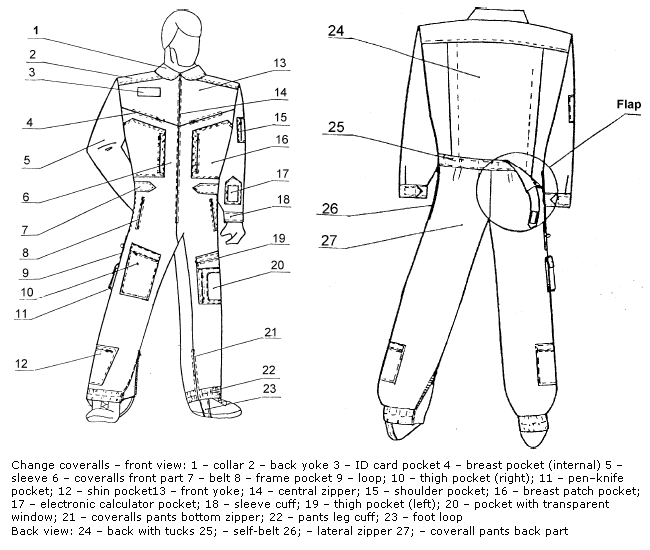


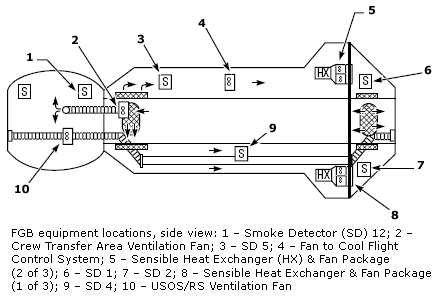


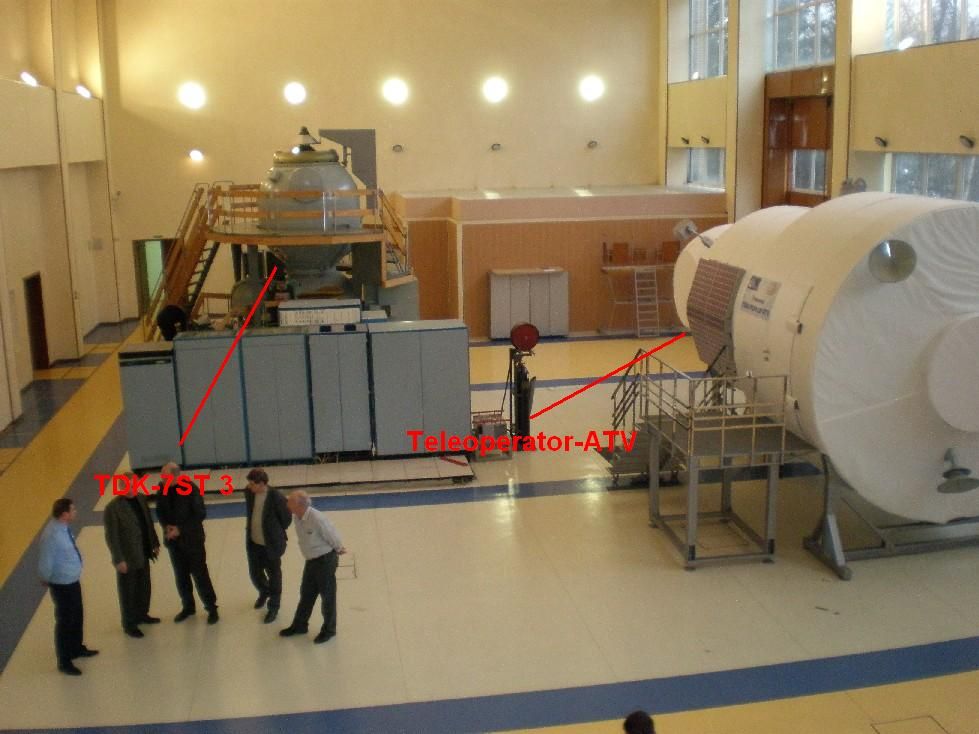


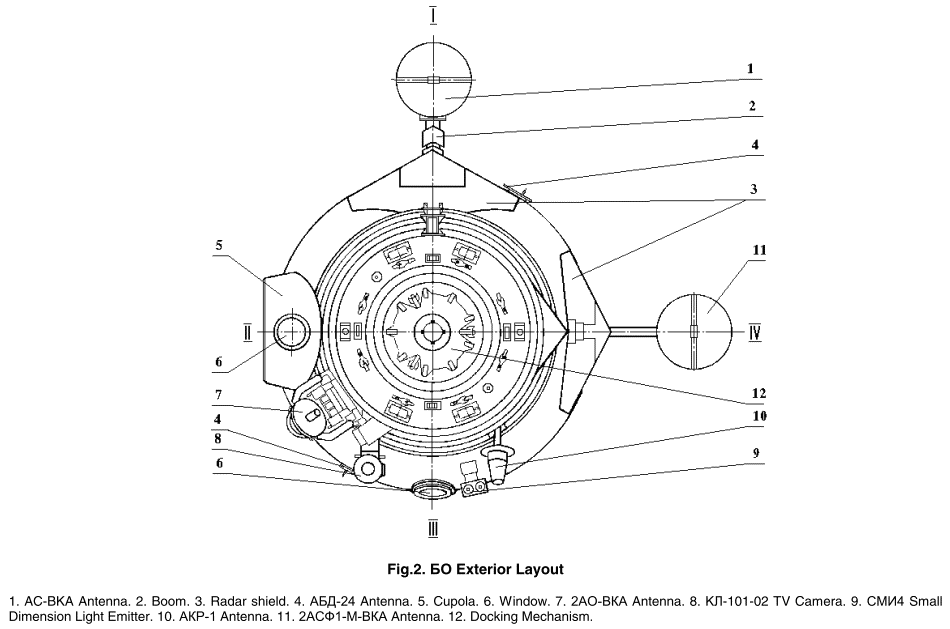
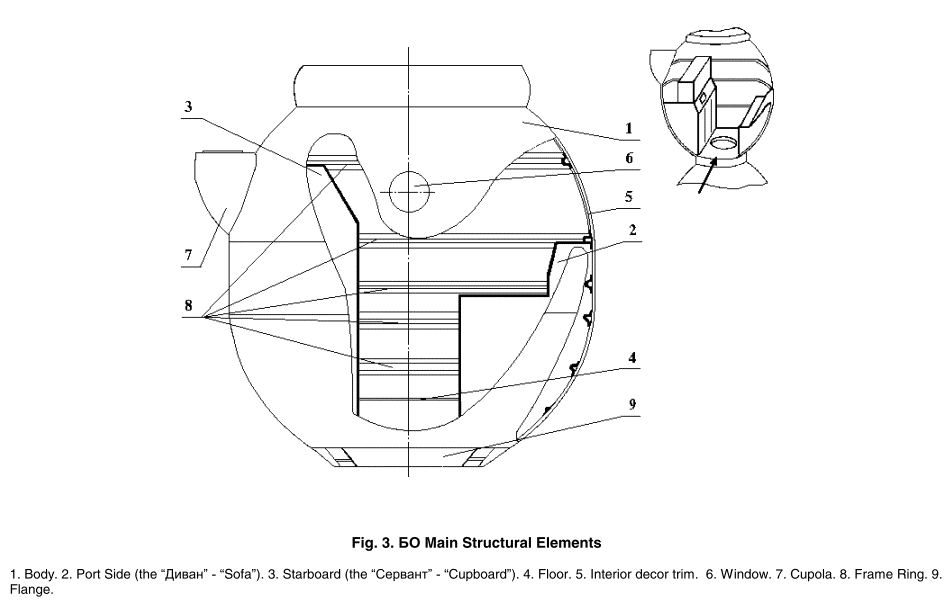
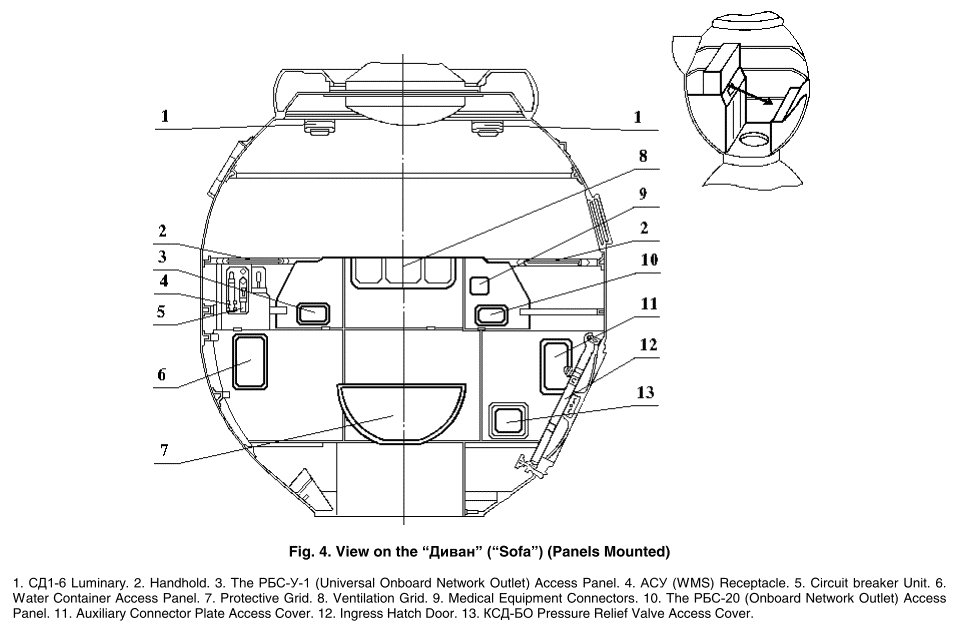
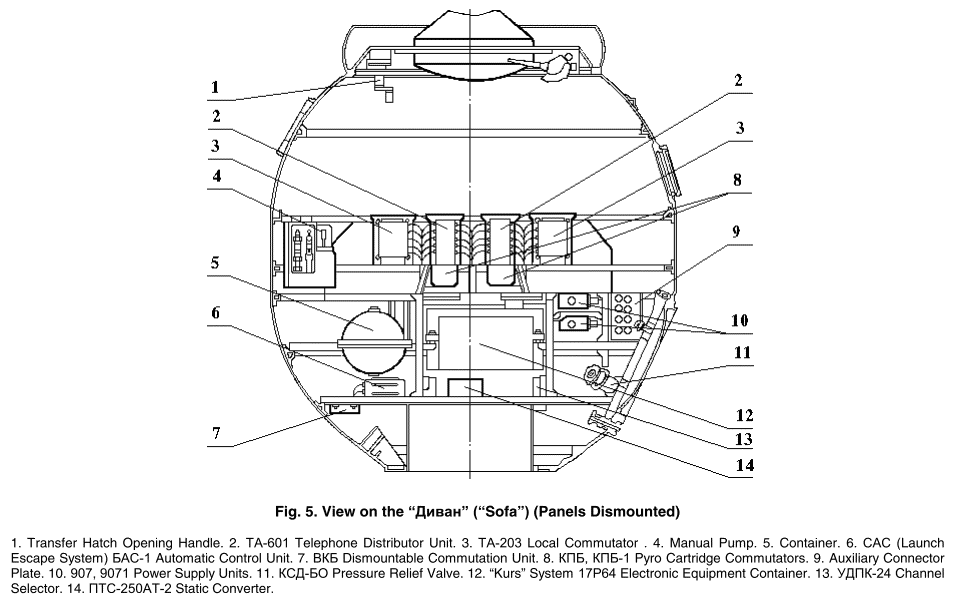
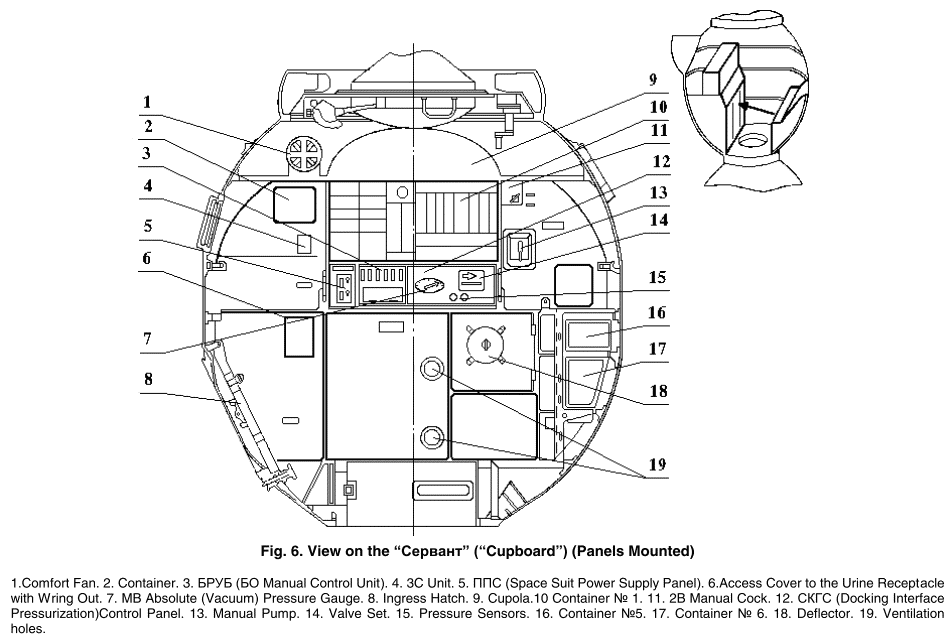
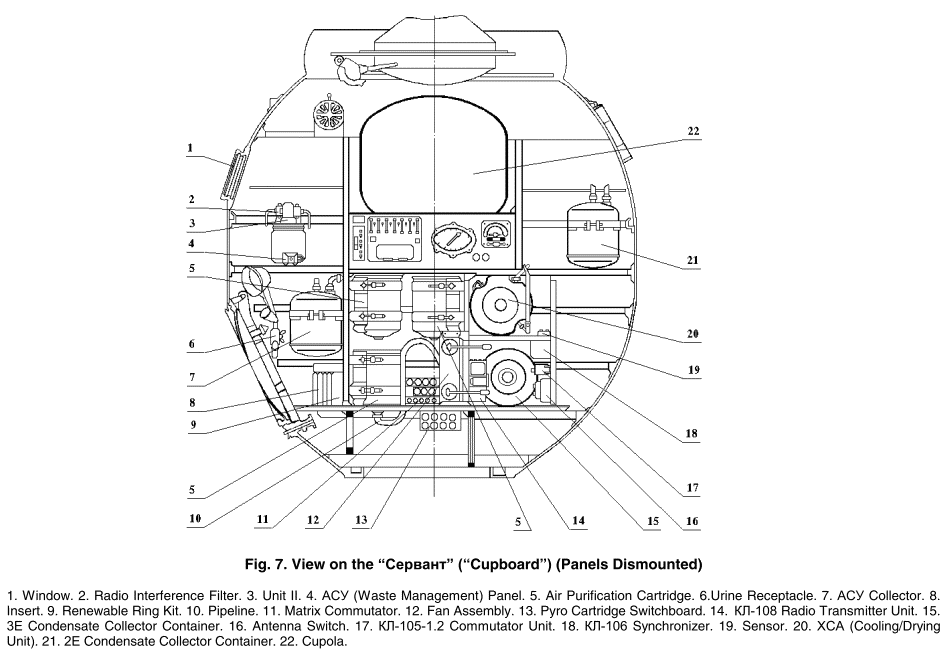
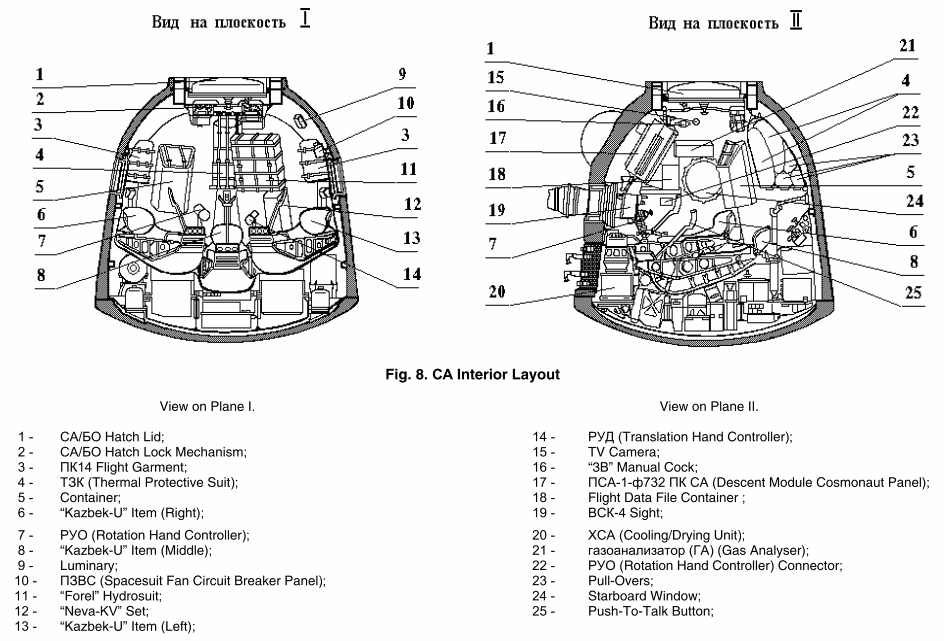
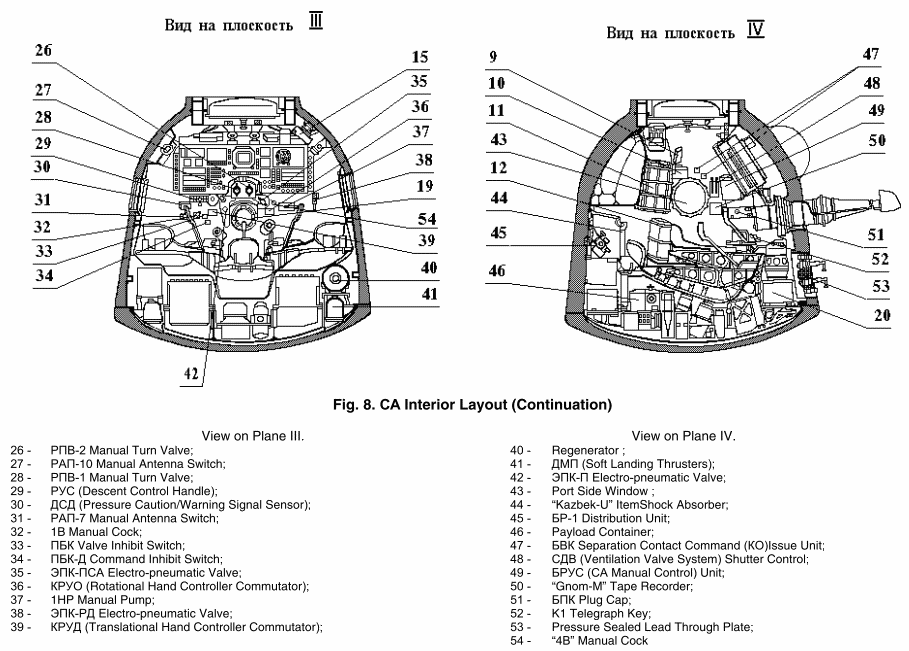
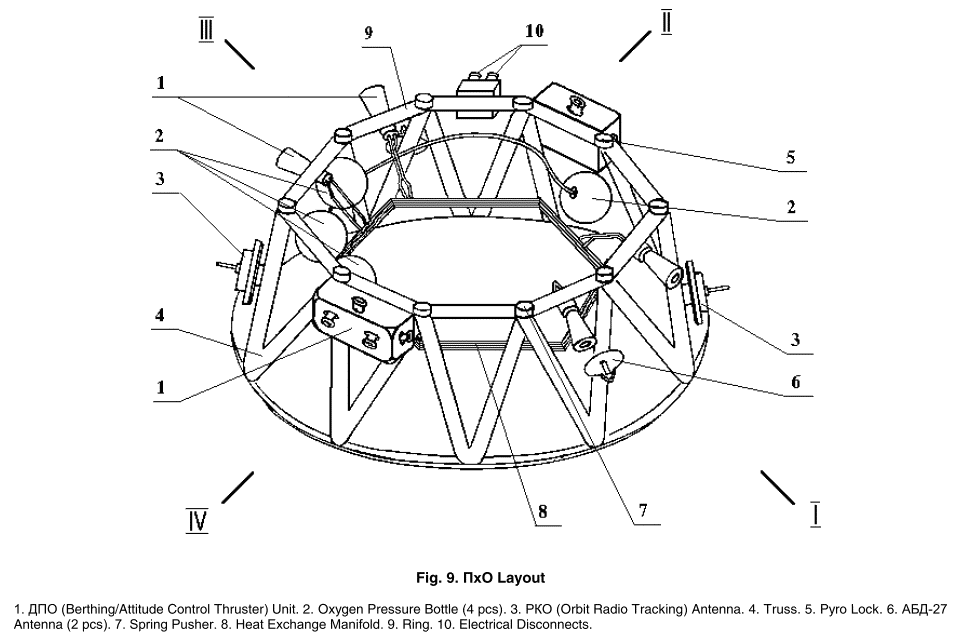
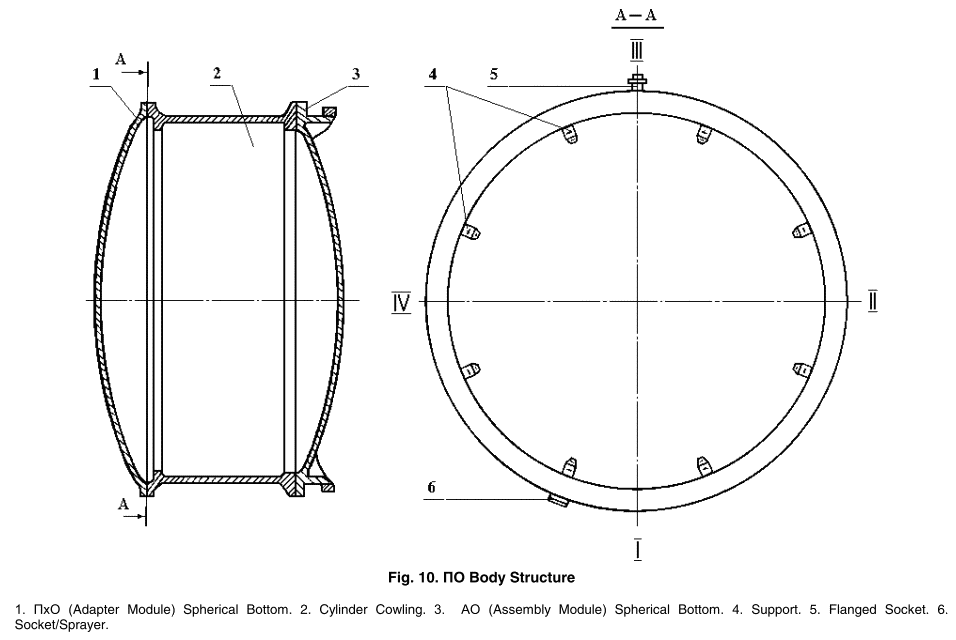
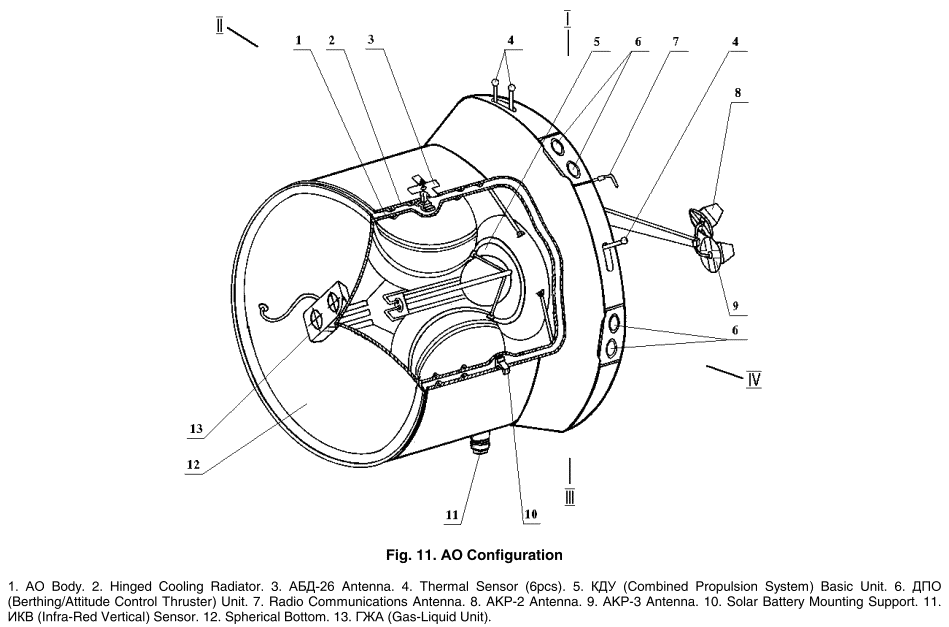
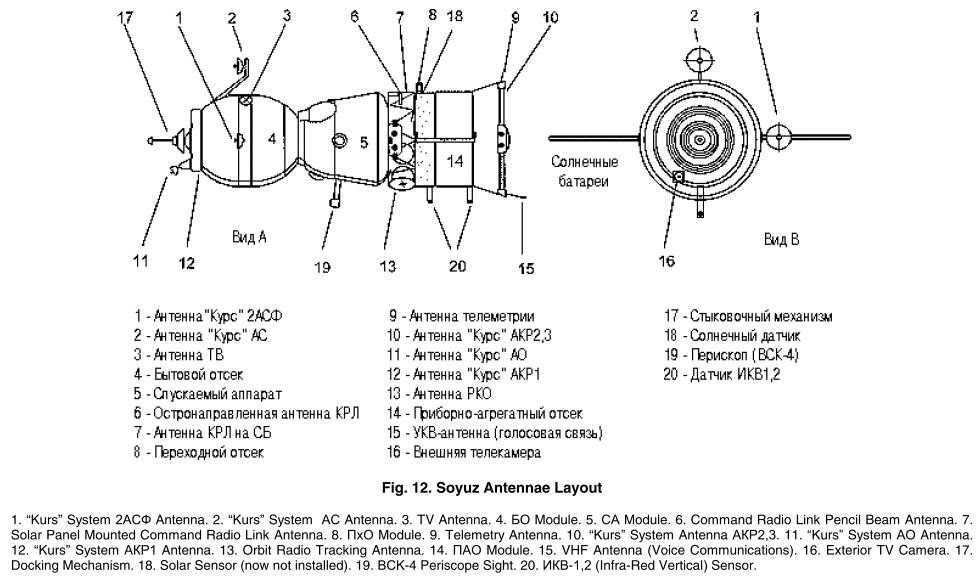


Military to civilian control
In 2009 the Russian Air Force decided to hand TsPK over to civilian control, namely to the Russian Federal Space Agency (Roskosmos), as announced by the Roskosmos news service on 27/4:
On April 27, Anatoly Perminov, Head of the Russian Federal Space Agency, held a meeting with the management of Gagarin Cosmonaut Training Center.
The meeting was attended by Alexey Panteleev, Vice Governor of the Moscow region, Valery Chernov, Territorial Settlement Minister of Government of the Moscow region, Vitaly Davyidov, State-Secretary-Deputy Head of Roscosmos, and the heads of Roscosmos Directorates.
Anatoly Perminov opened the meeting. In particular, he said:
“… GCTC history is linked tightly with foundation and evolution of the Russian and world human space programs. GCTC has everything required for crew training: modern unique labs and simulators, validated methods, high-quality expertise. The renewed Center will face more achievements in space exploration.
“Following the Order of the Russian Government, Roscosmos and Ministry of Defense now carry out the reorganization work to establish a Federal State Budget Entity under Roscosmos. There are some problems connected with GCTC hand-over to Roscosmos, and we discussed those with D.A. Medvedev, Russian President, at the meeting devoted to the Cosmonautics Day.
“The Act of the Russian President dated Jan. 19 also defines reorganization of the military city into a Restricted Administrative Territorial Settlement. Here, we appreciate the support provided by the Governor and the Government of the Moscow region a lot …
“Roscosmos and Ministry of Defence still have to do much to finalize liquidation process until July 2009. All the assets are to be handed over to Roscosmos, personnel is to get new appointments in the Federal State Entity, etc.
“All the issues regarding social protection of GCTC personnel will be solved.
“We have to work hard to establish a renewed Center, and to found a new City, which deserves its name of the Cosmonaut Training Center.
“I am sure that the personnel will support implementation of all current and future tasks related to cosmonaut training, and add more pages to the history book of the Russian space exploration.”
The formal transfer was to be completed by 1 July 2009. One reason for the transfer was cost-cutting by Minister of Defence Anatolii Serdyukov.
From an online video report at Roskosmos TV of a news conference, 16 May 2009:
ZATO without epaulets
The centre of preparation of cosmonauts named after Yurii Gagarin is on the threshold of a new life. In Star City the approach has changed. Officers will remove epaulets, the military become civil experts. Such are the realities of life. In the conditions of military reform from the Ministry of Defence the Center is transferred to the Federal Space Agency. Henceforth it will be ФГБУ, FGBU – a Federal state budgetary establishment.
"We will be ready to take any measures to create in Star City the normal conditions for the functioning of all social infrastructure that there was a corresponding investment climate. Everything that it will be necessary to make from outside the governments it is made in the near future,”assured Alexei Panteleev, the vice-governor of Moscow Region.
In official documents the town will be referred to as ZATO, the closed administrative-territorial entity (ЗАТО – закрытым административно-территориальным образованием) as it is still connected with classified activities.
“It is a territorial regime that is connected with many secrets – state secrets – which we are obliged to keep classified. It imposes certain restrictions,” Yurii Gidzenko, the head of department of special preparation at TsPK, explained.
More than 200 military men will continue service at the new Star City without transferring to the reserves. Recently the same kind of reforms took place at the Baikonur cosmodrome. Now it as a part of the Russian Space Department. Today it is possible to be proud of civilian Baikonur.
“After a year or two it is already impossible to ascertain the objects which we have accepted from the Ministry of Defence,” Anatolii Perminov, the head of the Federal Space Agency, has emphasized.
Being a past military man, Colonel-General Anatolii Perminov understands how it is hard to transfer to being a citizen. The head of Russian Space Department has assured the Star City officers that he will personally supervise all reorganisation processes.
“No one will be thrown overboard, we'll try not to offend,” promised Anatolii Perminov.
For people at Star City it is necessary to live on the Earth. Some officers live in service apartments from the Ministry of Defence, while others have no allocated housing. The question is difficult to solve. There will be a housing program in TsPK. “Epaulets, remain on for life, and most importantly, in the soul of this officer and others the best traditions are honored,” Aleksei Panteleev said.
In July the preparation center will be headed by Sergei Krikalev – the Hero of Soviet Union and the first Hero of Russia. He is not a military man, but expectations of officers are clear to him. The working group of the commission will consider all questions. Hospitals, drugstores, kindergartens, food industrial complexes – the infrastructure of Star City should be maintained.
The new leadership promises to improve the life of the town and attract young professionals a decent wage, with interesting business and promising projects. After all, Russia’s space program has already been set out for 30 years.
On 28 July 2009, for the first time in the history of the Star City, election of the city mayor and deputies of the Deputy Counsel took place in the City. (Roskosmos). There was a scandal surrounding the initial candidate, as described in this news article, where Colonel of the FSB Nikolay Rybkin was arrested for allegedly organizing the illegal delivery of an exceptionally large contraband of Chinese goods through Baltic Customs. This caused much indignation in Star City as he was a popular figure, and some thought the arrest a set-up.
A curious bit of trivia, regarding some Australian black swans (one of which can be seen in this Roskosmos news report):
One of his widely known acts was reintroducing twelve swans that inhabit the town’s lake. There was a time when Star City was proud of these birds, but during perestroika, someone ate the swans and sent the bones to the town’s administration. Rybkin, once again, ordered the swans from abroad.
On 22 October 2009, former cosmonaut Aleksandr Volkov became Head of Star City Administration – this is a separate role from that of the TsPK Chiefs. Coincidentally, he did two long space missons with Sergei (Mir Principal Expeditions 4 and 10). (Roskosmos interview, only in Russian).
On 7 December 2010, the Chief of Roskosmos, Anatolii Perminov, signed the Order “About Establishment of Roscosmos’ United Cosmonaut Corps,” to be formed before 1 January 2011.
Two new transport aircraft
In March 2019 TsPK received the first of two modified and dedicated Tu-204-300 passenger jets for the transport of cosmonauts and launch personnel to and from Chkalovsky Airfield and launch centers such as Baikonur.
A post at NASASpaceflight.com forum:
As reported by the Roscosmos State Corporation for Space Activities, on 29 March 2019, the first of two planned Tu-204-300 aircraft has been handed over to Yuri A. Gagarin State Scientific Research-and-Testing Cosmonaut Training Center (part of Roscosmos group) at the military airfield of Chkalovsky (ICAO: UUMU) in the Moscow region.
The Tu-204-300, factory no. 1450742864045, serial no. 64045 has been registered as RA-64045 and named after the legendary Soviet designer and scientist Sergey Korolev. The plane has been equipped at CJSC Aviastar-SP facility in Ulyanovsk (part of United Aircraft Corporation), which is responsible for manufacturing of An-124 and Il-476 cargo aircraft, as well as the whole Tu-204 family (except Tu-214).
The second Tu-204, named after the first cosmonaut Yuri Gagarin, will be transferred from the same location in early April 2019 and according to the head of the Cosmonaut Training Center P.N.Vlasov, both airplanes are identical in design.
This specialized modification of the Tu-204 includes roughly two thousand changes to the original layout, incl. satellite communication system that provides telephone connection and Internet access during the flight. Each of these specialized Tu-204-300s can accommodate up to 53 passengers located in three cabins, as well as six specialized compartments for additional crew members. Due to necessity to reach the new Vostochny spaceport, located on the 51st parallel north in the Amur Oblast, in the Russian Far East, the range of the aircraft has been increased to 9,000 km.
The main mission of these aircraft will be transportation of astronauts and the operational group of the Roscosmos corporation to space centers and back to the base upon landing. Additional tasks include flight training of astronauts for conducting visual and instrumental observations. According to Vlasov, first main and backup crews should board the new aircraft on the way to Baikonur spaceport in Kazakhstan this summer.
Press announcement at Roskosmos (also at TsPK):
On March 29, the airfield Chkalovsky of the Ministry of Defense of Russia hosted the transfer to operation of the joint aviation squadron of the FGBU SRI TsPK named after Yu.A. Gagarin of one of two Tu-204-300 aircraft. The plane arrived from Ulyanovsk is named after the legendary Soviet designer and scientist Sergei Korolev.
The event for the transfer of the aircraft was attended by the head of the Cosmonaut Training Center Pavel Nikolaevich Vlasov, the executive director of the manned space programs of the Roscosmos State Corporation Sergey Konstantinovich Krikalev and the general director of the leasing company Ilyushin Finance Co. (IFC) Alexander Ivanovich Rubtsov.
The second Tu-204-300 aircraft, transmitted to the Center from Rusaviainter JSC and the IFC, is named for the first cosmonaut of the planet, and its haul from Ulyanovsk is scheduled for early April. “Both airplanes are identical in design and made within the same technical assignment,” said the head of the Center Pavel Vlasov. “The main tasks of the aircraft of this class are the transportation of astronauts and the operational group of the Roscosmos State Corporation to space launching centers, returning after landing to the base, as well as flight training of astronauts for conducting visual and instrumental observations,” added Pavel Nikolaevich. The head of the Center expressed hope that the main and backup crews would fly to Baikonur for the pre-flight Tu-204-300 for pre-flight preparation for the summer launch.
Both aircraft Yuri Gagarin and Sergey Korolev are made in a special layout, allowing to accommodate up to 53 passengers, located in three cabins. Sergey Krikalev, commenting on the characteristics of the cabin, noted that the aircraft are equipped with six specialized coupes. This is due to the possible increase in the number of crew members on a prospective ship. “In 2012, when work was carried out to determine the appearance of these aircraft, the construction of the first launch complex of the Vostochny cosmodrome began. In this regard, the Tu-204-300 aircraft has a greater range in order to travel up to nine thousand kilometers without landings, ”said Sergey Konstantinovich.
The general director of the IFC, Alexander Rubtsov, noted that it was a great honor for the company to hand over the aircraft to the Center for operation. “During the construction of the Tu-204-300 for the CPC, we had to make more than two thousand changes to the design documentation. This is a multi-purpose aircraft that provides astronauts with the most comfortable transportation,” A. Rubtsov added. The planes are equipped with a satellite communication system that provides telephone connection and Internet access during the flight.

Tu-204-300 aircraft Sergei Korolev arrives at Chkalovsky airfield, 29/3/2019.

Sergei Krikalyov, Executive Director of Manned Space Programs at Roskosmos, watches the Tu-204-300 aircraft Sergei Korolev arriving at Chkalovsky airfield, 29/3/2019.
Diagrams
Maps from the book Russia’s Cosmonauts (2005):
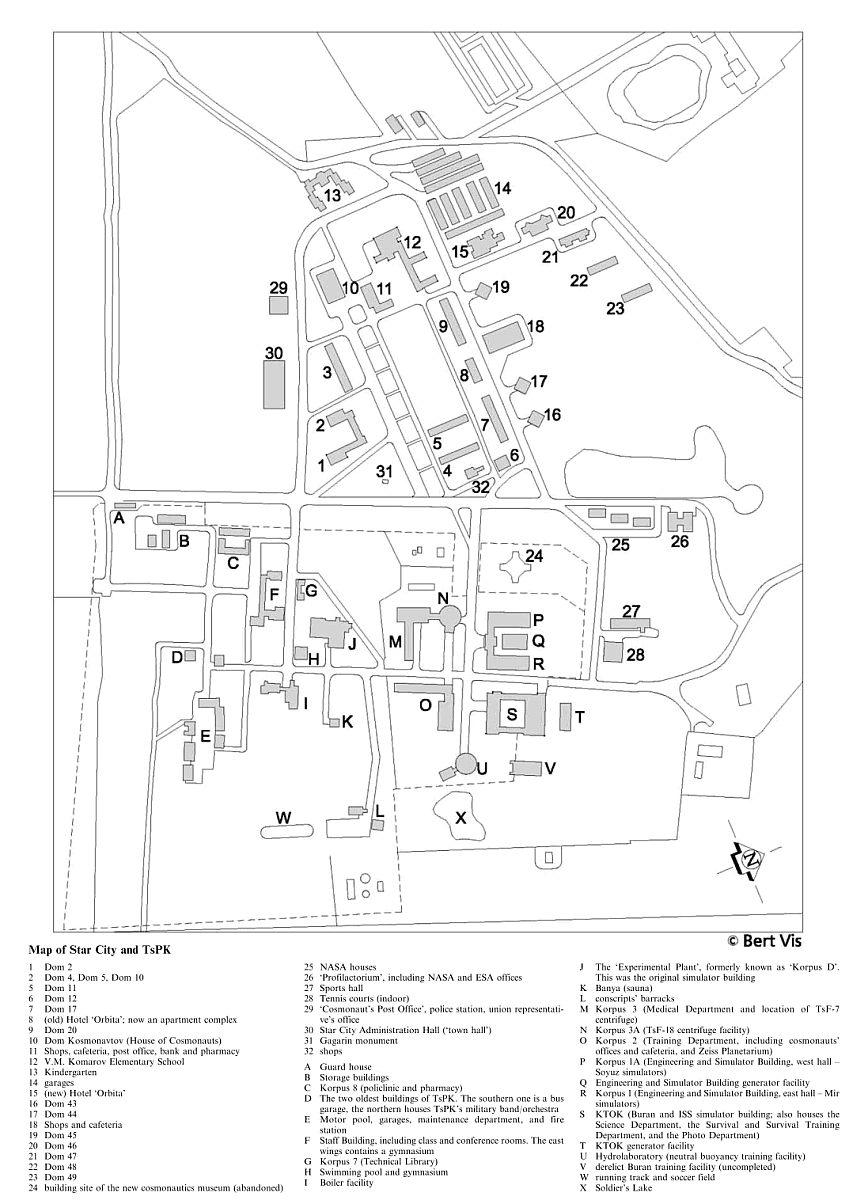
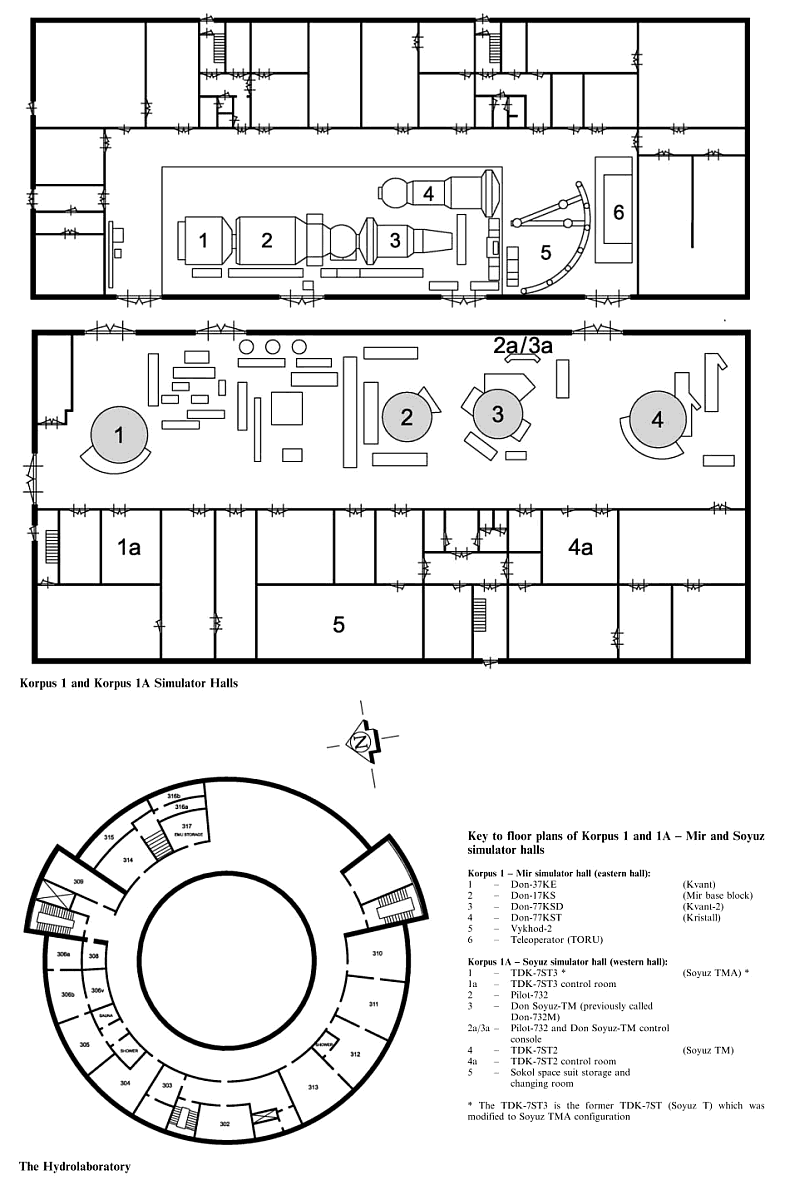
Google Maps screenshots. North is to the top in these:


Aerial photos at the TsPK site, looking west: 1, 2
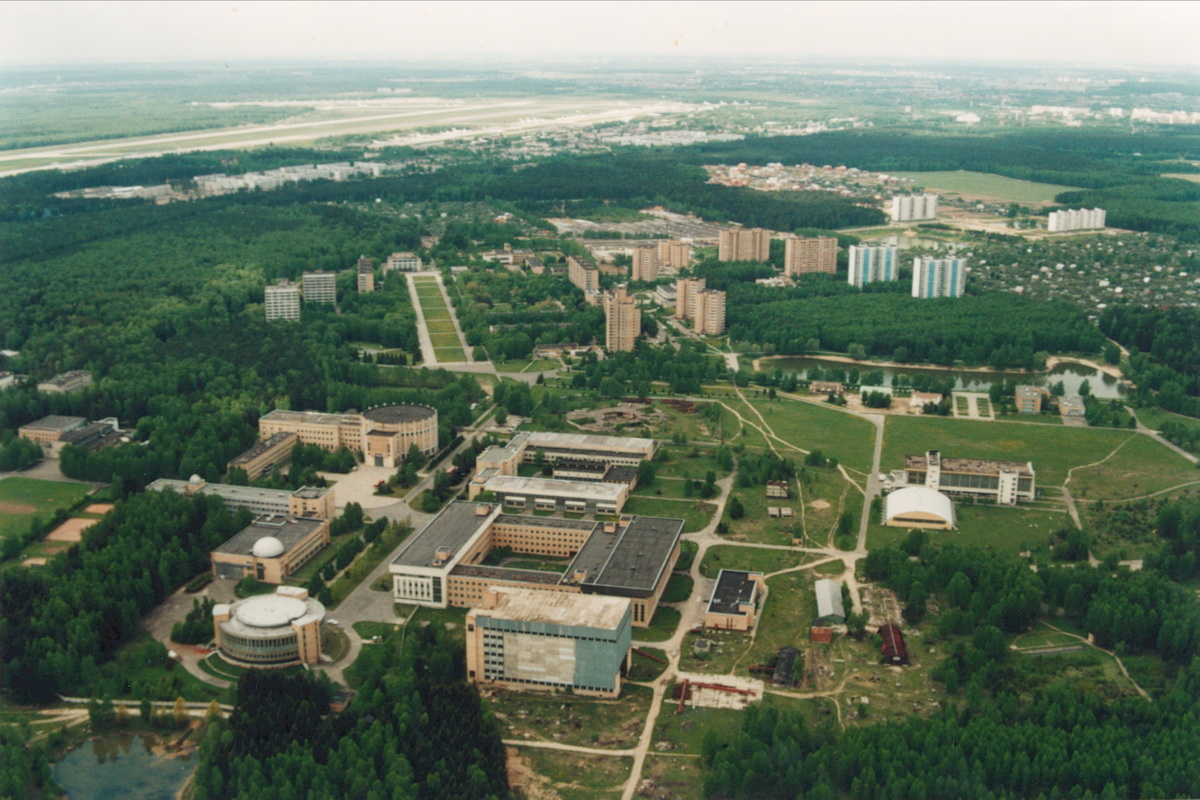
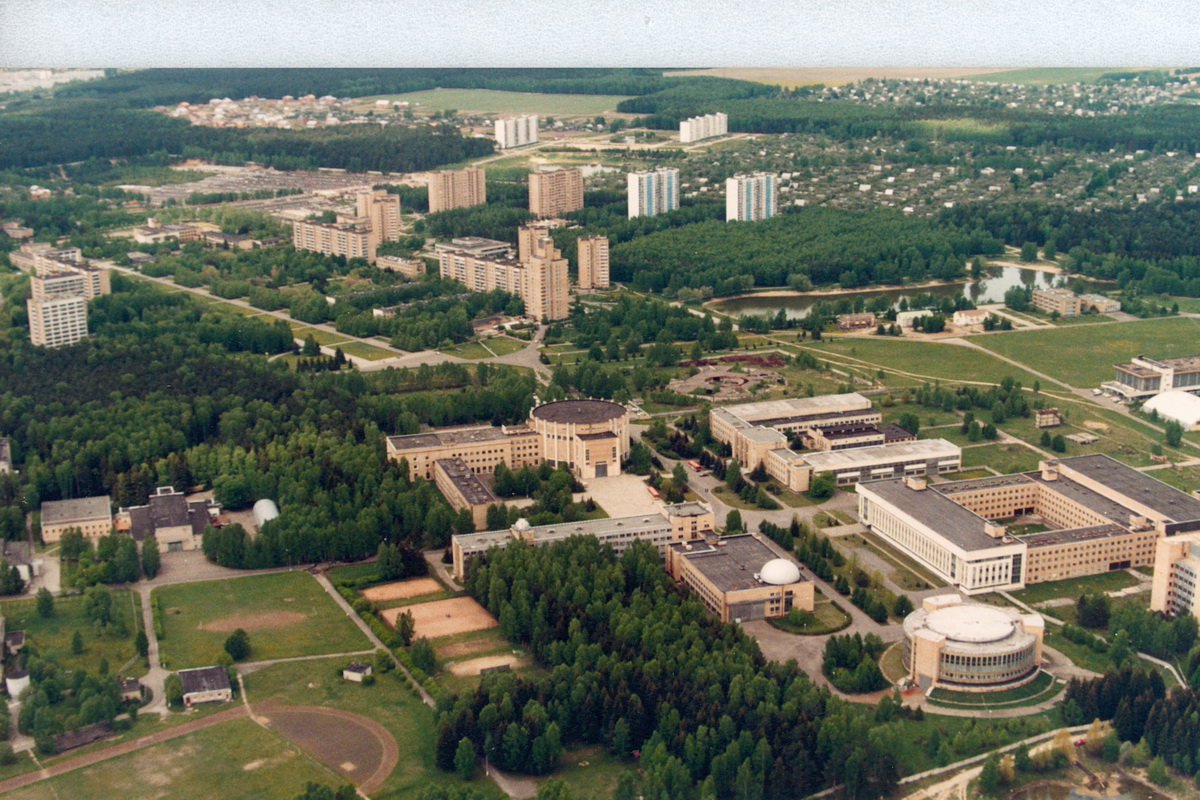
TsPK Chiefs gallery

Eu.A. Karpov, colonel of medical service
Полковник м/с. Е.А.Карпов (1960-1963)

M.P. Odintsov, Air Force colonel-general, twice Hero of the Soviet Union
Генерал-полковник авиации дважды Герой Советского Союза М.П.Одинцов (1963)

N.F. Kuznetsov, Air Force major-general, Hero of the Soviet Union
Генерал-майор авиации Герой Советского Союза Н.Ф.Кузнецов (1963-1972)

G.T. Beregovoi, Air Force lieutenant-general, twice Hero of the Soviet Union
Генерал-лейтенант авиации дважды Герой Советского Союза Г.Т.Береговой (1972-1987)

V.A. Shatalov, Air Force lieutenant-general, twice Hero of the Soviet Union
Генерал-лейтенант авиации дважды Герой Советского Союза В.А.Шаталов (1978-1991)

P.I. Klimuk, colonel-general, twice Hero of the Soviet Union
Генерал-лейтенант авиации дважды Герой Советского Союза П.И.Климук (before 2003)

V.V. Tsibliev, lieutenant-general, Hero of Russia
Генерал-лейтенант, герой России, В.В.Циблиев (2003-2009)

S.K. Krikalyov, С.К.Крикалёв, Energiya cosmonaut, Hero of the Soviet Union & Russia, first civilian Chief (2009-2014)

Yuri Lonchakov, Юрий Лончаков, (9/4/2014-2017)

Pavel Vlasov, Павел Власов, first non-astronaut to head Star City since 1972 (24/11/2017-)
Links
Updated: 20/4/2020
Docking Compartment-1 Pirs

Pirs («Пирс», “Pier”) has two roles: as an airlock for spacewalks from the Russian segment, and as a docking port for Soyuz or Progress ships.
It was launched at 23:34:55 UTC on 14 September 2001 on a Soyuz rocket. A specially-modified Progress cargo ship, Progress M-SO1, ferried Pirs to the International Space Station.
Pirs was to serve as an interim docking and spacewalk port until the launch of the second FGB or Universal Docking Module. It would then be moved to the azimuth or top port of Zvezda’s Transfer Compartment, to serve as a base for the Science and Power Platform (NEP). The original plan was to discard the module once the better-equipped UDM arrived, but after funding cuts it appeared Pirs would be kept. Even that plan became obsolete with cutbacks to Shuttle launches (the NEP, which was to have been carried up via two Shuttle flights, was cut out of the launch manifest).
The 2006 plan saw Pirs moved to the zenith (top) port of Zvezda’s PKhO, Transfer Compartment and still used as an extra docking port for Russian spacecraft.
The current plan saw it eventually replaced by MIM-2, but from late 2009 until the MLM is launched, both modules will be attached to Zvezda (MIM-2 to zenith, Pirs in its current nadir location). On launch of the MLM, a Progress spacecraft will be docked to Pirs and used to haul it away and deorbit it.
The DC had a projected lifetime of 5 years, though this has been much extended.
A RIA Novosti article for 12 July 2018 reported that Progress MS-12, unofficially nicknamed “Gerasima” (Герасима) in honor of the hero of the story of Ivan Turgenev “MuMu” (Муму), was to launch in April 2019 to dock with and deorbit Pirs once the science module Nauka is launched (the article stated from November 2018 to February 2019). The Progress will be undocked from the station only after Nauka is put into orbit and the working capacity of its propulsion system and control system is tested – the module will have to make its way to the ISS.
As of 2019, the launch date of MLM Nauka had been put back to July 2020.
Full name: СО-1: Стыковочный Отсек-1 / DC-1: Docking Compartment-1 / SO-1: Stykovochnyi Otsek-1
Structure
Pirs has one docking port at either end along its longitudinal axis: one active, the other passive. The active hybrid port, SSVP-M G8000, ССВП-М Г8000 is joined to the nadir port of the Zvezda Service Module. There are electrical connections to transfer power, and hydraulical connections to enable fuel to be transferred from a Progress cargo ship through Pirs to Zvezda’s storage tanks. The passive cone docking point, SSVP G4000, ССВП Г4000, on the opposite end enables Soyuz and Progress ships to dock. It also has fuel and power connection lines.
Pirs is equipped with 4 external antennae to measure relative motion between it and the ISS for its initial docking, and also the Kurs-P system to enable Soyuz and Progress ships to dock automatically to the DC-1.
Inside Pirs are controls for temperature regulation, communications, control of the module, television and telemetry systems and a power supply. There is also a ventilation duct with 3 fans.
The forward half-sphere of Pirs, which has a diameter of 2200 mm, was produced with the same dies and equipment used to construct the forward half-spheres (BO, Orbital Module, бытовой отсек, Bytovoi Otsek) of the Soyuz and Progress ships.
Two manually-operated Strela, «Стрела» (“Arrow”) cargo booms (ГСт-1, GSt-1 & 2) are attached to the base of Pirs (to attachment points BST-1, БСТ-1 & -2) for moving around cargo and cosmonauts. GSt-1 parts were brought up with STS-96 Discovery in 1999 and STS-101 Atlantis in 2000, and attached to the outside of PMA-1 until being retrieved and installed on Pirs in the 8 October 2001 spacewalk. GSt-2 was brought up inside Pirs, and installed during the 14 January 2002 spacewalk.
Pirs takes an hour and 40 minutes to depressurize, and forty minutes to repress. It has two 1000 mm-diameter hatches with windows set in (each 230 mm diameter). Hatch BL-2, БЛ-2 faces between forward and port (planes 2 and 3); BL-1, БЛ-1 faces between starboard and aft (planes 1 and 4). The hatches have annular handrails on the outside and inside.
Each hatch is designed for 120 openings. The hatches open from the inside, ensuring that the atmospheric pressure inside helps keeps them sealed. Unfortunately, some air is lost when a hatch is opened and there is no way of retrieving it (in the U.S. Quest airlock, evacuated air is pumped into retrieval tanks).
Hatch opening
The following hatch opening instructions are taken from yellow stickers (barely) visible in ISS photo ISS004-E-10640, showing Roberto Vittori and Mark Shuttleworth inside Pirs. EV hatch opening:
WARNING: DO NOT OPEN THE EV HATCH IF THE COMPARTMENT PRESSURE EXCEEDS 15mmHG [?].
EV hatch closing:
Data tables
| Mass at launch, kg | 4350 |
| Mass in orbit, kg | 2882 |
| Length of casing, mm | 4049 |
| Maximum diameter, mm | 4350 |
| Volume of airtight sections, cubic meters | 13 |
| Reserve mass for deliverable cargoes | 800 |
| Assembly orbit altitude | 350-410 km |
| Working orbit altitude | 410-460 km |
| Length with Docking Assembly extended | 2.55 m |
| Pressurized compartment volume | 13 m3 |
| Manufacturer | Energiya |
| Designation | M-SO1 (No 301) |
| NASA designation | 4R |
| Module designation | SO-1 240GK |
| Launch vehicle | Soyuz-U (No 677) |
| Launch date | 15 September 2001 at 23:35 |
| Launch site | Launch Complex 17P32-5, Area 1, Launch Pad 5, Baikonur Cosmodrome, Republic of Kazakhstan |
| Docking date | 17 September 2001 at 01:05 to the Zvezda SM nadir docking port |
| Undocking date (MSO-1 Instrument Unit) | 26 September 2001 at 15:30 |
| Destruction | 26 September 2001 at 23:30 |
| Mission | This special variant of the Progress brought the Pirs Docking Compartment-1 module into orbit, along with some supplies, including . The cargo delivered by the vehicle of an overall mass of about 800 kg incorporated such cargoes as flight equipment of Docking Compartment Pirs of about 290 kg (cargo boom, external worksite, portable universal container); science and utilization hardware of about 65 kg including hardware for performance of space experiments and research Plasma Crystal-3, GTS, as well as Andromeda program (to support the Russian-French flight to be performed in October during the ISS visiting crew mission), egress equipment of about 285 kg including spacesuit Orlan-M No 14, life support system equipment of about 130 kg, and flight data files |
| Notes | Progress M-SO1 consisted of a standard Progress Instrument Unit and control systems with the Pirs combined docking unit and airlock replacing the usual tanker and orbital modules |
| Mass of ship-module on orbit injection | 7130 |
| Mass of Docking Compartment Pirs when fully loaded | 3676 |
| Fuel mass in the tanks of the cargo ship | 875 |
| Carrier rocket-type | Soyuz |
| Parameters of the working orbit of the ship | |
| • Height | to 450 km |
| • Inclination | 51.6° |
| Duration of flight prior to docking with the Station | up to 4 days |
| Items | Weight (kg) |
|---|---|
| Regular equipment of docking module, stored in the transport position (Strela cargo boom, working place extension, the universal transfer container) | 288.6 |
| Spacewalk equpment (Orlan-M No 1280014, oxygen canisters, CO2 absorbent cartridges, water storage containers, universal storage containers) | 285.6 |
| Equipment for life support systems | 128.4 |
| Equipment for Zvezda SM | 13.3 |
| Scientific gear | |
| • For the French program “Andromede” | 46.6 |
| • For the “Plasma Crystal-3” experiment | 9.2 |
| • For medical studies | 6.7 |
| • For the GTS experiment | 2.0 |
| Flight documentation | 13.4 |
| Total | 793.8 |
Diagrams
Cargo ship-module Progress M-SO1

(Block with the hydro-steel framework of pumping propellant components is shown without the jacket.) (Diagram via NASA)
The Progress M-SO1 transport ship was a modified version of the Progress M cargo ship. It consisted of the Pirs DC-1 at the front, a transitional adapter and an Instrumentation/Propulsion Module.
The PAO (Instrumentation/Propulsion Module, Priborno-Agregatnyi Otsek, приборно-агрегатный отсек) at the aft end was identical to that of the normal Progress. It contained propulsion fuels and support systems to enable M-SO1 to reach the ISS autonomously.
The transitional adapter connected the PAO with Pirs. Pirs was connected with the adapter via a divided joint which contained 5 pyro-locks and propulsion units. After Pirs docked to the base of Zvezda, the pyro-locks were fired to separate the M-SO1 section from Pirs and deorbit it.
Gallery

Pirs under construction at Energiya in Moscow, 2001.

A nadir view of Pirs taken during the STS-108 mission in 2001. Zvezda is towards the top of the photo. Hatch VL-2 is visible, and a Strela crane. (Starboard at left of photo, port to right here as it’s upside-down.)

Roberto Vittori and Mark Shuttleworth inside the Pirs module.
Links
Updated: 12/4/2019
Service Module Zvezda

Zvezda («Звезда», “Star”) is the core of the ISS, providing living quarters and life support for the crew. It was originally intended for the Mir-2 space station and the design was based on the Mir Core Module, but when this was canceled after the fall of the Soviet Union, it was amalgamated into the ISS instead.
Zvezda is the first entirely Russian module (i.e. built and funded by Russia). The main developer was RKK Energiya and main subcontractor was GKNPTs Khrunichev. It was launched on a Proton-K rocket on 12 July 2000.
Zvezda is the most complex structure as it has many tasks to support: crew and ground communications, life support, Station orientation, enabling the approach and docking of Russian Progress and Soyuz ships, supporting experiments and spacewalks.
Full name: СМ: Служебный Модуль / SM: Service Module / Sluzhebnyi Modul’
Structure
Zvezda is a cylinder comprising four sections.
Sections
PKhO transfer compartment (ПхО, Переходный Отсек – PKhO, Perekhodniy Otsek): This spherical compartment provides 3 docking ports (it could be built with 5) and also serves as a back-up airlock if no specialized airlock is attached as it can be depressurized. It is the transfer point between the SM and the other ISS modules. It is 2.78 m in length with a volume of 6.85 m3. There are four lights inside. It has one axial (facing forward) and two lateral (top and bottom) hybrid passive docking ports of the type SSVP-M G8000, ССВП-М Г8000. Zarya is permanently docked to the axial port. The top port was to have supported the Science & Power Platform (НЭП, NEP), but with the cancellation of this, Pirs will eventually be moved there instead. Pirs is currently docked to the bottom (Earth-facing) port.
The Progress and Soyuz ships can’t dock to any PKhO ports as they have a different docking mechanism (probe-and-drogue). The PKhO ports are for modules only.
Working compartment section (РО, Рабочий Отсек – RO, Rabochii Otsek): This is the largest part of the SM and contains life support systems, instruments and crew quarters. It is 7.7 meters in length and has a total of 14 windows. It comprises two cylinders joined together by a conical adapter:
The intermediate chamber (ПК, Промежуточная Камера – PK, Promezhutochnaya Kamera): This is the transfer point between the RO and a docked Soyuz or Progress spacecraft. It is 2.0 m in diameter and 2.34 m in length. The internal volume is 7.0 m3. At the aft end is the passive docking assembly SSVP G4000, ССВП Г4000 (probe-and-cone type). The port can accommodate Soyuz and Progress dockings, and the European Automated Transfer Vehicle. A TV camera is attached to the outside to enable visual display of dockings.
The assembly compartment (АО, Агрегатный Отсек – AO, Agretatnyi Otsek): This is wrapped around the PK at the aft end and is unpressurized. It is used to position the orientation and propulsion engines around the module. There are also various antennae mounted for communications.
Docking ports summary
Systems
The onboard control complex (БКУ, Бортовой Комплекс Управления – BKU, Bortovoi Kompleks Upravleniya) that oversees the operation of the Russian ISS modules comprises the following systems:
The electrical power supply system (СЕП, SEP) supplies power to Zvezda, and can also transfer power from the U.S. segment if needed. Solar power is gathered by two solar arrays (СБ, SB) of 38 m2 each. They can be oriented toward the sun either automatically or manually by the crew. Power is stored in 8 800A storage batteries (АБ, AB).
The united engine installation (ОДУ, ODU) controls and stabilizes the ISS. There are 2 two main corrective engines (КД KD) and 32 smaller engines (ДО, DO) 11D428A for precision orientation. The oxidizer used is nitric tetraoxide and propellant is nitrogen. The tanks these are stored in are replenished by Progress cargo ships. The module has 4 tanks (2 for fuel, 2 for oxidizer), which can contain up to 860 kilograms of propellant in total.
The thermal control system (COTP, SOTR) maintains the temperature inside the modules and regulates air ventilation. It is separate from the other systems and works constantly. Temperature in the crew compartments is maintained in the 18°C to 28°C range.
The life support system (СОЖ, SOZH) provides extensive equipment to remove CO2 and other impurities via the Vozdukh, provide oxygen via the Elektron generator or solid cannisters and generally maintain an appropriate atmospheric composition (СОГС, SOGS) for humans. Water provision (СВО, SVO) is enabled through a condensate regeneration system and is also brought up from Earth and stored in tanks. A toilet and washroom facilities support crew hygiene needs (SSGO). There are, of course, food supplies onboard (СПО, SPO). There is also a fire detection system and extinguishers. Medical supplies are also provided.
Data tables
| Maximum crew the module can support | to 6 |
| Mass in orbit, kg | 20,295 |
| Length of housing, mm | 13,110 |
| Maximum diameter, mm | 4350 |
| Volume of airtight sections, cubic meters | 89 |
| Spread of solar batteries, mm | 29,730 |
| Area of photovoltaic cells, meters squared | 76 |
| Average power of power supply, KVT/SUT | 9.8 |
| Fuel mass, kg | 860 |
| Duration of functioning in orbit, years | 15 |
| Manufacturer | Khrunichev |
| Designation | 17KSM No 12801 |
| NASA designation | 1R |
| Launch vehicle | Proton-K (No 398-01) |
| Launch site | Launch complex 81/23, Baikonur Cosmodrome, Republic of Kazakhstan |
| Launch date | 12 July 2000 at 04:56:36 |
| Docking date | 26 July 2000 at 00:45 to Zarya aft port |
| Mission | Launch of Zvezda Service Module (docked with Zarya). Third ISS module to be launched (after Zarya then Unity) |
Diagrams

Zvezda has 14 windows, most downward-facing. There is one window in each kayuta, каюта (No.s 1 – port, and 2 – starboard – not shown here), and 6 set into the floor of the Working Compartment (No.s. 3-8), plus one 40 cm-diameter Observation Window (No 9) set into the flared skirting between the Working and Living Compartments. There are 3 22.8 cm windows in the Forward Transfer Compartment for viewing docking activities, and one set into the rear docking port. Window 7 has a shade; window 4 a vertical sight. (Diagram from the PDF documents linked to below.)
External links to three Zvezda exterior diagrams at Spaceref.com (PDF documents – to save without opening the document, right-click on the link and select “Save Target As”):
The following Zvezda exterior diagrams are taken from the Space Station User’s Guide: NASA ISS EVA Operations Documents PDFs at Spaceref.com:


Boeing diagram: Zvezda Service Module: Early Crew Living Quarters (71 KB).

Gallery

Nadir view of Zvezda in orbit, 2 December 2000.

This view shows an aft view of the Service Module; starboard is to the left, port to right and the hatch leading to the docked Progress cargo ship is behind Aleksandr Kaleri (ISS-8), who is at the Galley table. To his right is one of the twin kayuti, каюты (cabins – singular: kayuta, каюта). Photos of Yurii Gagarin and Konstantin Tsiolkovskii are attached to the panel above the rear hatch.

A view looking forward (toward Zarya), showing the Central Workstation with its four laptops.
Links
Updated: 12/4/2019