Mir Expeditions 4 & 9
- Mir Principal Expedition 4
- Mir Hardware Heritage: EO-4
- Mir Principal Expedition 9
- Mir Hardware Heritage: extracts
Sergei Krikalyov’s two Mir missions.
Mir Principal Expedition 4
Flight details of Mir Principal Expedition 4, «Мир» Экспедиция осовная 4, who launched on Soyuz TM-7.
Mission data
| Name | Role | Origin |
|---|---|---|
| Aleksandr Aleksandrovich Volkov Адександр Александрович Волков |
Commander Командир |
Yu.A. Gagarin RGNII TsPK, USSR РГНИИ ЦПК им. Ю.А. Гагарина, Россия |
| Sergei Konstantinovich Krikalyov Сергей Константинович Крикалёв |
Flight Engineer-1 Бортинженер-1 |
S.P. Korolev RSC Energiya, USSR РКК «Энергия» им. С.П. Королева, СССР |
| Jean-Loup Jacques Marie Chretien | Cosmonaut-researcher Космонавт-исследователь |
France, CNES |
| Name | Role | Origin |
|---|---|---|
| Aleksandr Stepanovich Viktorenko Александр Степанович Викторенко |
Commander Командир |
Yu.A. Gagarin RGNII TsPK, USSR РГНИИ ЦПК им. Ю.А. Гагарина, Россия |
| Aleksandr Aleksandrovich Serebrov Александр Александрович Серебров |
Flight Engineer-1 Бортинженер-1 |
S.P. Korolev RSC Energiya, USSR РКК «Энергия» им. С.П. Королева, СССР |
| Michel Ange-Charles Tognini | Cosmonaut-researcher Космонавт-исследователь |
France, CNES |
| Call-sign | Donbas-2, «Донбас-2» |
| Mir expedition | EO-4, ЭО-4 |
| Launch craft | Soyuz 7K-STM №57 carrying the Soyuz TM-7 spacecraft |
| Launch site | Area 1, Launch Pad 5, Baikonur Cosmodrome, Republic of Kazakhstan |
| Launched | 26 November 1988 at 15:49:34 UTC |
| Docked | 28 November at 17:15:40 UTC to the Kvant module. |
| Undocked | 26 April 1989 at 23:28:01 UTC |
| Landed | 27 April 1989 at 02:57:58 UTC |
| Landing site | 40 km NE of Dzezkazgan, Kazakhstan SSR |
| Mission duration | 151d 11h 8m |
Notes
The previous crew (Vladimir Titov, Musa Manarov and Valerii Polyakov) remained on Mir for another 25 days (the longest a 6-person crew had been in orbit). The previous crew then returned to Earth. Krikalyov and his crewmates prepared the Station for a period of unmanned operations as the next crew’s arrival had been delayed. They then returned to Earth on 27 April, 1989.
The Soyuz TM landing system is effective at reducing velocity in the vertical direction. However, according to cosmonaut Sergei Krikalyov, winds at the landing site often impart considerable horizontal velocity. As a result, about 80% of all Soyuz descent modules come to rest on their sides. During the rough landing, Krikalyov suffered a minor injury to his knee.
– Mir Hardware Heritage PDF document at NASA Shuttle-Mir Web
Soyuz TM-7 docking maneuvers
The table below was taken from “Orbital manoeuvres of the Mir Orbital Complex” by Phillip S. Clarke (published in The History of Mir 1986-2000 by the British Interplanetary Society).
| Spacecraft | Soyuz TM-7 |
| Launch date/time | 26 November 1988 at 15:50 |
| Docking port | +X (K) |
| Docking date/time | 28 November 1988 at 17:16 |
| Initial orbit – epoch | November 26:71 |
| Initial orbit – inclination ° | 51.61 |
| Initial orbit – period (min) | 88.79 |
| Initial orbit – altitude (km) | 194-235 |
| Docking orbit – epoch | November 28.77 |
| Docking orbit – inclination ° | 51.62 |
| Docking orbit – period (min) | 91.60 |
| Docking orbit – altitude (km) | 337-369 |
| Undocking date/time | 22 December 1988 at 06.45 |
| Re-docking date/time | 22 December 1988 at 06:59 |
| Re-docking – epoch | December 22.78 |
| Re-docking – inclination ° | 51.62 |
| Re-docking – period (min) | 91.37 |
| Re-docking – altitude (km) | 328-356 |
| Docking port | −X |
| Undocking date/time | 26 April 1989 at 23.28 |
| Descent date/time | 27 December 1989 at 02.59 |
Gallery
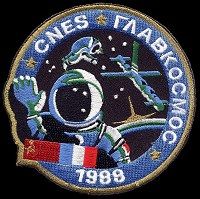
Soyuz TM-7 mission patch.

Soyuz TM-7 crew. Left to right: J-L. Chretien, A. Volkov, S. Krikalyov.

The Soyuz TM-7 crew during Black Sea survival training (from Ежегодник БСЭ 1989г, BSE Yearbook 1989). Left to right: Sergei, Jean-Loup Chrétien, Aleksandr Volkov.

The Soyuz TM-7 crew in a more relaxed moment (Sergei looks a bit pensive! And young!!!).

Chretien, Volkov and Krikalyov disembark from the bus carrying them to the launchpad (Videocosmos).

Sergei Volkov and Sergei Krikalyov at work on Mir.

From left to right: French spationaute Jean-Loup Chretien, Musa Manarov, Valerii Polyakov, Sergei, Vladimir Titov (?) and Valerii Polyakov. (Luca Coren)

“Pilots-Cosmonauts Alexander Volkov, Sergei Krikalev and Valery Polyakov, members of the Soyuz-7-TM space crew, after soft-landing.” (TopFoto)
Links
- Capcomespace: L’espace Sovietique: MIR 1988-89. In French, but features lots of photos and diagrams.
- Encyclopedia Astronautica: Mir EO-4
- Houston Chronicle: “3 cosmonauts blast off on historic Mir mission”
- Loty Kosmiczne: Sojuz TM-7 page (in Polish)
- Spacefacts: Mir Expedition EO-4 data page
Mir Hardware Heritage: EO-4
Below is a description of Sergei’s first mission to Mir, EO-4, from the excellent NASA document, Mir Hardware Heritage, by David S. F. Portree, published in March 1995. You can download the document in PDF form (4 MB) at the NASA Shuttle-Mir Web. Sergei Krikalyov was one of those interviewed for it.
2.9.2 Mir Base Block Detailed Description and Notable Features
Sergei Krikalyov, who flew on the Space Shuttle Atlantis in February 1994 and spent two long-duration stints aboard Mir, made several statements comparing conditions on the U.S. Shuttle with those on Mir. In general, Krikalyov states that living conditions aboard Mir are more hospitable than those on the Shuttle. This he attributes to Mir’s being designed for long-duration flight, while the Shuttle is designed to support a crew for only short periods of time.
Krikalyov further stated that living conditions on the station depend heavily on the preferences of the resident crew. Krikalyov stated that levels of cleanliness and odors varied according to the standards the resident crew was willing to accept. Similarly, the level of clutter varied considerably. Krikalyov stated that, on his stays, Mir was kept relatively tidy. The crews he was part of attempted to keep unused equipment and supplies behind the wall panels, and attempted to avoid attaching netting full of equipment to the station’s ceiling.
2.9.3.5 Mir Principal Expedition 4
- Alexandr Volkov, Sergei Krikalyov, Valeri Polyakov
- Crew code name: Donbass
- Soyuz-TM 7, November 26, 1988-April 27, 1989
- 151 days in space
Polyakov remained on Mir with Volkov and Krikalyov when Titov and Manarov returned to Earth in Soyuz TM-6. Polyakov’s total stay time (part of Principal Expedition 3 and all of Principal Expedition 4) was 242 days.
November 28-December 21 1988

Mir as it appeared during Sergei’s first stay in 1988. The Kvant module (right) is docked to the Base Block. (Soyuz & Progress spacecraft omitted for clarity.)
Long French visit to Mir – the Franco-Soviet Aragatz mission begins. The arrival of Soyuz TM-6 with French cosmonaut Jean-Loup Chretien (on his second mission to a Soviet space station) and Soviet cosmonauts Alexander Volkov and Sergei Krikalyov increased Mir’s population to six. According to Krikalyov, this was the “worst-case scenario” as far as crowding on the station was concerned. Not only were there more cosmonauts than usual aboard Mir; the station was also full of equipment and life support supplies delivered by Progress freighters for the joint Franco-Soviet mission. The crowding was exacerbated because there was no docking port free for a Progress freighter. Therefore, the crew could not use a Progress as a “pantry” or “storage room” for the station. The large joint experiment manifest – mostly medical and technology experiments chosen to support the French-led European Space Agency Hermes shuttle project – strained Mir’s electricity supply. The total mass of the experiments was 580 kg.
French EVA. Preparations for the first EVA involving a non-Soviet/non-U.S. space traveler forced the cosmonauts to cut short a TV meeting with diplomats from 47 countries on December 8. On December 9 Chretien and Volkov depressurized the multiport docking adapter and clambered outside Mir. Chretien was first out. He installed handrails, then attached the 15.5 kg Enchantillons experiment rack to the handrails by springs and hooks. He also attached electrical wires leading from the rack to Mir’s power supply. Enchantillons carried five technological experiments with applications to the Hermes shuttle program. Volkov and Chretien then assembled the 240-kg ERA experiment. They attached a mount to handrails on the frustum linking the multiport docking unit to the small-diameter portion of the work compartment. After resolving problems with cables linking ERA to a control panel inside Mir, they attached the folded ERA structure to a support arm on the platform. The structure was designed to unfold to form a flat six-sided structure 1 m deep by 3.8 m across. From inside Mir, Krikalyov commanded the structure to unfold, but to no avail. Volkov then kicked ERA, causing it to unfold properly. According to Krikalyov, taking the ERA outside helped relieve the crowding problems. The EVA lasted 5 hr and 57 min.
The Aragatz mission ends. After the EVA, Titov and Manarov showed Krikalyov and Volkov the peculiarities of living and working on Mir. On December 15, their 359th day in space, Titov and Manarov officially beat Romanenko’s 326-day single-flight endurance record by the required 10%. On December 19, Soyuz TM-6 was powered up for descent. The spacecraft undocked on December 21. Titov, Manarov, and Chretien landed under low clouds, in sub-freezing temperatures, near Dzhezhkazgan in Kazakhstan.
February 12-March 3, 1989
D-module (Kvant-2) delayed. In mid-February the Soviets announced that launch of the D-module (also called the augmentation module, or Kvant-2) was the victim of delays in the production of the module to be added after it, the T-module (technology module, or Kristall). The D-module had been at Baikonur, awaiting launch, since July 1988, but the T-module would not be ready until December 1989, and the Soviets did not wish to let 3 months go by with Mir in an asymmetrical configuration (that is, with only one lateral port filled). Rather than handing over to another Principal Expedition crew, the Donbass cosmonauts would mothball Mir and return to Earth at the end of their stint.
EVAs canceled. Krikalyov and Volkov had been trained to perform a total of six EVAs during Mir Principal Expedition 4. Krikalyov was to have been the first cosmonaut to fly the Soviet equivalent of the NASA manned maneuvering unit (MMU), the YMK. But delay of Kvant-2, which carried the YMK, pushed back the EVAs to the next Principal Expedition, the crew for which would consist of Krikalyov and Volkov’s backups.
Diagramma. The cosmonauts extended a 10m pole from the Mir base block’s small airlock. It carried sensors used as part of the Diagramma program to characterize the environment around Mir.
March 3-18, 1989
Antenna experiment. When Progress-40 backed away from Mir, it deployed an antenna consisting of two loops of wire, each 20 m across, from a pair of containers on either side of the Progress cargo module. The cosmonauts observed the deployment. During the 2 days before its destructive reentry, Progress-40 continued in free flight while characteristics of the antenna were assessed by the TsUP [Moscow Mission Control].
March 18-April 21, 1989
Mir mothballed. On April 10 Soviet reports had the cosmonauts beginning the process of preparing Mir for unmanned operation. Also during this period the cosmonauts replaced power supply units which were nearing the end of their design lives. Heightened solar activity led to some concern over the cosmonauts’ safety, but Soviet sources stated that radiation levels were not hazardous.
April 21-26, 1989
Soyuz TM-7 leaves Mir unstaffed. The engine on Soyuz TM-7 was used to boost the Mir complex to a new record mean altitude of 410 km in mid-April. Volkov, Krikalyov, and Polyakov then loaded Soyuz TM-7 with experiment results and film and returned to Earth. The landing was unusually rough because of high winds in the recovery zone. Krikalyov sustained a minor knee injury, though he downplayed its importance.
Mir Principal Expedition 9
Flight details of Mir Principal Expedition 9, «Мир» Экспедиция осовная 9, who launched on Soyuz TM-12. Because Sergei stayed on an extra shift, he also became part of EO-10.
Mission data
| Name | Role | Origin |
|---|---|---|
| Anatolii Pavlovich Artsebarskii Анатолий Павлович Арцебарский |
Commander Командир |
Yu.A. Gagarin RGNII TsPK, USSR РГНИИ ЦПК им. Ю.А. Гагарина, Россия |
| Sergei Konstantinovich Krikalyov Сергей Константинович Крикалёв |
Flight Engineer Бортинженер |
S.P. Korolev RSC Energiya, USSR РКК «Энергия» им. С.П. Королева, СССР |
| Helen Patricia Sharman | Cosmonaut-researcher Космонавт-исследователь |
England/United Kingdom |
| Name | Role | Origin |
|---|---|---|
| Aleksandr Aleksandrovich Volkov Адександр Александрович Волков |
Commander Командир |
Yu.A. Gagarin RGNII TsPK, USSR РГНИИ ЦПК им. Ю.А. Гагарина, Россия |
| Aleksandr Yuriyevich Kaleri Александр Юриевич Калери |
Flight Engineer Бортинженер |
S.P. Korolev RSC Energiya, USSR РКК «Энергия» им. С.П. Королева, СССР |
| Timothy Kristian Charles Mace | Cosmonaut-researcher, Космонавт-исследователь |
England/United Kingdom |
| Soyuz TM-12, «Союз ТМ-12» | |
|---|---|
| Call-sign | Ozon-2, «Озон-2» |
| Mir expedition | EO-9, ЭО-9 |
| Launch craft | Soyuz 7K-STM №62 carrying the Soyuz TM-12 spacecraft |
| Launched | 18 May 1991 at 12:50:28 UTC |
| Docked | 20 May 1991 at 14:30:43 UTC |
| Undocked | 10 October 1991 at 00:55:08 UTC |
| Landed | 10 October 1991 at 04:12:18 UTC |
| Mission duration | 144d 15h 21m for Artsebarskii |
| Soyuz TM-13, «Союз ТМ-13» | |
| Undocked | 25 March 1992 at 05:26 UTC (on TM-13) |
| Landed | 25 March 1992 at 08:51:22 UTC |
| Mission duration | 311d 20h 01m for Sergei, who stayed on an extra shift and returned home on TM-13 (with Aleksandr Volkov and Klaus-Dietrich Flade) |
Notes
The Soviet Union disintegrated in August during Artsebarskii and Krikalyov’s stay. Financial shortages saw the next two Soyuz missions (13 and 14) merged. Soyuz TM-13 (EO-10) was commanded by Aleksandr Volkov, with a Kazakh cosmonaut, Toktar Aubakirov, and Austrian, Franz Viehböck, on board. The Kazakh was not trained for long-duration missions, so he came down with Artsebarskii and Viehböck. Krikalyov agreed to stay on board with Volkov for an extra shift until the next flight, leading to erroneous media rumors of him being “stranded”. He thus became part of EO-10 with Volkov.
Soyuz TM-14 (EO-11) was finally launched on 17 March, 1992, with Aleksandr Vitkorenko, Aleksandr Kaleri and Klaus-Dietrich Flade (from the German Space Agency) aboard. Volkov, Krikalyov and Flade landed in Kazakhstan on 25 March on TM-13; Sergei, as the “last Soviet citizen,” still had his Communist party membership card. Sergei had spent 311.83 days in orbit, the longest unintended stay in space.
This would be Sergei’s last visit to Mir.
Soyuz TM-12 docking maneuvers
The table below was taken from “Orbital manoeuvres of the Mir Orbital Complex” by Phillip S. Clarke (published in The History of Mir 1986-2000 by the British Interplanetary Society).
| Spacecraft | Soyuz TM-12 |
| Launch date/time | 18 May 1991 at 12.50 |
| Docking port | −X |
| Docking date/time | 20 May 1991 at 14:31 |
| Initial orbit – epoch | May 18:59 |
| Initial orbit – inclination ° | 51.69 |
| Initial orbit – period (min) | 88.49 |
| Initial orbit – altitude (km) | 191-209 |
| Docking orbit – epoch | May 20:85 |
| Docking orbit – inclination ° | 51.61 |
| Docking orbit – period (min) | 91.94 |
| Docking orbit – altitude (km) | 366-373 |
| Undocking date/time | 28 May 1991 at 10:10 |
| Re-docking date/time | 28 May 1991 at 10:52 |
| Re-docking – epoch | May 28.50 |
| Re-docking – inclination ° | 51.61 |
| Re-docking – period (min) | 91.90 |
| Re-docking – altitude (km) | 364-371 |
| Docking port | +X (K) |
| Undocking date/time | 10 October 1991 at 00:52 |
| Descent date/time | 10 October 1991 at 04:12 |
Gallery
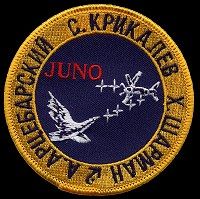
Soyuz TM-12 mission patch.

Soyuz TM-12 crew. Left to right: A. Artsebarskii, H. Sharman, S. Krikalyov.

Helen Sharman, Sergei and Anatolii Artsebarskii in the Soyuz trainer.

Informal crew portrait.

The Soyuz TM-12 crew wave for the cameras. (From Wil)

The TM-12 crew wave before boarding their Soyuz rocket.

Sergei during the Soyuz TM-12 mission – dressed in an orbital version of formal wear. (From Wil)

Anatolii Artsebarskii, Helen Sharman and Sergei aboard Mir
Three more photos also sent by Luca Coren. Some informal photos of the EO-9 crew.

Here, Musa Manarov, Helen Sharman, Sergei and Viktor Afanas’ev float at the aft end of the Core Module, in front of the galley table.

Sergei on drums and the other Sergei with a guitar.

Posing with Helen.
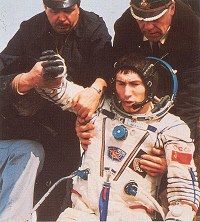
Sergei being helped out of Soyuz TM-13 after landing.
Links
- Capcomespace: L’espace Sovietique: MIR 1990-91. In French, but features lots of photos and diagrams.
- CollectSpace: Where is Helen Sharman these days, the lucky lady who got to fly with Sergei? This 8 April 2004 posting at the CollectSpace forum mentions her; she is married and has children. She does not seem to have her own website, though, that I could find.
In some correspondence I had with her the other year, she told me that she still keeps up with the space program (such as reading Spaceflight magazine), but otherwise has chosen to move on from that short chapter of her life which was otherwise unrelated to her science career. She concentrates on her new family, new professional life and prefers not to do the lecture/book circuit anymore.
- Encyclopedia Astronautica: Mir LD-3
- FPSpace: Space documentaries on DVD? “Another interesting anecdote about one of Krikalyov’s stays aboard Mir was that (he was a civilian) he was issued an Army draft notice while he was in orbit. Since he did not report as scheduled, an arrest warrant was almost issued because of his absence before it was realized by draft authorities that he was in outer space.”
- Franz Viehboeck: Austrian cosmonaut’s website gallery: “The life on Mir,” during the Soyuz TM-12 mission.
- Houston Chronicle archives:
- “Cosmonaut coming home to new world,” 21 March 1992
- “After 10 months, cosmonaut returns to a strange new world,” 26 March 1992
- Loty Kosmiczne: Sojuz TM-12 page (in Polish)
- The Moscow Times: “Pranks Show Lighter Side of Mir” (via Archive.org).
Cosmonaut Sergei Krikalyov managed to chat to a truck driver on a road in South Africa as he flew hundreds of kilometers overhead in 1992.Krikalyov sneaked an amateur radio onboard Mir and used it to establish a link with the truck driver, who was heading to Kimberley.Despite Krikalyov’s efforts to explain that he was actually talking from high above, the South African refused to believe the cosmonaut. The driver rogered “See you in Kapstadt,” as he signed off.
- New York Times: “After 313 Days in Space, It’s a Trip to a New World,” 26 March 2002
- Spacefacts: Mir: Expedition EO-9 data page, EO-10 and EO-11
- TsPK: Archival preflight photos of the crew: arceb2, arceb3.


Mir Hardware Heritage: extracts
Below is a description of Sergei’s second mission to Mir, EO-9 (which was extended into the second mission, EO-10), from the excellent NASA document, Mir Hardware Heritage, by David S. F. Portree, published in March 1995. You can download the document in PDF form (4 MB) at the NASA Shuttle-Mir Web. Sergei Krikalyov was one of those interviewed for it.
2.9.3.10 Mir Principal Expedition 9
- Anatoli Artsebarski, Sergei Krikalyov
- Crew code name: Ozon
- Soyuz TM-12, May 18-October 11, 1991
- 145 days in space
May 20-May 26, 1991

Mir configuration during Sergei’s second stay. The Base Block is at center, Kvant at right, Kvant-2 at bottom and Kristall at top. (Soyuz & Progress spacecraft omitted for clarity.)
Arrival of Soyuz TM-12. The Derbents welcomed aboard Mir Anatoli Artsebarski, Sergei Krikalyov (on his second visit to the station), and British cosmonaut-researcher Helen Sharman, who was aboard as part of Project Juno, a cooperative venture partly sponsored by British private enterprise. Sharman’s experimental program, which was designed by the Soviets, leaned heavily toward life sciences. A bag of 250 000 pansy seeds was placed in the Kvant-2 EVA airlock, a compartment not as protected from cosmic radiation as other Mir compartments. Sharman also contacted nine British schools by radio and conducted high-temperature superconductor experiments with the Elektropograph-7K device. Sharman commented that she had difficulty finding equipment on Mir as there was a great deal more equipment than in the trainer in the cosmonaut city of Zvyozdny Gorodok. Krikalyov commented that, while Mir had more modules than it had had the first time he lived on boar d, it di d not seem less crowded, as it contained more equipment. Krikalyov also noted that some of the materials making up the station’s exterior had faded and lost color, but that this had had no impact on the station’s operation.
Solar power problems. During a communication session with a British girls’ school on May 21, Sharman commented that Mir was experiencing solar array problems because of the station’s changing orientation. Late that day the level of background noise on the station suddenly fell from the customary 75 decibels as fans, circulating pumps, and other equipment shut down. The lights began to fade. A computer in the orientation system had failed, preventing the solar arrays from tracking on the Sun, and causing Mir to drain its batteries. Sharman stated that Afanaseyev and Manarov told her such power problems had occurred before. When it reentered sunlight, the station was turned to recharge its batteries.
May 28-June 1, 1991
Moving Soyuz TM-12. The Ozons needed to move their spacecraft to Mir’s aft port to make way for Progress M-8, which could not dock with the rear port because of the damage to the Kurs approach system antenna there. The move required 42 min.
June 1-August 15, 1991
MAK-1. The cosmonauts released the small MAK-1 satellite from the Mir base block’s experiment airlock on June 17. It was designed to study Earth’s ionosphere. However, a probable power failure prevented its antennas from deploying, and the satellite remained inert.
First EVA: fixing Kurs. On June 24 the Ozons exited the hatch on Kvant-2 and clambered over Mir’s hull to the aft end of Kvant, where they removed the damaged Kurs approach system unit and replaced it. They also assembled a prototype thermomechanical joint to be used in the assembly of space structures. The EVA lasted 4 hr, 53 min.
Second EVA: TREK. On June 28 the cosmonauts attached to Mir’s hull the TREK instrument, a device for studying cosmic ray superheavy nuclei. The experiment was devised by the University of California and delivered by Progress M-8. The Ozons used the Strela telescoping boom to move about the station. EVA duration was 3 hr, 24 min.
Third EVA: Preparing for Sofora construction. On July 15 the Ozons used the Strela boom to transfer equipment from the Kvant-2 EVA hatch to the work site on Kvant. They attached two ladders to Kvant to give them handholds, then assembled a platform for Sofora on Kvant. Sofora was to be a 14.5-m girder extending from Kvant. The EVA lasted 5 hr, 56 min.
Fourth EVA: Sofora construction commences. On July 19 Krikalyov and Artsebarski installed an automated assembly unit similar to the one Kizim and Solovyov had experimented with on Salyut-7 in 1986. Sofora was also an experimental construction, but the Soviets had plans to attach an attitude control thruster unit to it if it functioned as expected. The thruster unit would augment Mir’s attitude control systems. They assembled 3 of 20 segments planned for Sofora before returning to Mir. The EVA lasted 5 hr, 28 min.
Fifth EVA: Sofora construction continues. On July 23 the Ozons added 11 segments to the Sofora girder. The EVA lasted 5 hr, 34 min.
Sixth EVA: Sofora construction completed. On July 27 the cosmonauts added the last six segments to the Sofora girder. They also attached a Soviet flag in a metal frame to the top of the girder. This was not planned in advance; the cosmonauts decided independently to attach the flag. Artsebarski’s visor fogged up from exertion, but Krikalyov was able to help him back to the Kvant-2 hatch. EVA duration was 6 hr, 49 min.
August 23-September 30, 1991
Failed coup d’état in Moscow. The coup against Mikhail Gorbachev had little immediate impact on Mir operations. Progress M-9 was launched as the coup attempt fell apart, on August 21. Boris Belitsky, a Radio Moscow space and science reporter, stated that the TsUP relayed broadcasts of Soviet Central TV (pro-coup) and Russian Radio (anti-coup) to the Ozons. He stated that there were never any plans to abandon the station during the coup, but revealed that such provisions existed in the event of the outbreak of a major war on Earth.
2.9.3.11 Mir Principal Expedition 10
- Alexandr Volkov, Sergei Krikalyov
- Crew code name: Donbass
- Soyuz TM-13, October 2, 1991-March 25, 1992
- 175 days in space
Krikalyov remained on board Mir while Artsebarski returned to Earth in Soyuz TM-12. Volkov arrived on Soyuz TM-13 to replace Artsebarski. Krikalyov’s total time in space (Principal Expedition 9 and 10) was 320 days.
October 4-10, 1991
Soyuz TM-13 arrives. Soyuz TM-13 carried Austrian cosmonaut-researcher Franz Viehboeck and Kazakh cosmonaut-researcher Toktar Aubakirov. The flight was unusual for carrying no flight engineer. Veteran Russian cosmonaut Alexandr Volkov commanded. The Austrians paid $7 million to fly Viehboeck to Mir, and the Kazakh cosmonaut flew partly in an effort to encourage newly-independent Kazakhstan to continue to permit launchings from Baikonur Cosmodrome. The cosmonaut-researchers photographed their respective countries from orbit and conducted the usual range of materials processing and medical experiments. Artsebarski traded places with Volkov and returned to Earth in Soyuz TM-12.
October 21, 1991-January 20, 1992
Impact damage. By this date the Mir base block had suffered orbital debris and meteoroid damage on the flat sealing surface of one of its docking rings and on most of its windows.
Progress M-10 aborts docking. The spacecraft broke off its first docking attempt on October 19 at a distance of 150 m. It successfully docked on October 21.
Cosmos 1897 drifts off station. The Altair/SR satellite drifted to 90° E in the geostationary belt by March. By late April the Soviets had maneuvered it back to 95° E, but by the end of 1991 it had drifted to 77° E and was widely considered inoperative. The other Altair/SR satellite, Cosmos 2054, continued to serve as a communications relay between Russia and Mir.
Diagramma. In October the cosmonauts extended a Diagramma boom from Mir’s small airlock to test the atmosphere around the station.
Mir problems. The cosmonauts ended 1991 by replacing storage batteries and conducting ongoing repairs on the complex. At the end of the year total solar array power production was down to 10 kW. In addition, 4 of 6 gyrodynes on Kvant-2 and 1 of 6 gyrodynes on Kvant (5 of Mir’s total of 12) had failed.
Progress M-10 undocking delayed. The spacecraft topped off Mir’s propellant tanks on January 13. Undocking planned for January 18 was postponed by a problem with the wiring of Mir’s gyrodynes, which affected the station’s attitude. When it undocked on January 20, it carried a Raduga return capsule, which was safely recovered.
January 27-March 13, 1992
Progress M-11. The spacecraft carried a repair kit for the station’s gyrodynes. During its approach to the station, flight controllers in the TsUP were on strike for higher rates of pay, but they did not interfere with the docking. Progress M-11 boosted the complex into a 413 km by 380 km orbit before undocking. Communication cutbacks. In January 1991 the fleet of ocean-going tracking ships in place since the early 1960s was phased out of Mir operations to save funds. Some of the ships continued to operate to support unmanned missions, and could step in as a backup when needed to support Mir. By mid-February, Mir was spending up to 9 hrs each day out of touch with the TsUP because of tracking system cutbacks.
EVA. On February 20 Volkov and Krikalyov opened the Kvant-2 EVA hatch for what would be Krikalyov’s seventh EVA in less than a year. The heat exchanger on Volkov’s Orlan-DMA spacesuit failed, forcing a hasty revision of the EVA plans. Volkov remained near the hatch, so could not operate the Strela boom to move Krikalyov to the prime work site on Kvant. Volkov assisted in installation of space exposure experiments near the hatch, then Krikalyov clambered down Kvant-2 and over the hull to Kvant. He disassembled equipment used in building the Sofora girder in July 1991, then cleaned the cameras on Kvant. Finally, he collected samples of solar cells added to the third (top) array on the base block in 1988. The EVA lasted 4 hr, 12 min.
2.9.3.12 Mir Principal Expedition 11
- Alexandr Viktorenko, Alexandr Kaleri
- Crew code name: Vityaz
- Soyuz TM-14, March 17-August 10, 1992
- 147 days in space
March 19-25, 1992
Soyuz TM-14 arrives … Klaus Dietrich Flade became the second German to visit a space station when he reached Mir with the Vityaz crew. The first was Sigmund Jahn of East Germany, who visited Salyut 6 in 1978. Flade conducted 14 German experiments as part of Germany’s preparation for participation in the Freedom and Columbus space station projects.
… and Krikalyov departs. Sergei Krikalyov was to have returned to Earth in October 1991, but moves to cut costs had forced modifications to his mission. A Soyuz TM flight was canceled, and his replacement, Alexandr Kaleri, was bumped from the Soyuz TM-13 flight to make way for Toktar Aubakirov on the Soyuz TM-13 flight. Krikalyov had to remain on board Mir. Western news agencies had reported that Krikalyov was stranded on Mir, though this was of course incorrect. NPO Energiya paid Kazakh authorities $15 000 in rents for airports and helicopters during the recovery operation.